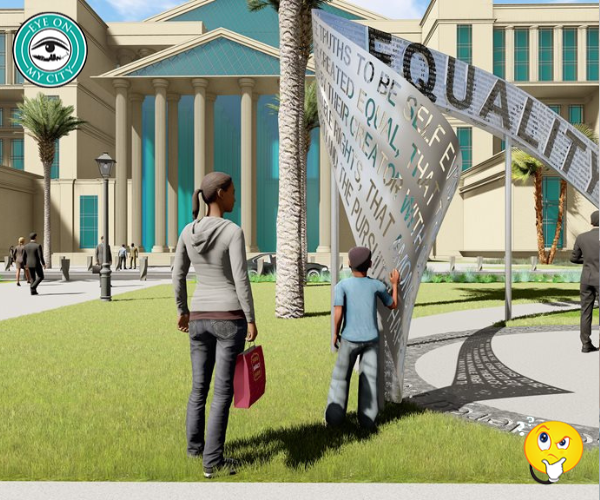
A long-planned public art project for the Duval County Courthouse plaza is once again in limbo.
Since the courthouse was completed on West Adams Street in 2012, city officials have been planning to have a public art piece constructed on the lawn of the 3-acre site. Originally, the project, part of the city’s Art in Public Places Program (APP), was slated to be completed and revealed for the 10th anniversary of the Courthouse building which would have been in 2022. However, it took city lawmakers four years to authorize the art project’s budget totaling $728,611 and another seven years passed before the city selected a firm to design and construct the sculpture.
In 2021, former mayor, Lenny Curry, in partnership with the Cultural Council of Greater Jacksonville that was tasked with managing the project, chose Cliff Garten Studio, based in Venice, Cal., that has designed landscape sculptures and memorials throughout the U.S. and internationally, to bring the project to fruition.
Once Garten’s studio was selected, Curry said, “This iconic and thoughtful piece will be a proud symbol of our community and a monument for four of our nation’s most sacred ideals.”
The design of the sculpture, titled “These Truths”, was to feature two flowing ribbons of stainless steel, inscribed with the words ‘justice’, ‘equality’, ‘equity’, and ‘freedom’ that would frame the entrance to the Courthouse. The ribbons were to have writings from the foundational texts of our democracy, and five local poets and authors engraved on its surface. The words would have been illuminated at night, telling the story of the community, and its continued push toward justice and equality.
So, what brought about the interruptions that continually delayed the project? Some reasons cited included COVID-19-related cost increases and disagreements over the content of the project’s messaging. In June 2023, an art selection panel approved the third draft of the text that would adorn giant metal scrolls on the sculpture, including changing the word “equity” to “truth.”
The city has paid the artist $315,000 for design and engineering work. However, the project was once again halted last year and now City leaders are considering using the remaining funds that were allocated for the project for other courthouse needs.
Currently the DOGE Committee, tasked with finding government spending that is considered unnecessary, is working on legislation to reappropriate the project’s remaining budget and is in talks with Lance Day, chief judge of 4th Judicial Circuit, on what Day sees as the best use for those funds. Day is known for managing court resources, improving security, and dealing with administrative matters in the Fourth Circuit. He oversees circuit court operations, manages civil case resolutions, and leads security studies for the judiciary.
The Cultural Council of Greater Jacksonville informed the DOGE Committee, chaired by Councilman Ron Salem, that approximately $387,000 of the original allocation for the project, remains. Salem has said that no time frame has been set as to when he could introduce the bill suggesting a new use for the funds.
According to Jacksonville Today, DOGE Committee member Raul Aris said, “We paid the artist $300,000. We’re not getting that back. We lost $300,000 because there was some sort of communication mishap between the judge at the time and the Cultural Council.”
Day has said his concerns about the sculpture are not a criticism of Garten’s work, but he is apprehensive about the potential for vandalism of the sculpture and the feasibility of the project’s cost. Day said he is not opposed to public art, but he put forth the question of whether the cost of the project is a want or a need for the city at the present time.
Salem concurred with Day about the placement of the art piece.
“I am not opposed, or is the council opposed, to this piece of art or public art at all,” Salem said. The judiciary just felt it was not an appropriate place for this piece because of the chance that it would be vandalized and maintaining it would be costly.”
Salem said no decision has been made as to what courthouse needs would be covered with the remaining funds; however, Day has openly mentioned that he would like to use some of the remaining funds for security at the courthouse, installing bollards to prevent vehicles from driving on the lawn or crashing into the building.
In an email to Eye on Jacksonville, Councilman Rahman Johnson, District 14 and an ex-officio board member of the Cultural Council, stated that, “Courthouses exist to pursue truth, and public art exists to provoke reflection. When a city pauses to weigh those values, it must also honor the public intent behind its investments. Any redirection of dollars requires process, and that process ensures democracy takes both justice and imagination seriously.”
Local authors involved with project have expressed concern that the project has been put on hold once more.
Author and English professor Tim Gilmore told Action News that this kind of treatment is not unique.
“Jacksonville has a history of driving its artists out of town, it’s done that for more than a century,” Gilmore said. “I think any sophisticated and important city values the voices of its writers. It was very exciting to be part of a project where we were coming up with a way the voice of the city could speak back to the city.”
NOTE: The photo is a rendering taken from the City of Jacksonville Website.