
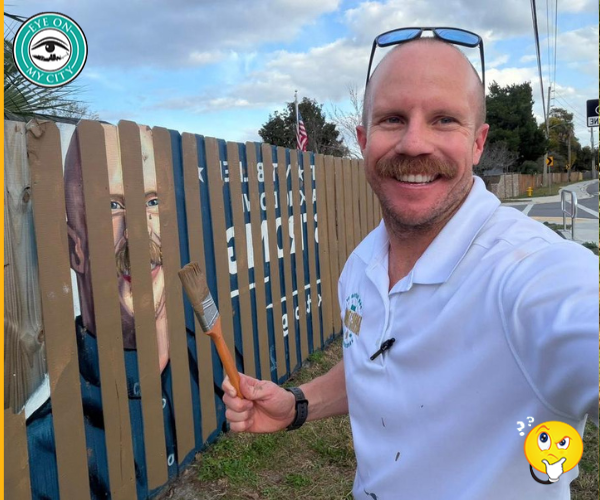
A painting by a political candidate has sparked questions about free speech and Jacksonville’s municipal code enforcement policy.
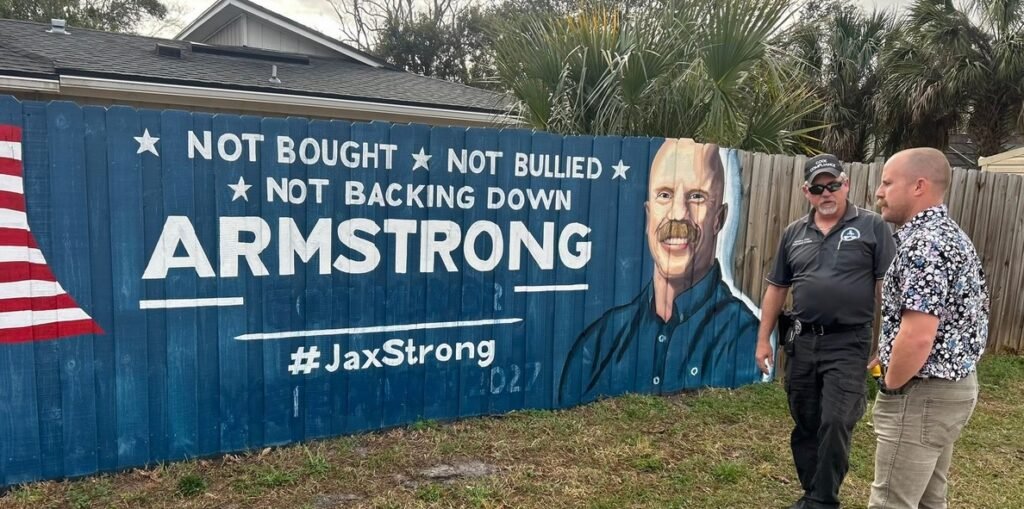
A supporter of Ron Armstrong, a republican candidate for mayor, arranged to have a message painted on the fence surrounding her property. The message was positioned to face the front of the property so it would be visible from the street.
A representative from the Municipal Code Enforcement Officer visited the property and informed the homeowner that the painting could not remain as it was without alteration. This is where some confusion about the circumstances surrounding the removal of the painting begins.
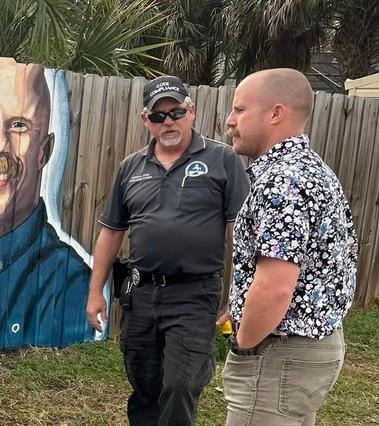
Armstrong explained that the property owner, who lives on the city’s southside, said she was told the painting could remain if the words “for mayor” were removed. The wording was then removed; however, the code enforcement officer later returned and stated the entire painting had to be removed due to a zoning ordinance violation related to the placement of signage on a fence. The cited violation referenced Section 656.1303(1)(2) of the municipal code. The property owner was given three days to remove the painting.
Melissa Ross, director of strategic initiatives/press liaison in the office of Mayor Donna Deegan, said the Municipal Code Compliance Division enforces sign regulation under Chapter 656 of the Jacksonville Code of Ordinances, which includes requirements for sign placement and size. She explained that the display referenced in the inquiry was reviewed by the Building Dept. and determined to meet the definition of a sign under the Code, regardless of whether it was painted on a fence or constructed as a traditional sign.
“City regulations require signs to be set back at least 10 feet from the street right-of-way and prohibit placement within 25 feet of an intersection,” Ross said. “In this case, the display was located at the setback line and did not meet the required distance. The property owner was notified of the applicable code provisions and given an opportunity to bring the property into compliance. The city enforces its sign regulations in a content-neutral manner regardless of the message displayed.”
A discussion among a group of Armstrong supporters, who gathered at Grounds for Grace, a local non-profit ministry in Arlington, noted that no one was able to find out who complained about the painting, but the property owners were given a printed message from someone in the Holiday Harbor neighborhood, a community known for its boating culture, tranquil atmosphere, and proximity to the Intracoastal Waterway. The message read as follows:
“Please, have respect for your fellow neighbors. We all want a clean and nice neighborhood. Painting an advertisement on your fence is an eyesore and lessens the value of our homes. It also encourages others to put up their own advertisements, signage, and graffiti. We have a beautiful new road, with million-dollar homes stretched along San Pablo Road. Please help protect our home values, respect your fellow neighbors, and remove the painted advertisement on your fence.”
Armstrong then painted over the message on the fence.
The incident has raised concerns among residents and civil liberties advocates who argue that the city’s enforcement practices may infringe on constitutionally protected political speech.
“The city is using the municipal code to minimize his (Armstrong) effectiveness by eliminating his message,” said Ryan Gandolfo, who is actively campaigning for Armstrong. “Our grassroots movement is really moving fast, and they have never seen anything like this. They are worried.”
And the saga about municipal codes and signage appears to be continuing where Armstrong’s campaign is concerned.
“This week I was asked to take down a political sign that is posted on my company’s door,” Armstrong said. “When Ryan (Gandolfo) called the city to ask about the reason for removing the sign, a city employee yelled at him over the phone stating, he is not going to win anyway, so take it down.”
“I feel like we have lost our freedom of speech because of the bureaucracy of the city of Jacksonville,” Armstrong said. “We respect the city’s rules, but this was meant as a gesture of community support, not defiance. This painting wasn’t just about politics—it was about the support of someone who believes in the future of Jacksonville as much as I do.”
A local Armstrong supporter, who said he is preparing to file a federal lawsuit against the city, added that many residents are unaware that municipal citations often result in administrative hearings in which the prosecutor, the witnesses and the judge are all city employees. These hearings are not like a court, where people’s fundamental private rights are protected by due process, separation of powers, trial by jury, and formal rules of procedure and evidence.
“This issue has broader implications for residents of Jacksonville,” Armstrong said. “Municipal code enforcement officers — part of the Municipal Code Compliance Division within the Neighborhoods Department — are frequently used to investigate and penalize property owners for relatively minor infractions, such as signage placement or lawn maintenance. These violations can carry significant financial penalties, reportedly reaching up to $500 per day in Jacksonville.”
Interestingly, Armstrong notes that something positive has come out of the situation. He points out that he already has a large following and after this happened, even more people know who he is.