For years, we have warned readers about the campaign trash that lands in our mailboxes every election season.
You know the pieces.
The glossy mailers with scary photos. The twisted headlines. The half-truths dressed up as facts. The political hit pieces designed to make a good candidate look sordid, unethical, corrupt, or dangerous.
And once that mailer hits your mailbox, the damage is done.
You cannot unsee what you saw. You cannot unring that bell. And too often, good candidates are forced to stop talking about their ideas and start defending themselves against lies, distortions, and consultant-created garbage designed to sway voters at the last minute.
We thought that was bad.
Then came the news out of St. Johns County.
According to news reports, three elected officials — St. Johns County Commissioners Christian Whitehurst and Sarah Arnold, along with former St. Augustine Beach Mayor and current City Commissioner Dylan Rumrell — have been charged with misdemeanor counts connected to an alleged fake Republican voter guide that circulated before the 2024 election. Former campaign consultant Brianna Jordan also faces charges, including an additional felony count of tampering with evidence, according to that report.
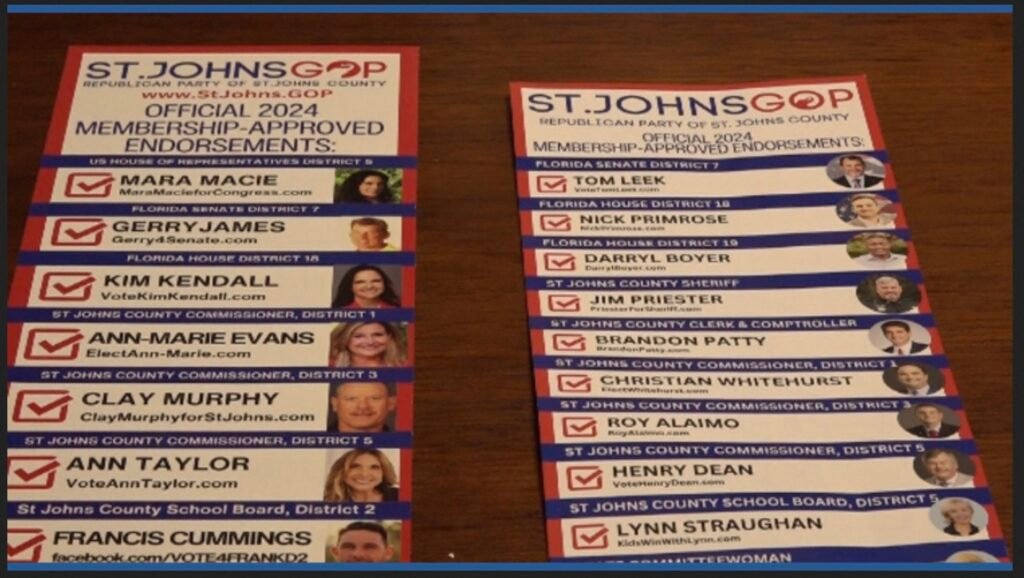
The allegation is not simply that someone sent a nasty mailer. The allegation is that a fake voter guide was created to look like it came from the local Republican Party and falsely showed certain candidates as being endorsed by the party when they were not.
That is not ordinary politics. That is not hardball campaigning. That is not “everybody does it.”
That is alleged election deception delivered straight into voters’ mailboxes.
Florida law is clear that a voter guide may not be represented as an official publication of a political party unless written permission has been given. Florida law also requires voter guides to include proper disclaimers identifying what they are and who is behind them.
And yet, according to investigators, the fake guides allegedly mimicked the St. Johns County Republican Executive Committee’s official voter guide, used a similar logo with altered colors, and left off the legally required language identifying who created or paid for the guide. Investigators also alleged the mailers were sent from Orlando and Jacksonville in an effort to conceal their origin.
Action News Jax reported additional details from a criminal affidavit, including allegations that tens of thousands of fraudulent voter guides were printed, assembled, and mailed to Republican primary voters. St. Johns County GOP Chair Denver Cook called it a “mass-scale deception” and said he believed it changed turnout and affected who won and lost in the community.
Let’s pause right there.
For years, voters have been told to worry about election integrity at the ballot box. And yes, we should. But election integrity does not begin when a voter walks into a precinct. It begins when voters are given honest information before they vote.
If campaign consultants can create fake endorsements, fake voter guides, fake slates, and fake impressions — and then stuff those lies into mailboxes days before voting begins — then the people’s vote is being manipulated before a ballot is ever cast.
That should concern every voter, every candidate, every political party, and every elected official who claims to care about clean elections.
This is also where the political consulting world needs a serious wake-up call.
Too many consultants have made a living in the gray areas of politics. They hide behind committees. They bury disclaimers. They use emotional tricks, ugly photos, and carefully worded accusations to destroy reputations while keeping their own fingerprints off the damage.
Enough.
If the allegations in St. Johns County are proven true, this should not end with a slap on the wrist, a fine, or a quiet political shrug. There must be real consequences for anyone involved in creating, funding, approving, distributing, or concealing fraudulent campaign materials.
And yes — it is time to ask whether stronger penalties are needed when deceptive political mail crosses into the use of the postal system to mislead voters. If mailboxes are being used as the delivery system for election deception, then law enforcement and lawmakers should examine every available remedy, including whether mail fraud or other higher-level charges apply in appropriate cases.
The message must be simple:
Do not use the mail to deceive voters.
Do not fake endorsements.
Do not impersonate a political party.
Do not hide who paid for campaign material.
Do not destroy a candidate’s reputation with lies and then call it “strategy.”
And do not expect voters to trust elections when the very people asking for power are accused of tricking voters to get it.
The State Attorney’s Office, the Florida Department of Elections, the Florida Elections Commission, and — where federal races or federal election laws are involved — the FEC should treat deceptive campaign mail as a serious threat to election integrity.
Clean up our mailboxes.
Clean up campaign consulting.
Clean up the loopholes that allow political operatives to poison elections and then walk away to work the next campaign.
Let the St. Johns County case be the moment that changes how campaigns are run in Florida. Let it be the moment when voters, candidates, parties, and prosecutors all say: no more.
Campaign consultants who play dirty should not be rewarded with the next big client.
They should be investigated, exposed, prosecuted where the evidence supports it, and removed from the political bloodstream.
Because good candidates should not have to spend the final days of a campaign defending themselves against lies.
And voters should never have to wonder whether the “official” guide in their mailbox is real — or just another dirty trick.