
CBS ran a story under a boring headline designed to make your glazed eyeballs glide right past it, “DHS memo directs ICE to ramp up asylum-related fraud cases.” But buried deep in its bland beige exterior was a fairly explosive piece of news: the federal government is now authorized to civilly or criminally prosecute the activist lawyers who have long been coaching their clients to lie.

Here is a fun game you can play at home. Go to your local immigration court, pick any asylum case at random, and read the claim. There is an excellent chance —and by “excellent” I mean “statistically overwhelming”— that the claimant will vow that they face persecution or torture in their home country because of their race, their political opinion, or some other protected characteristic.
This is remarkable, if you think about it. Not because persecution is rare in the world. Persecution is, unfortunately, quite common. What is remarkable is the uniformity. Every single person, from every single country, facing every single set of circumstances, turns out to have a claim that fits perfectly into the exact legal language required for asylum. It is as if millions of poorly educated people independently arrived at the precise same conclusions about their situations, without any outside coaching whatsoever.
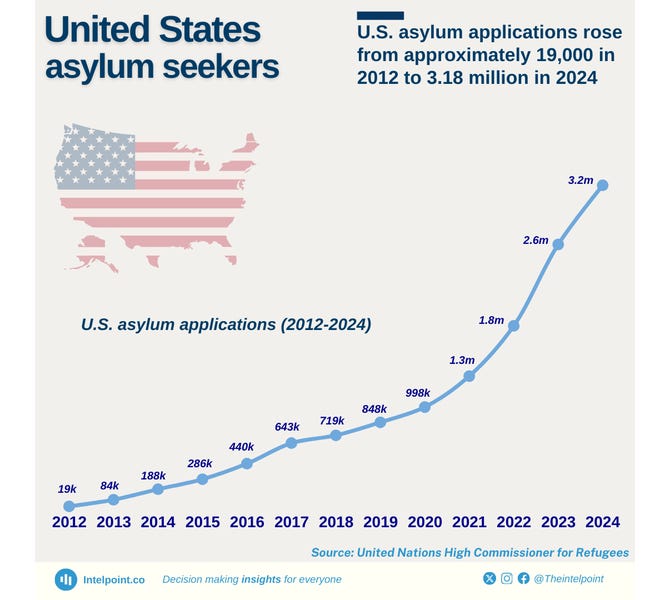
I mean, what are the odds? According to UN statistics, asylum applications rose from 19,000 in 2012 to an eye-watering 3.18 million in 2024.

🔥 As it turns out, we are getting a pretty good idea of how that happened. In the story, CBS reported that ICE lawyers are now authorized to civilly or criminally prosecute the activist NGO lawyers who have been coaching their clients to lie.
James Percival, the top ICE attorney, who seems to have decided that someone needed to say the quiet part out loud, drafted a new DHS memo. Percival wrote that “it has become standard practice for immigration lawyers to argue that virtually every illegal alien faces persecution or torture in their home country because of a protected characteristic such as race or political opinion.”
He continued: “The immigration bar and powerful Big Law pro bono practices frequently coach clients to conceal their past or lie about their circumstances when asserting their asylum claims.”
Now, “Big Law pro bono practices” is Washington bureaucrat-speak for very large, white-soled law firms that charge their corporate clients $1,200 an hour and then, for virtue-signaling points (and political favors from Democrats), devote a handful of associates to providing free legal services for asylum claimants. This structure, according to the Percival memo, is being systematically used to manufacture fraudulent claims on an industrial scale.
To be clear: we are not talking about a few bad apples. We are talking about what Percival described as standard practice. The legal equivalent of a factory assembly line, except instead of producing widgets, it produces asylum claims, each one carefully engineered to check the correct boxes, regardless of whether the underlying facts bear any resemblance to the boxes being checked.
🔥 Here is the thing about asylum fraud that everybody has been pretending didn’t exist: it was entirely predictable.
The United States has spent the last several decades running what can only be described as an honor system for asylum claims. You arrive. You assert persecution. A lawyer —usually a free one, provided by a nonprofit funded through laundered taxpayer money— helps you frame your claim in the precise legal language most likely to succeed. The system, backlogged by years and staffed by people, some of whom are genuinely trying to do the right thing, gives you the entire benefit of the doubt.
And then we are surprised when people game it.
This is a little like installing a vending machine that dispenses free candy whenever you press a button, and then expressing shock that people are pressing the button. A great deal of human behavior can be explained by the simple observation that people respond to incentives. This is not a controversial insight. It is, in fact, the foundational premise of every economics textbook ever written. And yet, somehow, it was never applied to the asylum system.
The people arriving in this system, it should be noted, are frequently coming from some of the most difficult, most corrupt, most authoritarian societies on earth. This is not a criticism of them as individuals. It is an observation about the environments that shaped them. People who grow up in systems where the rules are arbitrary, where officials are corrupt, and where survival depends on finding the angle— those people, by necessity, become very good at finding the angle.
They have been trained by their circumstances to probe the edges of any system they encounter.
Importing large numbers of people with those adaptive skills into a system specifically designed to reward self-authenticated claims with minimal verification is not a humanitarian policy. It is an experiment. And like many experiments conducted without adequate controls, it has produced some unexpected results.

🔥 If you want a case study in how not to run an immigration program, consider the Biden administration’s so-called “Welcome Corps,” a private-sponsorship scheme that allowed U.S. residents to ‘sponsor’ refugees for resettlement. The idea was virtuous. The execution was, to use a technical term, a wasteland of fraud.
Almost immediately, reports emerged of people being asked to pay to be “included” in the program. Sponsors named refugees they barely knew. Fraud and scams proliferated with the speed and enthusiasm of a fungus in a warm, damp basement. The program was eventually shut down last summer by the Trump Administration, which at that point was essentially inheriting a system that had been left running unattended like a garden hose on a concrete driveway.
Just to pick one country at random, in the U.S. refugee program, Somalia, for example, has been one of the top origin countries. Just between 2012 and 2022, at least 46,000 Somali asylum refugees were resettled in the United States. The numbers increased dramatically under the Biden Administration’s Welcome Corps program. So.
A serious country, as one observer put it, would not run a cultural stress test at this scale until its border screenings, asylum adjudications, fraud detection, and enforcement mechanisms were clearly capable of swiftly punishing cheating and regularly rewarding honesty. The United States did not do this. The United States instead signaled, loudly and repeatedly, that self-authenticating claims with thin to no verification were basically a ticket to stay. And then it paid lawyers to help people from low-trust cultures write those claims.

🔥 The decision to begin prosecuting NGO lawyers is, as the original memo suggests, a good start. It is the legal equivalent of chopping the head off a coral snake: targeted, precise, and aimed at the mechanism that makes the whole snaky operation function.
For years, the activist legal community has operated on the safe assumption that helping clients lie on asylum claims was a form of advocacy. This is a creative interpretation of legal ethics. Most bar associations, when pressed, will confirm that “coaching clients to conceal their past or lie about their circumstances” is not, technically, what they had in mind when they wrote the rules about zealous representation.
It turns out there is a meaningful difference between arguing your client’s case aggressively and entirely fabricating the case. The prospect of civil, criminal, or bar prosecution tends to help clarify that distinction.
Of course, going after the lawyers is not a structural fix. The deeper problem —a porous, backlogged, highly discretionary asylum regime that was designed for a different era and a different volume of claims— will require actual legislation to repair. Legislation requires the Senate. The Senate is currently hamstrung by a 1970s-era silent filibuster rule.
So in the meantime, the Administration is doing whatever it can while Congress is unavailable: using every executive tool at its disposal to patch the leaks in a system that was never designed to handle the pressure it is currently under.
It is not a permanent solution. It is more like a very determined person with a very large roll of duct tape, working their way around a boat that has developed an impressive number of holes.
But it is progress. Stay tuned for much more.