
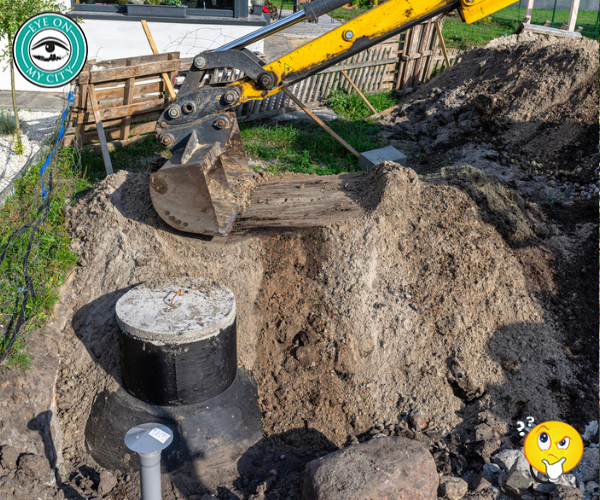
Despite a lack of convincing justification, the city continues to spend billions of dollars on septic tank replacement, probably the greatest deliberate transfer of wealth Jacksonville has ever experienced.
During recent years, the city embarked on an ambitious program to extend water and sewer lines into areas where homes currently depend on septic tanks and wells.
This was based on assertions that septic tanks posed a health hazard. But there have been few instances of homeowners being punished for having faulty septic tanks.
Also, government has continued to allow new septic tanks to be installed – presumably to be replaced at taxpayer expense in years to come. Eye on Jacksonville has reported some of the facts related to this issue but with the help of artificial intelligence, we took a new and broader look.
Duval County had about 88,834 permitted septic tanks as of 2003–2004. ChatGPT reported an estimated 85,000 septic tanks in 2024, based on information from the Onsite Sewage Treatment and Disposal System program administered by the Florida Department of Health. Since 2021, it has been regulated under rules enforced by the Florida Department of Environmental Protection. Local permitting and inspections are still handled by the county health department.
Here is the data for new and repair permits, 2015-2024:
| Year | New_Construction | Repair_Permits | Total_Permits |
| 2015 | 327 | 531 | 858 |
| 2016 | 348 | 547 | 895 |
| 2017 | 372 | 565 | 937 |
| 2018 | 414 | 589 | 1,003 |
| 2019 | 444 | 603 | 1,047 |
| 2020 | 669 | 628 | 1,297 |
| 2021 | 875 | 651 | 1,526 |
| 2022 | 657 | 673 | 1,330 |
| 2023 | 642 | 689 | 1,331 |
| 2024 | 611 | 702 | 1,313 |
The city has identified 35 “septic tank failure areas” where repair permits and system failures are common. Many of these areas were built before sewer infrastructure was extended, so homes still rely on septic.
Many of the phase-out projects are in Northwest Jacksonville.
- Riverview
- Biltmore
- Beverly Hills (East & West)
- Christobel
- Lake Forest
(I lived in Lake Forest in 1957. We had a septic tank, and it had to be serviced.)
The Riverview project alone could affect about 2,400 parcels, making it one of the largest conversions planned.
These homes were built before sewer lines were available in those areas. In addition, they are in low elevation, near key waterways and have septic tanks nearing the end of their service life.
Despite failures, AI reported very few cases where homeowners were criminally prosecuted for septic failures.
Instead, homeowners usually face notices of violation. orders to repair or replace the septic system, administrative fines or referral to code enforcement or a special magistrate.
At least in theory.
The process is supposed to work like this:
- Complaint or inspection identifies a failing system.
- The County Health Department issues a notice of violation.
- The owner must:
- Repair or replace the septic system
- Connect to sewer if available
- If the owner refuses, they may receive citations and escalating fines. Enforcement usually emphasizes voluntary compliance rather than punishment.
But authorities generally try to avoid penalizing homeowners because repairs are costly.
There have been 3,500–5,000 complaints over a 10-year period.
Estimated enforcement activity (10 years)
| Action | Estimated total |
| Warning / repair orders | ~2,000–3,500 |
| Administrative citations or code cases | ~300–800 |
| Homes condemned or declared unsafe | dozens |
| Criminal prosecutions | ~0–2 |
In 2019 Action News reported a home was condemned for a malfunctioning septic tank, forcing the owner to repair the system before the home could be occupied.
Septic replacement often costs $10,000–$30,000.
Residents of the affected areas bought their homes at a reduced price because they did not have water and sewer service.
Sewer lines have been extended for years but in the past homeowners had to pay the expense of connection, including replacing their septic tanks.
Now, rather than having the expense of replacing their septic tanks, they are getting the work done free, adding considerable value to their homes at taxpayer expense.
Chat GPT identified 10 specific census tracts in Jacksonville that likely have the highest septic failure rates.
Here are realistic examples of the impact calculated by ChatGPT:
| Home value w/o sewer | Possible value increase | New value |
| $120,000 | $6k–$24k | $126k–$144k |
| $160,000 | $8k–$32k | $168k–$192k |
| $200,000 | $10k–$40k | $210k–$240k |
But lunch isn’t totally free.
The homes that get free sewer connections and increased value also will see increases in property tax bills and water and sewer bills.
Chat GPT estimates the city might realize increased tax revenue of $4.5 million annually.
Some homes could start paying water and sewer charges (often about $850 a year in some neighborhoods) plus $350 a year in property taxes.
However, if the movement in the Florida Legislature to eliminate taxes on homestead property becomes law, former septic tank owners may get a lot of benefit at little cost.