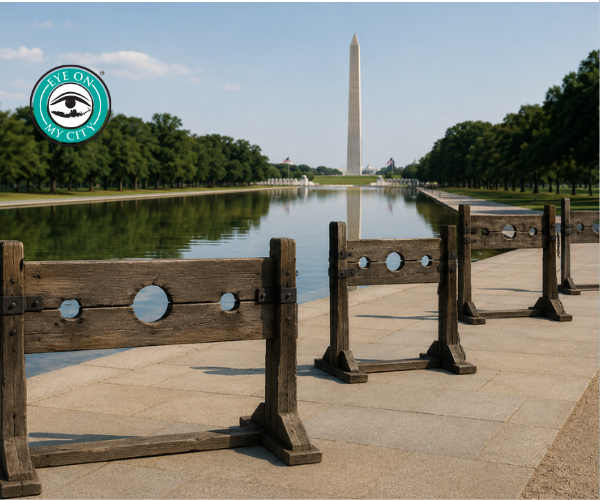
The Lincoln Memorial Reflecting Pool was meant to mirror national memory. Instead, it’s becoming a mirror of something else: a country increasingly unsure how to respond when people openly disrespect shared public spaces.
Recent incidents involving vandalism and interference at the Reflecting Pool have drawn federal attention and arrests. One case involving graffiti and damage has been treated as a federal offense, underscoring that this is not harmless mischief—it is defacement of a national monument.
But the larger issue is not just what is happening—it’s what the public no longer sees.
Consequences That Are Out of Sight
There was a time when public wrongdoing came with visible consequences. Not cruelty for its own sake, but clarity. People saw what happened when you crossed certain lines. That visibility created restraint in others.
Today, consequences are largely hidden—processed through paperwork, courts, and quiet resolutions the public never sees. The act is public, but accountability is private.
And when accountability disappears from view, so does the restraining effect it once had.
A Culture That Hesitates to Draw Boundaries
There is a growing sense that society is reluctant to enforce boundaries in a way that creates discomfort—even when those boundaries protect shared civic space. The result is predictable: more boldness, less restraint, and a steady erosion of respect for places that belong to everyone.
Defacing a national monument is not expression. It is a declaration that nothing is off limits.
And yet the response often feels muted, procedural, and disconnected from the seriousness of the act.
Cruelty or Clarity?
Critics of stronger public consequences argue that visible punishment risks humiliation or abuse. That concern matters in a system built on due process.
But there is another kind of cruelty: the slow normalization of disrespect because consequences are no longer seen or understood.
A society that refuses to visibly enforce its boundaries eventually stops believing in them.
Something Is Off
What’s happening around places like the Reflecting Pool is not just vandalism. It’s a signal.
A signal that public spaces are becoming less protected—not legally, but culturally. And a signal that consequences, when they do arrive, no longer shape public awareness.
The question is no longer whether we can restore a monument.
It’s whether we still believe anything in public life is worth defending out loud.