Bookending the Flock camera debate is the equally loud war on data centers. Yesterday, the President declared a side. Like clockwork, the sharklike editors at the Washington Post smelled blood in the water and gleefully reported, “Trump says voters who oppose data centers will ‘kill the Golden Goose.’”
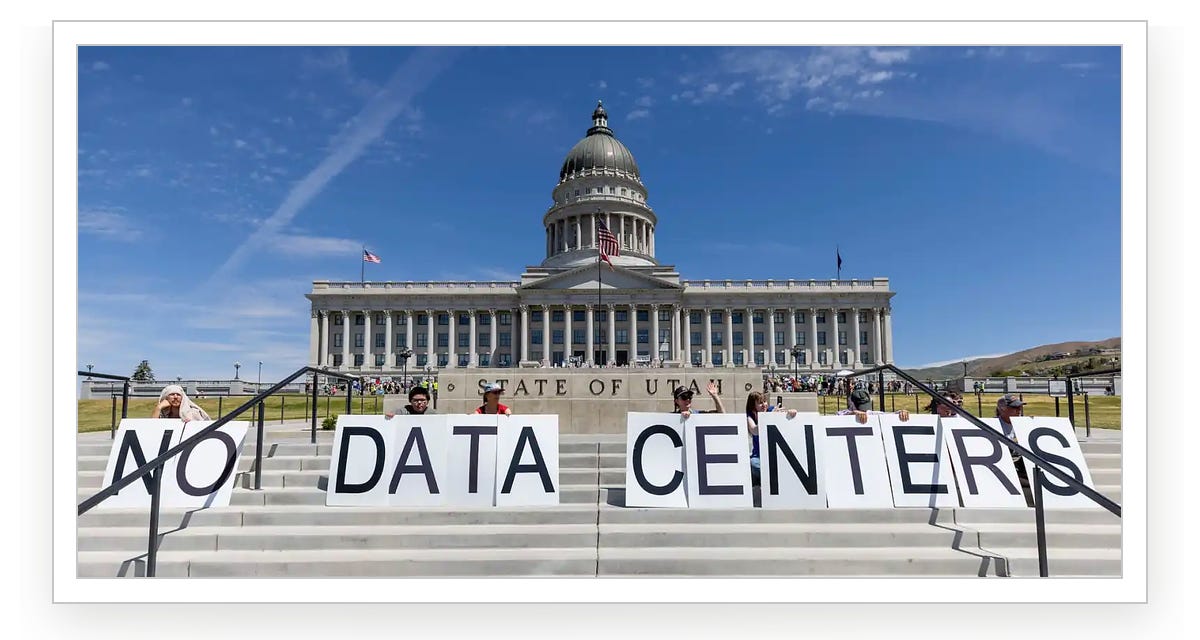
Polls show Americans from both political parties are increasingly hostile to the server farms central to the artificial intelligence boom. Some Republicans running for office this year have publicly broken with Trump on the issue. In July, Florida issued regulations requiring, among other things, that new data centers obtain special water permits and not increase local citizens’ utility rates. It passed 37-zero in the state senate.
At bottom, it is, in fact, NIMBYism (“not in my backyard”). Americans love instant AI answers. They simply prefer the machine producing them to live three counties away with a separate water supply.
Yesterday, President Trump issued a dramatic and unusual warning to all of us. “The only reason that communities throughout the U.S.A. should not want Data Centers is if they want to end up being backwards and poor,” Trump wrote on Truth Social.
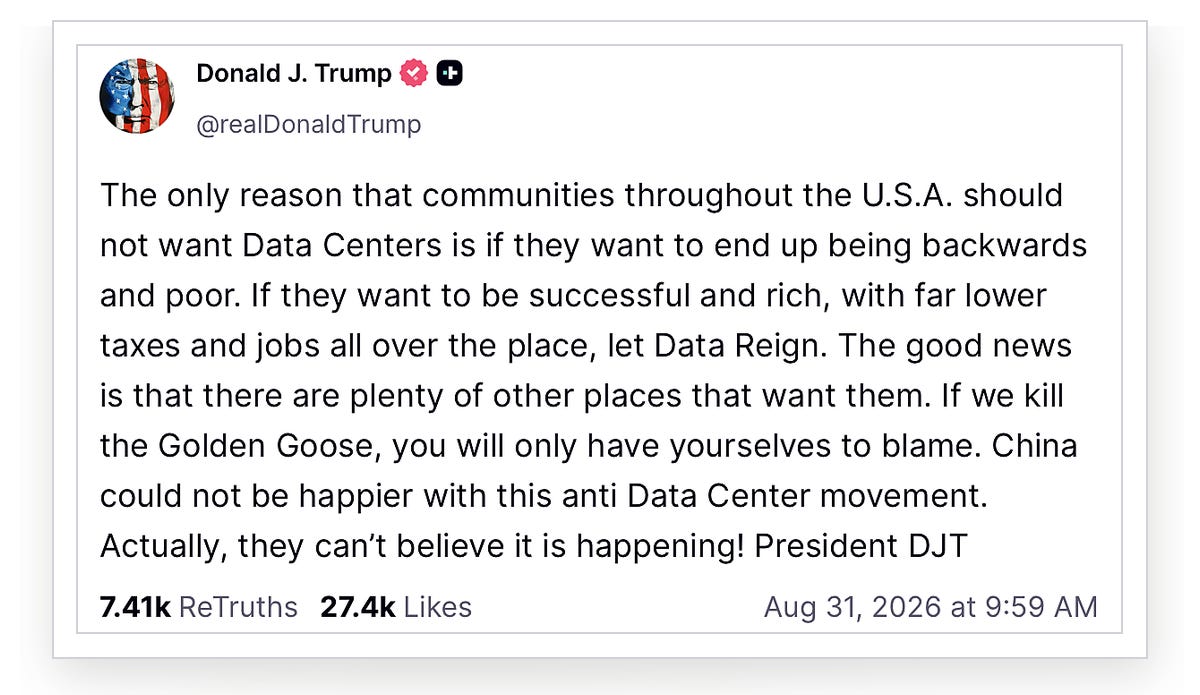
“China could not be happier with this anti-Data Center movement, he added.” The President was not entirely wrong.
🔥 America’s turmoil over data centers has reached a fever pitch. AI companies have done a terrible job of advocating for themselves, instead preferring to torture everybody with constant claims that their models have become smart enough to lie, hack, and steal, and that we’re always five minutes away from a Terminator-style breakout as Skynet becomes self-aware and kills us all.
Meanwhile, AI still constantly hallucinates and refuses to admit what race the Founders were.
Trump’s first correct point was that the debate is not organic. Not even close. It is heavily influenced by well-heeled anti-data center forces, including our literal enemies, who are falling behind us in the AI arms race. In June, Politico ran a story about Chinese astroturfing:
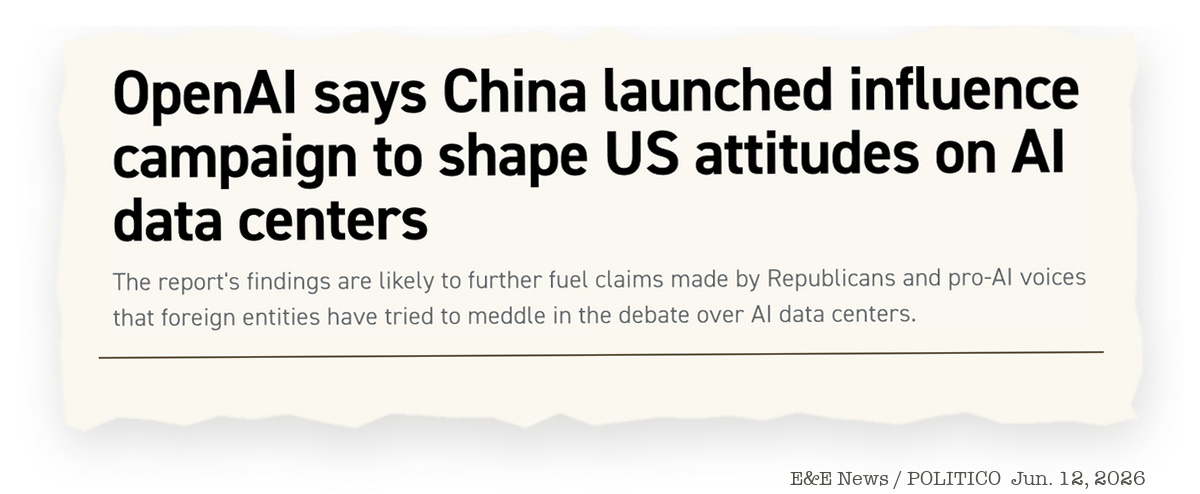
OpenAI caught the Chinese doing it because they were using ChatGPT to help “frame their messages” for the American public. Irony.
Late last week, Fox News reported that X (fka Twitter) had caught another Chinese influence operation, once again targeting data centers.
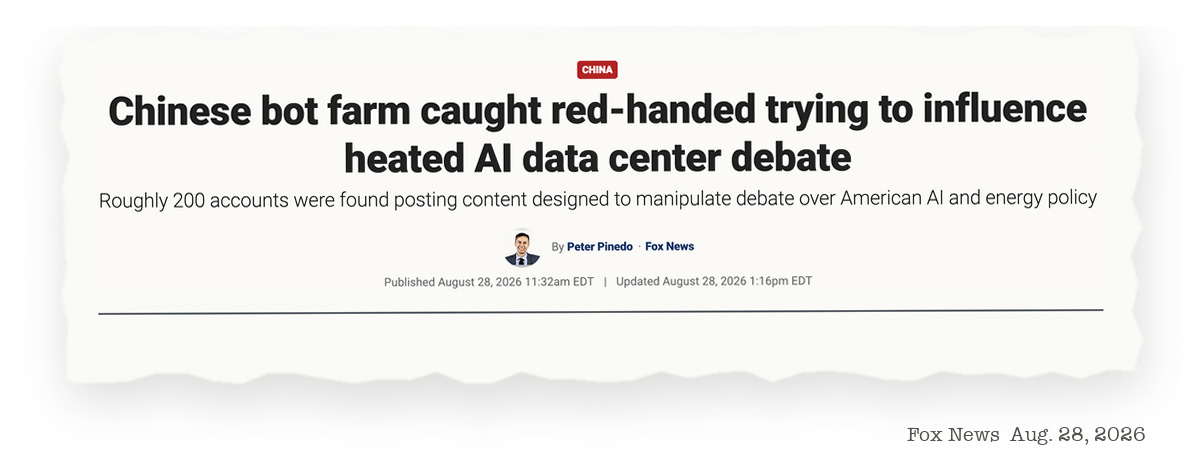
X’s Global Government Affairs account said the platform’s safety team identified a bot farm of approximately 200,000 inauthentic Chinese accounts “involved in influence operations.” Of those, 200 were dedicated to anti-data center advocacy, but disguised as authentic Americans.
Posts by these accounts claimed that AI data centers are driving up household electricity prices and straining the grid. One meme shared by the X team depicted horrified citizens standing across from data center developers holding bags of cash under the caption, “Data centers get subsidized while we foot the bill!” Another meme said that “the AI industry is booming, but the costs are being borne by ordinary people.”

This week, President Trump told reporters that local communities and states should want to welcome data centers because “the jobs are enormous, and the money paid, the taxes paid are just enormous.” That is all true. Blue-collar workers are earning six figures on data center projects, and small villages of supporting vendors are emerging around data center locations. Small towns that were largely forgotten are reappearing on the travel map.
Even vaccine-injury poster boy Senator John Fetterman (D-Pa.) warned that China benefits. “AI supremacy and energy dominance underpins our national security,” Fetterman said. “China continues to fuel and benefit from our overreaction. I reject the political pandering and hyperbole over data centers or AI doomsdaying.”
🔥 The alarming water claim, which lingers like herpes in some parts of social media’s fever swamps, holds that each chat query vaporizes a gallon of water. Not that anyone cares, but that fake statistic has been debunked for months. Data centers use less water than an average golf course. They mostly recycle their water, which is used for cooling the CPU farms.
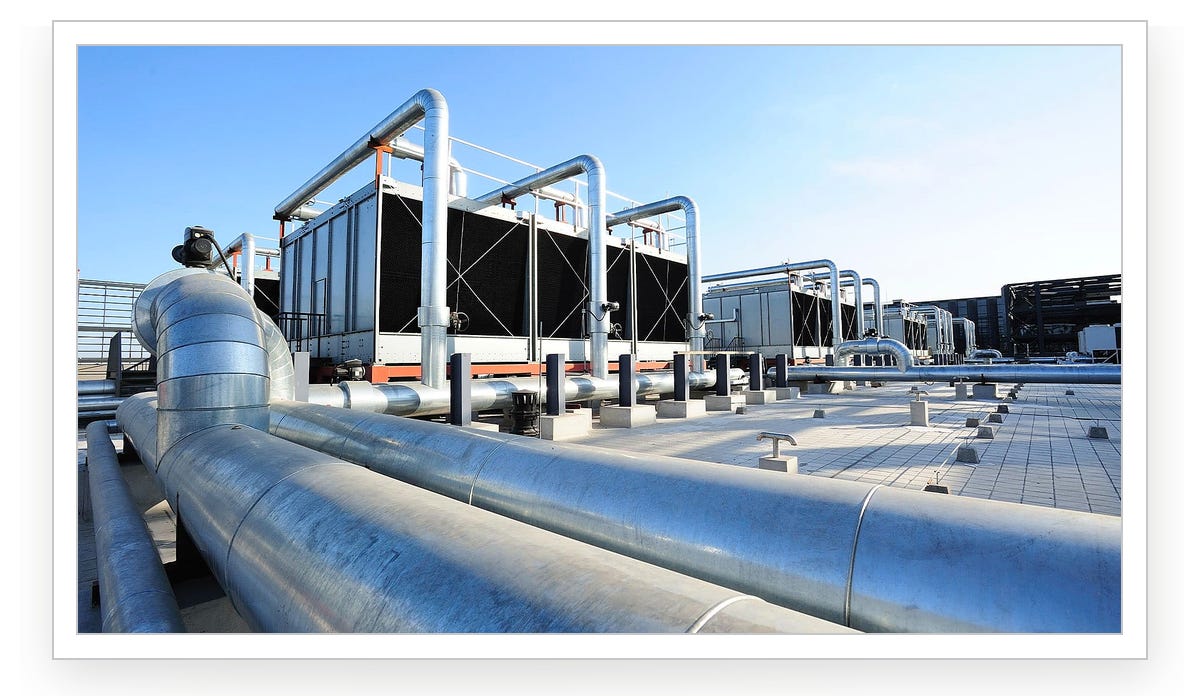
Nobody ever pickets golf course construction. But the data center has become America’s village witch: blamed for water shortages, high electric bills, lost jobs, neighborhood disruption, artificial intelligence, tech billionaires, and probably whatever happened to cursive.
But the current real debate has now focused on power use, even though America has a terrific grid compared to nearly every other country, like in Europe, where rolling blackouts have become as common as Muslim immigrants. Here in the US, we are not running out of juice. The argument is that data centers require cities to build specialized substations for them, and once online, draw enough power to raise local rates by some unspecified amount.
Fine, as far as it goes, and it could even be true, but it is a manageable concern, not an apocalyptic Skynet situation. “I think probably 99% of the backlash to data centers has come in areas where building a data center means higher utility and higher electricity for the people on the ground,” Vice President JD Vance said yesterday. “If you build a data center, you should be putting power back into the grid, not taking it out, and if that is happening, I don’t think the data centers are that controversial.”
But the nation’s moral panic has already skipped past ordinary questions about rates and zoning and arrived at the giant humming cube is coming for your neighborhood.
That less scientific line of complaints has to do, as with the East Wing Ballroom, with aesthetic injuries. “Neighborhood disruption” can mean a legitimate noise or traffic problem. It can also mean somebody has spotted some construction equipment from the artisanal pickle store. Details matter.
None of this means homeowners should subsidize a trillion-dollar industry’s electric habit. Residential customers are ratepayers, not involuntary venture capitalists. The best data-center policy can fit on a bumper sticker: bring your own power and pay your own tab.
The solution is simple. A server farm should add generation, instead of arriving at the grid like a distant cousin who brings six children to Thanksgiving and asks whether anyone has a spare bedroom. They should be built in out-of-the-way locations, such as those we already reserve for sewage treatment plants, airports, and landfills.
Fortunately, America already possesses engineers, zoning codes, utility commissions, and more lawyers than any build-location emergency could possibly require.
🔥 Yesterday we looked at the explosion of paid social media outrage. There is every reason to think that the data center debate is, to some unknowable extent, as fake as Nancy Pelosi’s smooth brow. What we know for sure is that the world is in a race for AI supremacy; that the race is measured in months, not years; that the US is currently winning that race; and that data centers are fueling an extraordinary economic renaissance. That is all true.
We also know both the Chinese and the Democrats are furiously hostile to them. That doesn’t prove data centers are harmless. But it should make us skeptical of the political volume dial. And the argument don’t build datacenters is crazy.
Trump correctly called data centers a “Golden Goose.” Opponents increasingly describe them as Godzilla. This leaves uninformed voters choosing between magical poultry and a radioactive lizard when all they actually need is a utility rate schedule. Here’s where I land: Stay off the social media bandwagon. Build data centers intelligently. And fast.
Fortunately, Professor Hoagland could not be reached for comment on the aesthetics of server farms.
Opinions vary. Let me know what you think.