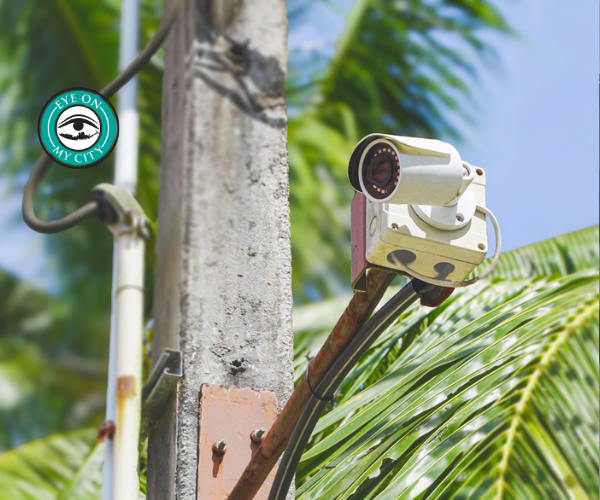
Flock camera haters enjoyed a massive win yesterday. NBC reported, “Florida bans Flock and other license plate readers from state highways as backlash grows.” The subheadline added, “The state said it was ordering cameras removed from the right-of-way of state highways ‘to preserve Floridians’ sovereignty and quality of life.’”
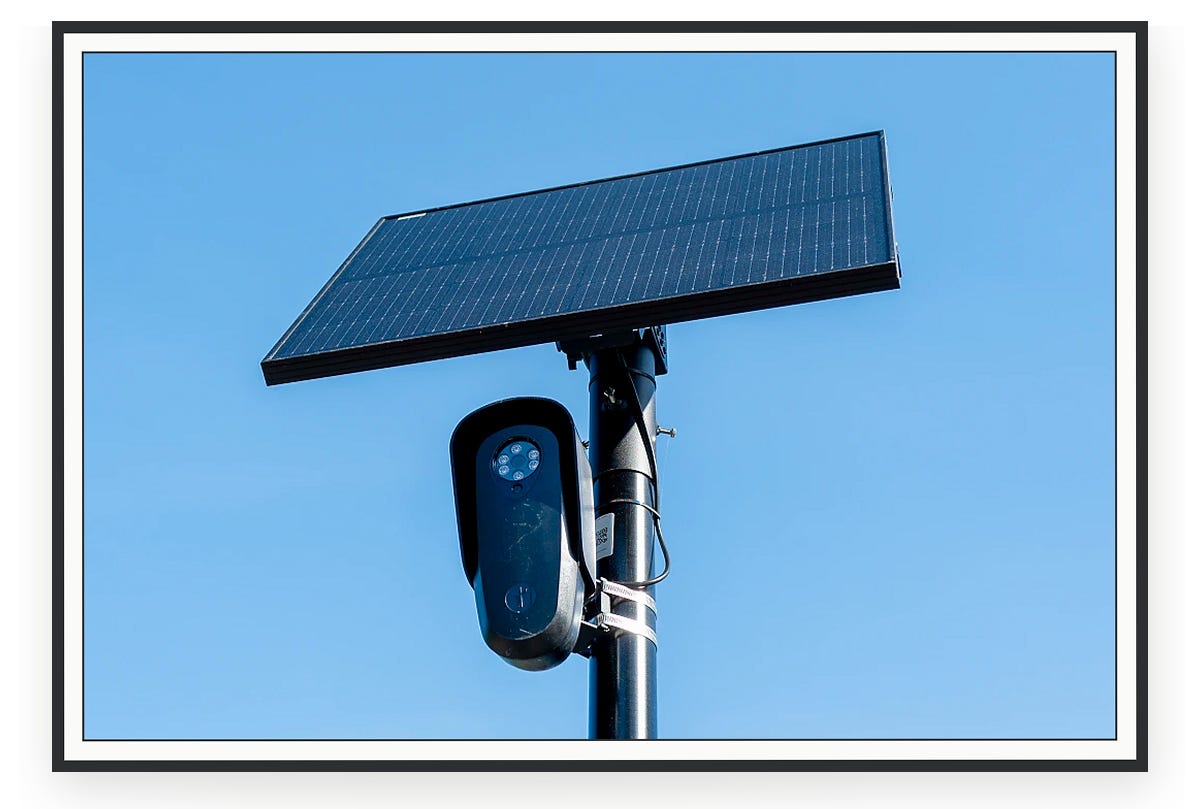
Yesterday, Florida’s Department of Transportation published a one-page memo that stripped local police of the ability to place surveillance cameras and license plate readers on any state highway in the Sunshine State.
The DOT memo cited a “recent exponential increase” in deployments of law enforcement cameras, as well as “concerning reports of misuse, data privacy concerns, and surveillance schemes” that merit immediate action “to preserve Floridians’ sovereignty and quality of life.”
You must understand that Florida is a sovereign land where citizens wish to be left alone with their boats, their fried alligator nuggets, and their comprehensive theories about which neighbor reported the shed to the homeowners association. That is also why we usually tint our car windows to the approximate opacity of a welding helmet. And we value the freedom to rapidly transit six lanes without signaling if Publix closes in eleven minutes.
Today, in fact, began Florida’s annual sales tax holiday for guns and ammunition. It lasts for four months. So.
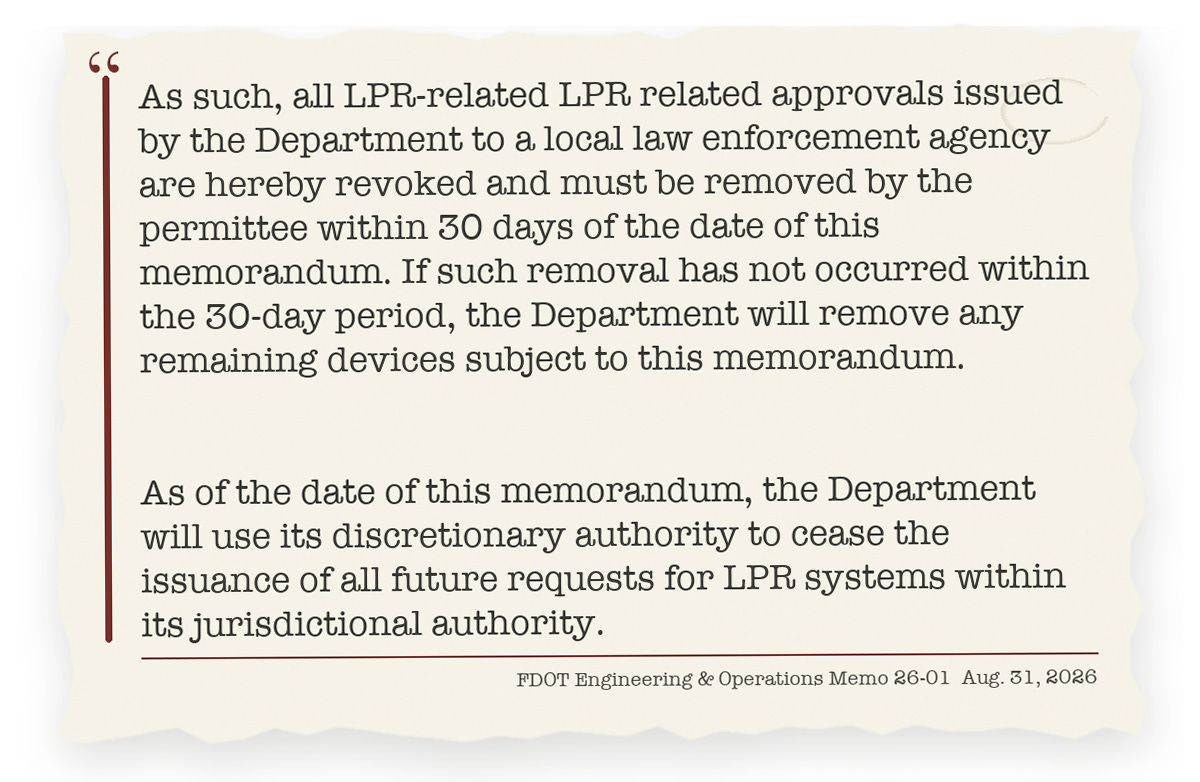
🔥 The state said it was canceling all existing Flock permits within 30 days, otherwise they’ll cut them down, and no new permits for license-plate readers (LPRs) will be issued:
It’s spreading. Jacksonville’s Sheriff’s office said it would cancel all LPRs throughout Duval County, not just ones on state highways or next to Buc-ee’s. Yesterday, Governor DeSantis told reporters, “You want to get in your car and you want to go down to Buc-ees in St Augustine, it’s really none of the government’s damn business.”
Last week, Texas Governor Greg Abbott (R) halted all state funding for Flock cameras. Nationally, over 100 local governments have canceled or not renewed their LPR contracts since the beginning of last year, NBC reported. Here in Alachua County, Sheriff Chad Scott announced he’s pulling all 27 of his own cameras, and said, “Those people are not suspects, and they should not be treated as such.” Get the Flock out of here.
For its part, Flock has belatedly announced changes in response to people’s privacy concerns. It has reduced the default period for storing people’s movement data from one month to one week. It has also said it will do more to lock out law-enforcement users whose searches show “abnormal activity.” (Translation: abnormally stalking their lovers.)
Flock, faces an existential crisis of credibility, prefers to look on the bright side. Gamely trying to defend itself, Flock insisted in a statement, “In just the last few weeks in Florida, the technology was used to find missing children, led to the arrest of a murder suspect, and assisted in solving numerous other crimes.”
In fairness, Flock cameras do find missing children. But so does milk, and the carton doesn’t log your shopping trip.
Governor DeSantis, who obviously isn’t relaxing into lame-duck status with only four months to go before he leaves office, was highly critical of the camera technology. “These cameras that are out there now — who’s to say they’re only doing the license plate?” he wondered. “I think it’s capturing people in their cars. I think it’s capturing way more information than they’re letting on. And you’ve seen the abuse.”
This kind of thing might be odd for a lame-duck governor in the final months of his last term, but it might also be terrific for a 2028 presidential run. I’m only saying.
Personally, I’m sitting this debate out. At this point, not even including Flocks and other LPRs, there are more cameras than Americans. Ring doorbells, driveway monitors, convenience store opticons, camera-enabled eyeglasses, and neighbors keeping a wary 24×7 eye on each other.