Breaking the educational monopoly probably is the most significant action Florida government has taken in the past century.
Once given a choice, parents steered their children to the exit doors of the state’s government schools inn droves.
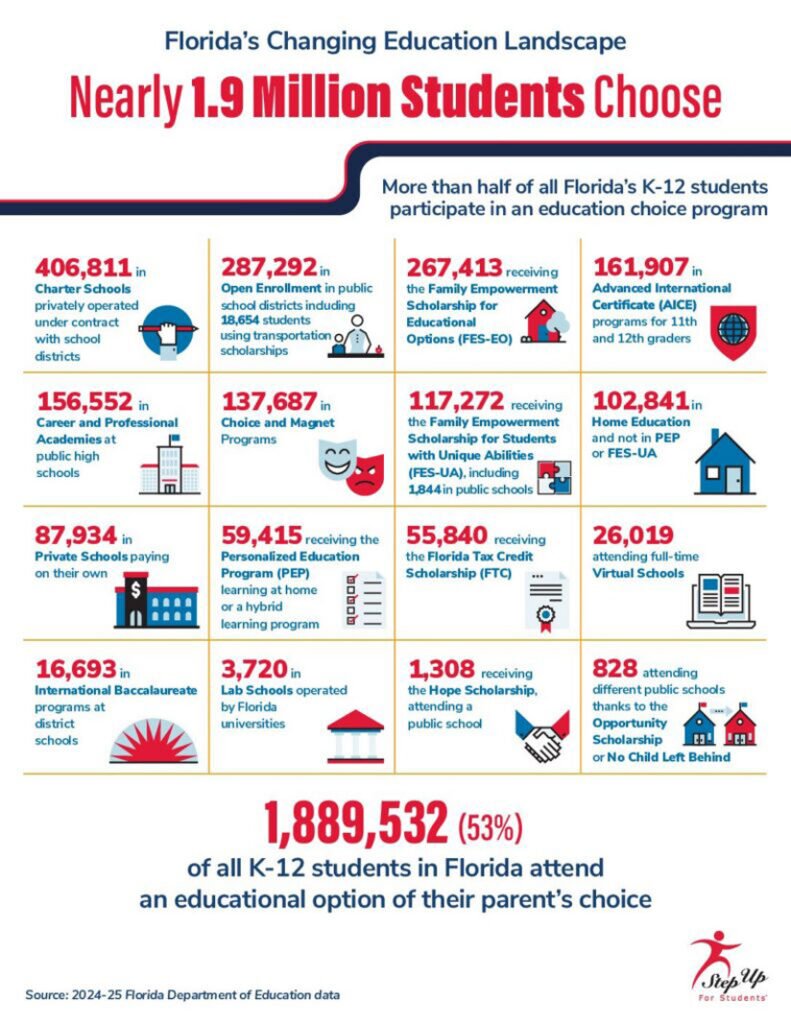
In the 2023-24 school year, some 25 years after the reform effort began, more than half of all Florida students were participating in alternative educational programs. The percentage increased the following year.
Among the results:
- Poor students who had been locked into failing schools got an opportunity to get an education.
- Taxpayers realized significant savings.
- New and innovative teaching methods were employed, once the powerful teacher unions lost their ironclad control of the system.
- Government schools began showing improvement because of the competition.
School choices generally split into three main brackets:
1. Traditional Zoned Schools (47% to 49% of students)
These are standard neighborhood public schools managed by local school boards where enrollment is determined by the location of a student’s home.
2. Public School Choice Options
Charter Schools: Independent public schools managed by private boards. This remains the most popular choice option in the state, with an enrollment of more than 380,000 students and growing.
District Open Enrollment: Programs allowing parents to send their children to any public school in the district (or adjacent districts) that has excess capacity.
Magnet Schools & Specialized Academies: District-run schools featuring focused curricula (STEM, performing arts, International Baccalaureate [IB], or Advanced International Certificate of Education [AICE]). AICE programs alone saw an explosive 17% enrollment jump in recent counts.
3. Private and Home-Based Choices (Vouchers/ESAs)
This is the fastest-growing segment of Florida’s education landscape since the 2023 universal expansion of the state’s voucher and Education Savings Account (ESA) programs. Scholarships for private and home education grew by roughly 142,000 students in a single year:
Family Empowerment Scholarship for Educational Options (FES-EO): This program has seen the largest numeric growth.
Personalized Education Program (PEP): A newer pathway allowing parents to receive ESA funds to conduct an education program entirely at home without being tied to a traditional public or private school.
In South Florida, charter schools are a substantial percentage of the school population. Larger districts such as Miami-Dade, Broward, Palm Beach, and Orange, have highly saturated charter school markets. Furthermore, urban centers have seen layout changes and school consolidations as students move to private schools using the FES-EO scholarship.
A rising trend across 37 of Florida’s 67 school districts involves traditional public schools acting as approved providers for scholarship students. This allows home-education or private-scholarship students to pay a public district school directly for individual classes, sports, or specialized services, blurring the lines between “public” and “private.”
Florida schools are rapidly moving from the century-old model. Government schools continue to have the largest student counts, but school districts are increasingly opting to market their own unique magnet programs and open-enrollment features to actively compete with charter networks and the private voucher system.
Duval County has had an overall 11% decline in traditional school enrollment during the last decade. The district-operated enrollment (excluding public charter schools) continues to compress, leaving the district with seat over-capacity and prompting several recent school closures and consolidations. Plans for some new schools have been dropped.
Duval County Public School Enrollment
(These AI-collected figures reflect district-operated public schools and do not include the independent public charters authorized within the county boundaries).
| School Year | Total District-Operated Enrollment | Key Takeaways |
| 2023–24 | 101,470 | Universal voucher expansion begins; initial stabilization but steady outward pressure. |
| 2024–25 | 101,236 | Five under-enrolled campuses closed/merged at the end of this year. |
| 2025–26 | 100,349 | Enrollment contracts further as the state’s voucher and alternative pipelines mature. |
Where are the local students going?
When Duval County closed five of its traditional campuses at the end of the 2024–25 school year, a tracking analysis revealed that families are increasingly opting for other types of schooling:
- 82.3% remained within traditional public schools (transferring to a different district-zoned school).
- 6% moved immediately to a public charter school.
- 11.6% completely exited the school district, transferring to private schools using state vouchers (FES-EO), enrolling in the Personalized Education Program (PEP), or choosing standard homeschooling.
Total enrollment funded through the Florida Education Finance Program (FEFP) actually grew by over 250,000 students since the 2022–23 baseline. However, that natural population growth was highly uneven.
State budgetary reports show that 95% of those new students were never previously enrolled in district public schools; instead, they are existing private and home-education students now receiving state-funded Family Empowerment Scholarships (while continuing to pay school taxes).
Despite the overall state education budget increase, total state funding explicitly going to district-operated and charter public schools decreased by nearly $300 million because of choices made by parents – in effect, votes on the value of government schools to them.
Some label this “underfunding,” which is a ridiculous claim. If a district loses students, it is no longer paid to educate those students. It continues to receive money from Florida taxpayers and tourists to augment money it gets from local taxpayers, based on its student population.
Eye on Jacksonville also looked at Dept. of Education data on district enrollment for each district, fiscal years 2023 to 2026 and found Duval had no change. Small districts such as Jefferson and Madison had the largest percentages of loss but larger districts such as Hillsborough and Pinellas were in the top 10. Because of population growth, the overall loss statewide was only 1 percent.