
Years ago, I was hired by the JEA Board, during Jim Dickenson’s tenure as CEO, to help facilitate the creation of its Board Governance Policy Book.
It was a special project — and an important one.
The goal was to give that board, and future boards, a clear roadmap for how board members should conduct themselves, how they should oversee management, and how integrity and accountability should remain at the foundation of their service.
And let me tell you, those board members worked at it.
They spent hours — actually days — going over words, policies and responsibilities because they understood something that sometimes seems to get lost today:
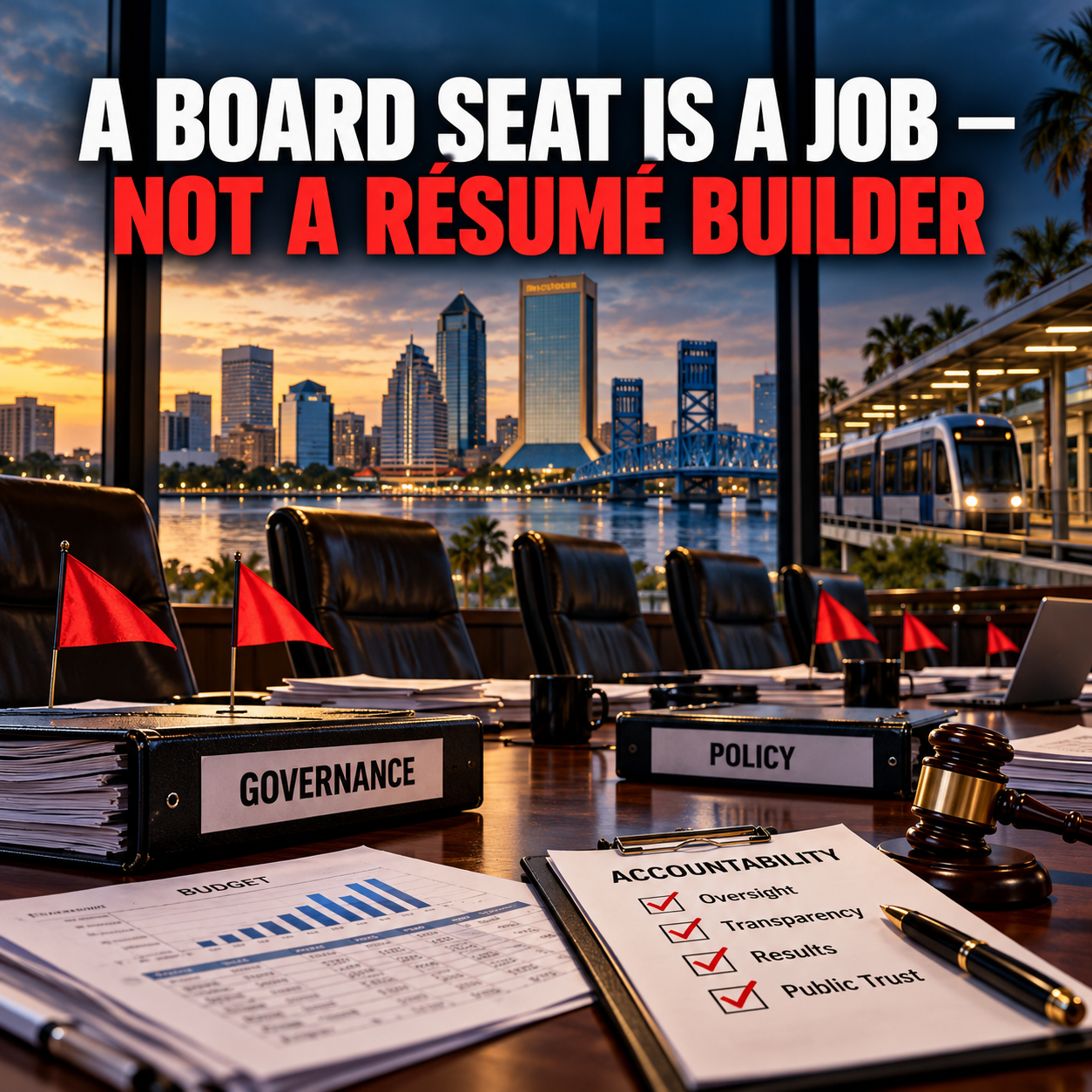
Serving on a public board is not an honorary position. It is a job.
One of those JEA board members was Ashton Hudson. Ashton was highly engaged in that governance work and ultimately became chairman of the JEA Board.
So yesterday, when I ran across an opinion piece Ashton wrote for Jacksonville Today titled “The JTA board owes Jacksonville an explanation for the wreckage,” it certainly got my attention.
Because what we are watching unfold at JTA did not suddenly happen overnight.
For years, people have raised questions and waved red flags about JTA. Former board members, members of the media and concerned citizens questioned spending, projects and the direction of the authority.
Too often, instead of those questions being seriously examined, the people asking them were dismissed.
And that is where boards matter.
About four months ago, I had an opportunity to meet with then-JTA CEO Nat Ford. I told him something I have said many times: Sometimes an organization can have a perception problem even when leadership believes the criticism is wrong.
And a perception problem is still a problem.
During our conversation, I told him about that old JEA governance project. I suggested he get a copy of the governance policies JEA had developed, review them and consider adapting something similar for JTA.
No expensive consultant would even be necessary. Take a good model, modify it for the authority and establish very clearly how the board and management are expected to operate.
He seemed interested.
And that was that.
Not long afterward, Ford announced his departure from JTA and was subsequently selected to become president and CEO of Dallas Area Rapid Transit beginning in late October.
I still think the advice was good.
Wherever you lead, have strong governance policies.
But here is the part people sometimes forget:
You actually have to use them.
A policy manual sitting on a shelf does absolutely nothing.
Companies, utilities and public authorities can spend countless hours developing mission statements, governance policies, strategic plans and procedures. But unless leadership and the board actually implement them — and hold one another accountable to them — they are just paper.
That is really the heart of what Ashton wrote about JTA.
As he put it, a board is supposed to challenge management, test assumptions and demand reliable numbers — not simply support the CEO and hope everything works out.
He’s right.
A good board can support its CEO while still asking hard questions.
A good board can respect management while still demanding answers.
And a good board understands that its ultimate responsibility isn’t to protect the person sitting in the CEO’s chair.
It is to protect the organization and the public it serves.
For too long in Jacksonville, we have sometimes treated appointments to important public boards as prestigious additions to someone’s résumé instead of serious fiduciary responsibilities.
That needs to change.
If you agree to serve on a board controlling hundreds of millions of dollars in public assets, you need to put on your big-boy or big-girl pants and do the work.
Read the reports.
Ask the uncomfortable questions.
Understand the numbers.
Challenge assumptions.
And when red flags start waving, don’t attack the people holding the flags.
Find out why they’re waving them.
I was proud to see Ashton Hudson write his piece. It reminded me of those long days many years ago when a JEA board sat around a table carefully debating what good governance ought to look like.
He apparently remembered the lesson.
Jacksonville could use a whole lot more board members who do too.
Do better, Jacksonville. And let’s start doing better now.