
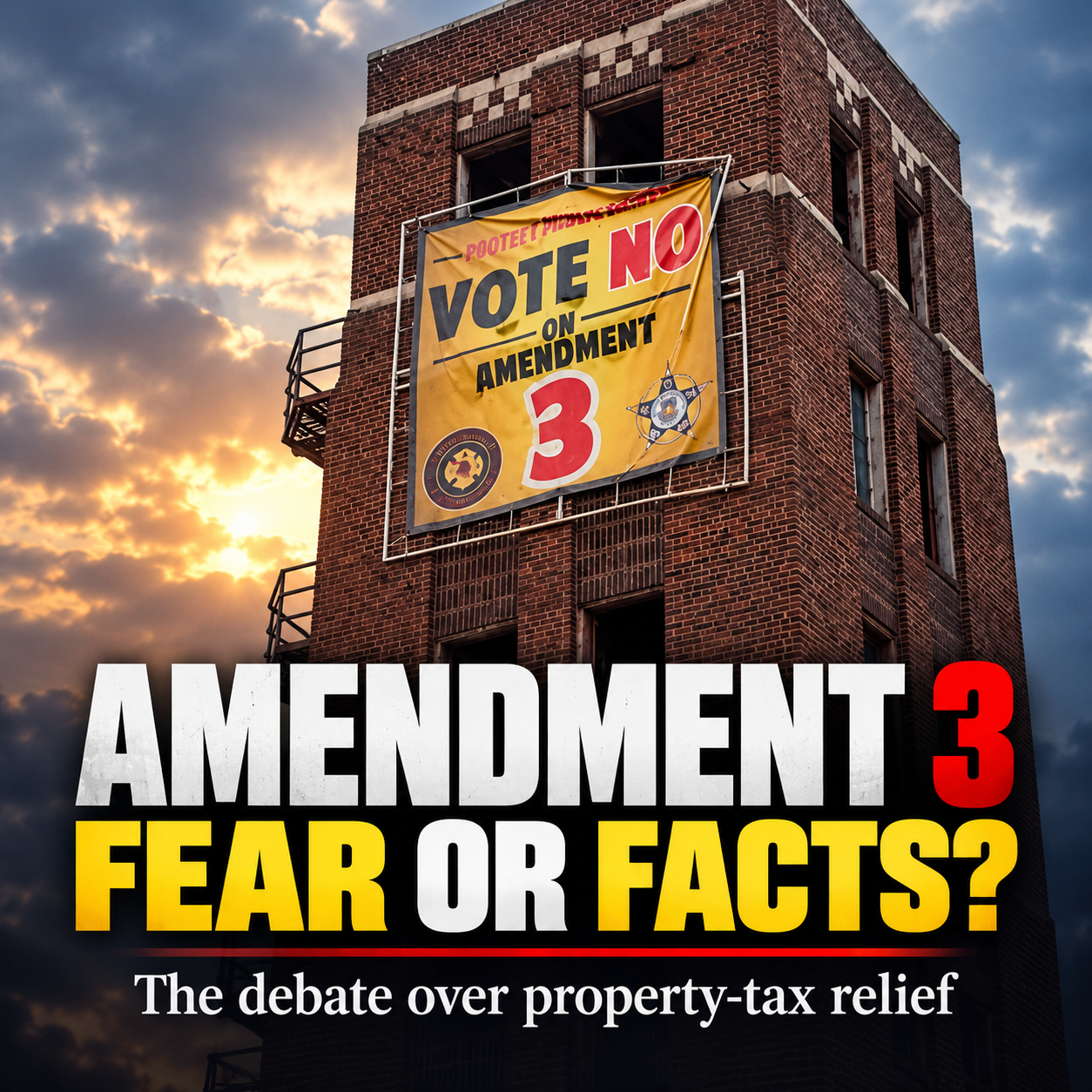
I am seeing more and more warnings about Amendment 3 — especially involving our police officers and firefighters.
If you vote for Amendment 3, we are told, prepare yourself. Police will be cut. Firefighters will disappear. Essential services will suffer.
It is a powerful argument because nobody wants fewer police officers protecting our neighborhoods or fewer firefighters answering the call when our homes are burning.
But before we allow fear to make this decision for us, how about we actually read what Amendment 3 does?
That is why I am encouraging Eye readers to watch a video from Grant Warrington that has been making the rounds. He walks through six of the biggest claims being made about Amendment 3 and asks viewers to look beyond the rhetoric and into the actual language.
Watch Grant’s video on Amendment 3 here:
And some of what he discusses is right there in Florida’s official ballot information.
Amendment 3 would increase the homestead exemption for non-school property taxes to $150,000 in 2027 and $250,000 in 2028, with inflation adjustments after that. The existing school-tax structure is not included in that increased exemption.
It also says counties and municipalities must use property-tax revenue for specified purposes including public safety, education and schools, infrastructure, natural resources, debt service, employee retirement benefits, and government operations and administration.
That matters when you hear the argument that police and fire simply have to be the first things sacrificed.
There is another piece of this story that deserves a lot more attention.
Florida law now requires counties and municipalities to conduct a public budget-reduction exercise identifying ways they could potentially reduce the following year’s budget by 10% without compromising essential public services such as law enforcement and fire services or violating legal obligations.
Read that again.
Local government has to look for potential savings without compromising police and fire.
So when the first response to property-tax relief is, “We may have to cut your police and firefighters,” – it’s a fear tactic and who is behind creating the fear?
I have tremendous respect for our first responders. That is precisely why I don’t like seeing them placed in the middle of political campaigns designed to frighten taxpayers.
They deserve better than that. And so do taxpayers.
There are issues Floridians should understand before voting.
Amendment 3 does not eliminate every property tax. It applies the larger homestead exemption to non-school levies. Non-homestead property, businesses, rentals and investment properties remain taxable under the system.
Local governments also retain other revenue mechanisms. And Grant correctly points out that special assessments and certain fees sit outside the property-tax exemption — meaning taxpayers should watch carefully to see whether local governments attempt to replace lost property-tax revenue elsewhere.
That is a legitimate discussion.
So are questions about the effect on individual county and city budgets.
But those questions should be answered with numbers, not frightening commercials.
Here’s our hope: turn down the noise!
That may be my biggest takeaway from Grant’s video.
Turn down the noise.
Stop assuming that the loudest person in the room has the facts.
Don’t automatically believe someone simply because he or she is wearing a uniform in a political advertisement or a sign is flying from one of their buildings. Don’t automatically believe a politician. Don’t automatically believe a taxpayer group, either.
Do your homework. Read the amendment. Look at your own county budget.
Ask what government spending looked like five years ago compared with today.
And remember that everyone participating in this debate has interests of their own.
Grant deserves a thumbs-up for encouraging Floridians to dig deeper rather than simply react to the latest frightening headline.
At Eye on Jacksonville, that is what we intend to keep doing as November approaches.
We will keep following Amendment 3, the claims being made about it, the numbers behind those claims and what it could mean for Northeast Florida taxpayers.
Because whether you ultimately vote YES or NO, one thing should not cast your ballot for you:
Fear.


One Response
It’s extremely difficult to simply believe State politician’s claims of benefits without unintended consequences without serious media discussions of refined and examined details of financial conditions in our municipalities and shortfalls once this proposal becomes part of the state’s constitution. Constitutional amendments are hard to employ and even harder to remove down the road, which leads me directly to ask these questions:
Why is this idea only being brought up and voted on during the last year (lame duck?) of Desantis’s term? Seems to me this should be a “Day One” type of proposal that actually requires an awful lot more PUBLIC DISCUSSION and EXAMINATION showing line by line how the changes might affect the citizens of all regions in the state. We should be discussing the pros and cons of the financial changes as well as exposing to SUNSHINE exactly what regions of the state will be adversely affected the most.
FEMA is considerably under-managed by the Federal Government and is already under considerable pressure to perform properly and in quick enough time frames since mass layoffs and budget changes have been implemented this past two political years by Federal Government decisions. We haven’t had a severe weather event this year, but only two years ago we certainly did. FEMA hasn’t been seriously tested yet in this administration and prices for everything have SKYROCKETED. So then, how are we supposed to be able to help ourselves should the next major storm cause severe disruptions to our lives……..It’s already been pretty well documented that the Federal Government as it’s currently being managed is likely unable to perform in a time-frame or willingness that would be necessary.
I’m just torn between the chance to save some money and possibly contributing to a tax-reducing scheme that isn’t fully thought out. Why haven’t we had better and MORE public discourse about the actual realities of budget shortfalls including specific explanations by municipalities delineating REAL vs IMAGINED financial implications.