We were ordinary Americans asking questions about Washington. Seventeen years later, we’re still asking — but now we’re beginning to understand just how the system works.
In 2009, a bunch of ordinary Americans stood up and said something was wrong in Washington, D.C.
We didn’t have political science degrees. We weren’t professional activists. We didn’t have consultants, pollsters, media teams or powerful lobbyists telling us what to say.
We had jobs. Families. Businesses. Bills to pay. Children to raise.
And we had a gut feeling that something was terribly wrong with the way our government was operating.
I was one of those people.
As a co-founder of the First Coast Tea Party in Jacksonville, Florida, I watched thousands of everyday Americans come together because they believed their government had forgotten who it was supposed to serve.
We were young as a movement. We were politically inexperienced. And looking back, we were probably pretty naive.
But we weren’t stupid.
We could see the spending. We could see the bailouts. We could see the debt piling up. And we couldn’t understand why Washington seemed to operate under an entirely different set of rules than the rest of America.
We knew something was wrong. We just didn’t know how deeply embedded the problems were.
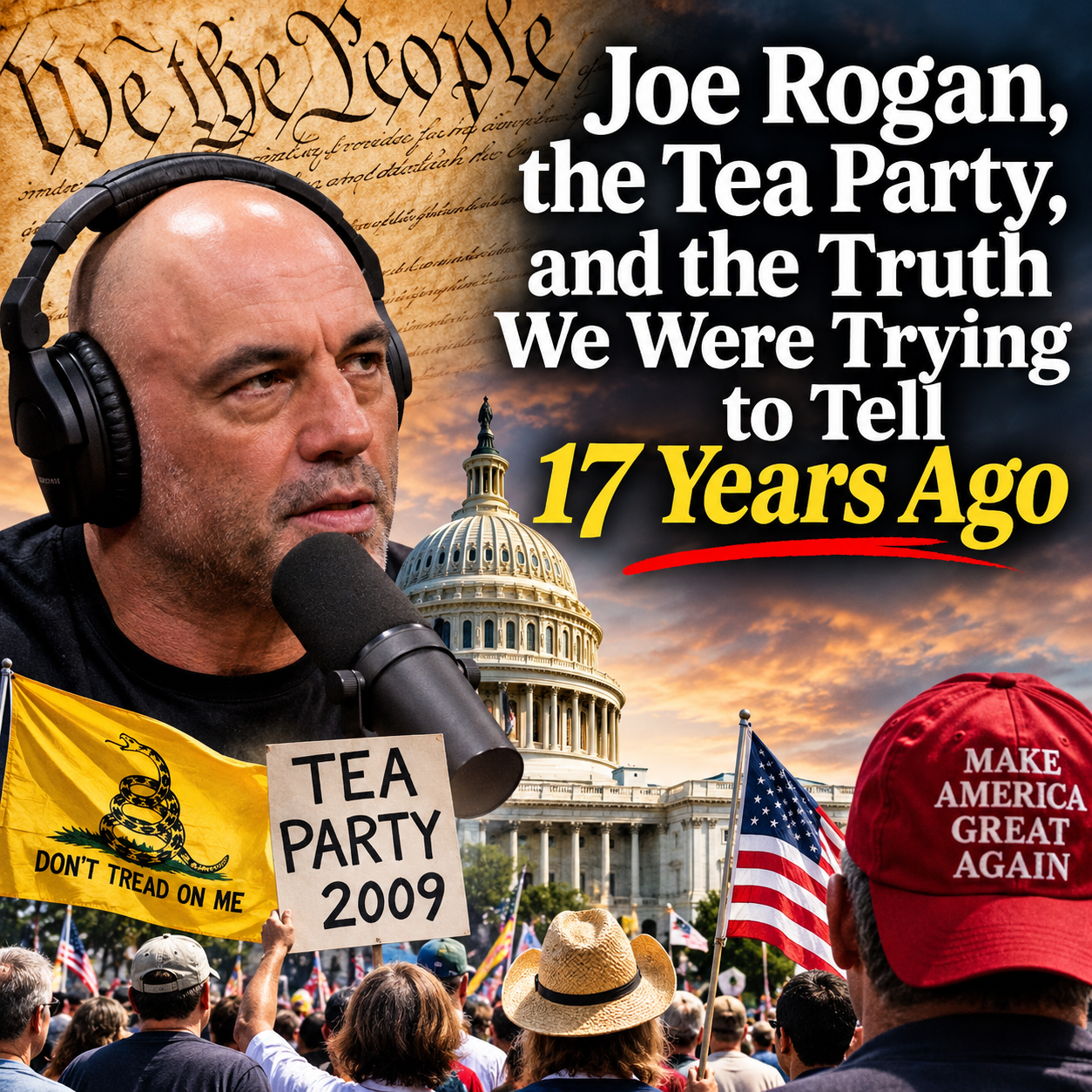
And now, seventeen years later, along comes Joe Rogan and his guest Calley Means to remind me of those early days.
Joe Rogan Was Learning, Too
Here’s something interesting I discovered while looking back at Rogan’s podcast history.
Joe Rogan started his podcast in December 2009, the very year the Tea Party movement was taking hold across the country.
His audience was much smaller back then. He was a comedian having conversations with interesting people, exploring ideas, questioning things and sometimes getting things wrong.
Sound familiar?
In September 2011, Rogan discussed the Tea Party with comedian Duncan Trussell. The conversation included criticism of the movement’s positions on healthcare and personal responsibility.
Rogan acknowledged that Tea Party supporters believed strongly in personal responsibility, although he also said he thought the way they were going about it was pretty silly.
I would have loved to have had a conversation with him back then!
Because what he might have discovered was that many of us weren’t trying to abandon our neighbors or destroy government.
We were trying to save a country we loved from a government we increasingly didn’t recognize.
But here’s what I find fascinating.
Joe Rogan has spent seventeen years asking questions, listening to people, challenging conventional thinking and learning more about how the world operates.
And so have we.
His influence has grown enormously, but perhaps more importantly, so has the range of people and experiences informing his conversations.
That doesn’t mean he’s always right. None of us are.
It means that understanding complicated systems takes time.
Why Did Our Own People Turn on Us?
One of the most painful lessons from those early Tea Party years had nothing to do with Democrats.
It had to do with Republicans.
We worked hard to help candidates get elected because they promised to stand up for limited government, fiscal responsibility and the American people.
We knocked on doors. We held rallies. We made phone calls. We raised awareness. We sacrificed time with our families and time away from our businesses because we believed we were doing something important.
And then something strange would happen.
The candidates would win.
They would go to Washington.
And suddenly, some of the very people we had helped elect didn’t seem nearly as interested in hearing from us anymore.
Sometimes we were treated like an inconvenience. Sometimes we were told to be patient. Sometimes we were expected to simply support the party and stop asking so many questions.
And sometimes it felt as though the people we had helped put into office had become part of the very system we sent them there to change.
Why?
That question bothered me for years.
Were we asking too much? Were we too demanding? Had we failed to understand how Washington worked? Or as I figured out years later, Washington was deeply entrenched with people who had lost touch with those they had gone there to serve and peer pressure with the DC elite was too difficult to fight so they gave in and became a part of the problem we were trying to shine a light on.
We certainly weren’t perfect at messaging. We weren’t professionals, and we made mistakes.
But I have come to believe something else.
We underestimated just how difficult it would be to change a system that had become very comfortable operating exactly as it was.
Enter Calley Means. And Here We Go Again.
On November 6, Joe Rogan released a fascinating interview with Calley Means, a former senior adviser who worked on the Make America Healthy Again agenda inside the Trump administration.
Means had recently resigned.
And what he described sounded painfully familiar.
He alleged that a relatively small group of politically influential insiders and special interests was interfering with policies that voters believed they had elected the administration to pursue.
He described disputes involving pesticides, food policy, corporate lobbying and political fundraising.
Among his allegations were claims that certain insiders put industry interests ahead of the reform agenda.
These are serious accusations, and they require evidence and accountability. The White House has defended its record, pointing to changes in dietary guidelines, artificial food ingredients and support for regenerative farming.
But what struck me wasn’t simply the controversy surrounding particular officials.
It was the larger question.
How is it that Americans can elect people who promise to change Washington, only to discover that the machinery of Washington can keep operating much as it always has?
This is not just a Republican problem or a Democratic problem.
It is a government problem.
And it is precisely the kind of question we were asking in 2009.
Watch Joe Rogan’s November 6, 2026, interview with Calley Means — Episode #2578.
Mr. Smith Went to Washington. We Went There, Too.
One of my favorite old movies is Mr. Smith Goes to Washington, the 1939 Frank Capra classic starring Jimmy Stewart.
Jefferson Smith arrives in Washington believing that the people serving in government are there for honorable reasons.
He believes in the system. He believes in the goodness of people. He believes that doing the right thing should be enough.
And then he discovers the backroom deals, political manipulation and powerful interests operating behind the scenes.
His innocence meets Washington’s reality.
I think many of us in the Tea Party experienced our own Mr. Smith moment.
We went into politics believing that if we worked hard enough, elected the right people and told the truth, good things would happen.
Then we discovered there were people with far more money, influence and political experience who weren’t particularly interested in changing the rules.
Watch this scene from Mr. Smith Goes to Washington and tell me it doesn’t remind you of what we’ve been witnessing for decades.
The remarkable thing is that a movie made in 1939 can still inspire this conversation in 2026.
Maybe that tells us how old the problem really is.
But Something Has Changed. And It’s Big.
In 2009, we relied heavily on the traditional news media to tell our stories.
And when they didn’t understand us, dismissed us or portrayed us unfairly, it was difficult to get our message out.
We didn’t have millions of followers or our own enormous broadcasting platforms.
But today?
Joe Rogan can sit down with a former Washington insider for more than two hours and give Americans an opportunity to hear that person’s account directly.
Independent journalists can investigate public records and publish their findings.
Citizen watchdogs can scrutinize budgets, contracts and government decisions.
And ordinary Americans can compare competing claims, investigate evidence and ask questions that once might never have made it past a newspaper editor or television producer.
That’s a remarkable change.
Of course, new media comes with responsibilities, too. A popular podcast doesn’t automatically make an allegation true. We still have to examine evidence, hear competing explanations and distinguish facts from suspicions.
But at least more people now have the opportunity to participate in the conversation.
The gatekeepers no longer have exclusive control over what Americans get to hear.
And that gives me hope.
Maybe We Weren’t Wrong. Maybe We Were Early.
Looking back on those Tea Party years, I sometimes wish we had known then what we know now.
I wish we had understood the power of lobbyists, the influence of political consultants, the importance of government staffing and just how many decisions get made far away from public view.
I wish we had known how to follow the money more effectively.
I wish we had been better at recognizing the difference between a candidate who wanted to change Washington and one who simply wanted to become part of it.
And I wish we had known that winning an election was only the beginning of the work.
But here’s what I would never change.
We stood up.
We asked questions.
We refused to accept that ordinary Americans had no business challenging the people in power.
And we learned.
Just as Joe Rogan has learned through thousands of conversations, many of us who participated in the Tea Party have learned through years of watching, questioning and working to hold government accountable.
Sometimes it takes years to understand what you were seeing all along.
Sometimes it takes insiders willing to speak publicly.
And sometimes it takes millions of people hearing the same stories before they begin asking the same questions.
The Tea Party Isn’t Dead. It Just Went Back to Work.
There’s something else I want people to understand.
The Tea Party didn’t die.
Many of us simply went back to our businesses, our families and our everyday lives. We had spent years organizing, rallying, educating and fighting for the principles we believed made America great. We were unorganized Americans who cared but we had no leader and without a leader, the movement can not continue.
And then along came Donald Trump.
Here was a man who wasn’t part of the traditional political establishment, who spoke openly about Washington’s failures and who promised to take on a system that so many of us had spent years trying to change.
For many of us, it felt as though we had finally found someone willing to lead the fight we had started.
Trump called his movement Make America Great Again.
We had called ours the Tea Party.
Different names. Different approaches. But many of the same Americans were there, still concerned about government spending, political insiders, accountability and the future of our country.
The Tea Party didn’t disappear. Many of its members became part of MAGA.
We were thrilled to have someone who seemed willing to take our concerns directly into the White House.
But we also discovered something we hadn’t fully appreciated in those early days.
Even a president who promises sweeping change must contend with Congress, federal agencies, entrenched interests, political appointees and a bureaucracy that doesn’t simply disappear after an election.
And that’s why I found the Joe Rogan conversation with Calley Means so fascinating.
It brought me right back to the questions we were asking in 2009.
Why is changing Washington so difficult? Why do promises made on the campaign trail sometimes run into resistance once people take office? And how do ordinary Americans ensure that their elected leaders remain accountable?
We didn’t have all the answers then.
We have more information today, but we still have plenty of questions.
And perhaps that’s the greatest lesson of these seventeen years.
Finding a leader is one thing. Changing a system is another.
The Tea Party helped teach us how to organize and make our voices heard. The MAGA movement brought many of those voices together under a new banner.
Now the question is whether Americans can turn all those years of political experience into lasting institutional reform.
Because the people who stood up in 2009 haven’t forgotten why they stood up in the first place.
Now Comes the Hard Part: Changing Washington
Exposure is important. But exposure alone isn’t enough.
We have to turn information into action.
We need to demand transparency about who influences government decisions. We need to examine the revolving door between government and lobbying firms. We need to ask why political promises sometimes disappear after Election Day.
We need to pay attention to appointments, budgets, contracts and administrative decisions, not just campaign speeches.
And most importantly, we need to stop treating the people we elect like celebrities who deserve our unconditional loyalty.
They work for us.
That includes the politicians we like and the politicians we helped elect.
Perhaps especially those politicians.
The goal should never be to protect a party, a personality or a political career.
The goal should be to protect the American people’s right to a government that serves them.
We also need something the early Tea Party didn’t always have: a long-term strategy for making reform stick after the rallies end and the elections are over.
That means staying informed, building independent watchdog organizations, supporting public-records investigations, demanding measurable results and holding our own elected officials to the same standards we demand of everyone else.
There are no shortcuts.
And One More Thing…
I don’t look back on the Tea Party movement with embarrassment.
I look back with gratitude.
Gratitude for the thousands of people who gave their time, their money, their energy and their hearts because they believed America was worth fighting for.
We didn’t have all the answers.
We still don’t.
But we had the courage to ask the questions.
And today, with people like Joe Rogan opening up conversations that millions can hear, perhaps Americans have a better opportunity than ever to understand what happens between Election Day and the decisions made in Washington.
The more we know, the better equipped we become to demand something different.
And maybe that’s the next chapter of the movement that started all those years ago.
Not simply getting people elected.
Making sure the government actually changes after they get there.
Because seventeen years later, I still believe what I believed when we started the First Coast Tea Party.
Washington belongs to the American people.
And it’s about time Washington remembered that.
An Invitation to Joe Rogan
Joe, if this article happens to find its way to you, I’d love to have a conversation.
Not just with me, but with some of the original Tea Party founders who stood up in 2009 because we knew something wasn’t right in Washington.
We weren’t political insiders. We were ordinary Americans who believed we could make a difference. And we learned some hard lessons along the way.
You’ve spent seventeen years asking questions, listening to people and uncovering how things really work. We’ve spent those same years watching Washington, sometimes shaking our heads, sometimes getting our hearts broken, but always learning.
I think we’d have a lot to talk about.
Not to relive the Tea Party movement or argue about who was right and who was wrong.
But to ask a much bigger question:
Now that we know so much more about how Washington works, what are we going to do to change it?
Because exposing the problems is only half the battle. Fixing them is the other half.
And maybe it’s time for a conversation between those who started asking questions in 2009 and those who are bringing those questions to millions of Americans today.
The coffee’s on me, Joe.
Let’s talk about how we give Washington back to the people it was supposed to serve.
Billie Tucker
Co-founder, First Coast Tea Party
EyeOnJacksonville.com