Ron, I really didn’t want to write this article.
In fact, I thought we had settled this matter six months ago, privately and professionally.
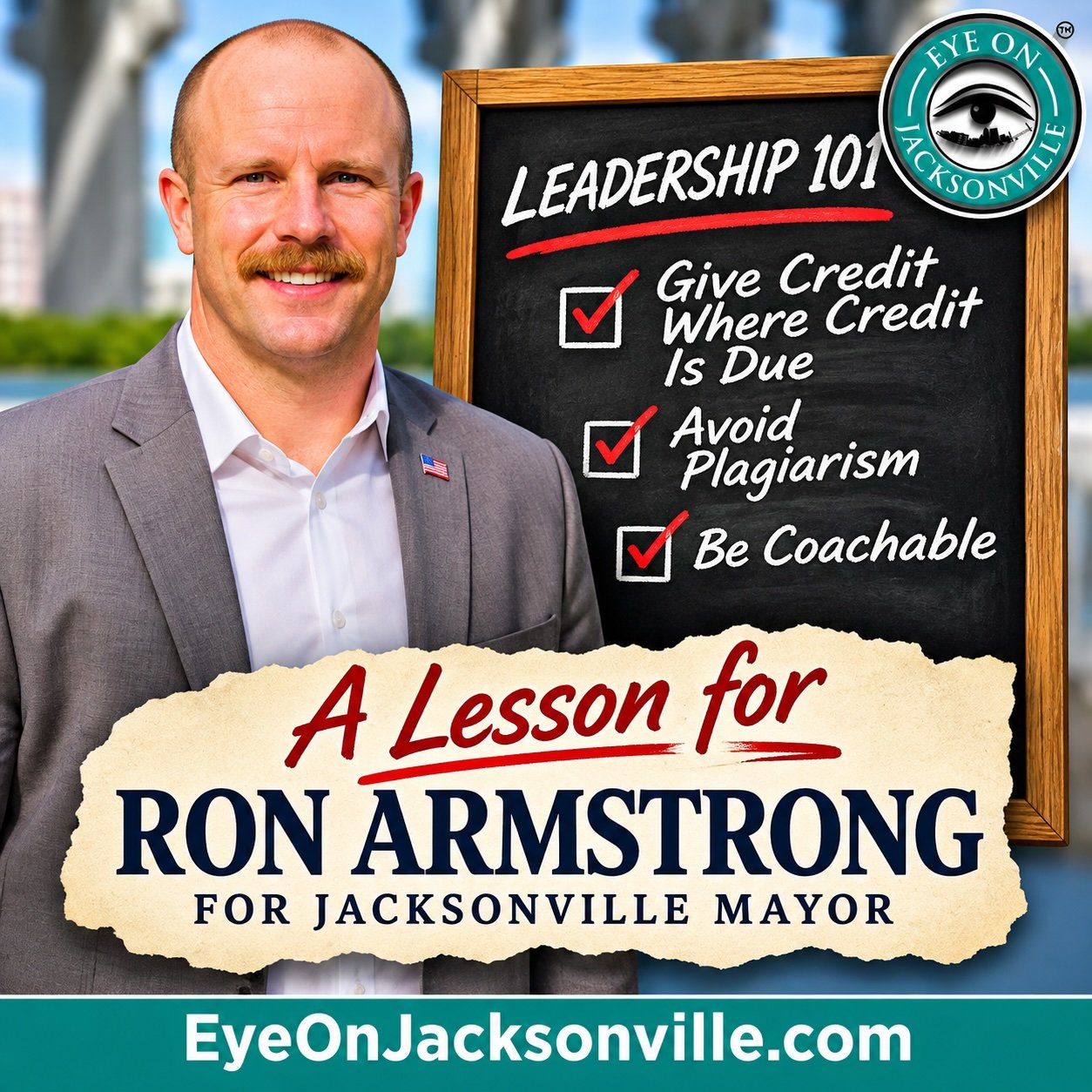
But apparently, it’s time for a little Leadership 101.
Back in May 2026, I wrote an article for Eye on Jacksonville titled “Kevin, Kevin, Kevin — What the Heck Is Going On?”
In that article, I wrote:
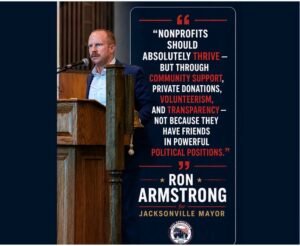
“Nonprofits should absolutely thrive — but through community support, private donations, volunteerism, and transparency — not because they have friends in powerful political positions.”
Those were my words, written for an article I published on Eye on Jacksonville.
Shortly afterward, I discovered that Jacksonville mayoral candidate Ron Armstrong had used my exact quote in a campaign graphic featuring his photograph and name. There was no attribution to me or Eye on Jacksonville.
I wasn’t pleased, but I decided to handle it privately.
I sent Ron a simple email:
“Hello Ron: I saw your post on facebook. It was a direct quote that came from an article I wrote and published at Eye on Jacksonville. If you are going to use someone’s quote, you need to make sure to give them credit for it. Even a link to our article would be nice.
Thought you should know. Thanks, Billie Tucker, Founder of Eye on Jacksonville”
Ron responded:
“Absolutely. You got it.”
Then he sent another message:
“Post edited.”
He corrected the attribution, and I considered the matter closed.
But on November 20, Ron reposted the original graphic without attribution. I saw it posted on Facebook the following day.
Ron, seriously?
We already had this conversation.
Let’s Talk About Plagiarism — and Leadership
We teach children in elementary school that when they use someone else’s words, they give that person credit.
It’s called attribution.
When you take someone’s exact words and present them as your own, that’s plagiarism.
It’s not complicated. It’s not a gray area. It’s a basic principle taught in school, journalism, and the business world.
And it doesn’t suddenly become acceptable because you’re running for political office.
In business, we call this Business 101.
You give credit where credit is due.
If an employee comes up with a brilliant idea, you recognize that employee.
If a colleague writes something meaningful, you acknowledge the author.
If a volunteer spends countless hours making your organization successful, you thank that volunteer instead of pretending you did all the work.
Leadership isn’t about collecting credit. It’s about giving credit.
That’s how you build trust. That’s how you earn respect. And that’s how you encourage good people to keep doing good work.
The First Time Might Have Been a Mistake. What About the Second?
Ron, I was willing to give you the benefit of the doubt in May.
Maybe you liked the quote and forgot where you saw it. Maybe you didn’t realize it needed attribution.
Whatever the reason, I pointed it out privately.
You acknowledged it.
You corrected it.
Good. That’s how mature adults handle mistakes.
But now, six months later, we’re back to the same graphic without the correction.
I can’t tell you why that happened. Only you can explain that.
What I can tell you is that it makes the original apology and correction seem rather meaningless.
A leader should be coachable.
Someone who aspires to manage a major American city will receive advice, correction, criticism, and challenges every single day.
Some of that advice will come from people who support him. Some will come from people who disagree with him.
The ability to listen, learn, make adjustments, and maintain those adjustments is fundamental to leadership.
That’s why this seemingly small incident raises a much bigger question:
Are you ready and able to take on the responsibilities of Mayor if a lesson as simple as giving someone proper credit has to be repeated?
It’s a fair question to put to someone seeking public office.
Don’t Take Credit. Give It.
Imagine being Mayor of Jacksonville.
You’ll have department heads, employees, volunteers, advisers, community leaders, and citizens bringing you ideas every day.
Some of those ideas will be terrific.
Some will save taxpayers money. Some will solve longstanding problems. Some will improve people’s lives.
And when they do, the appropriate response isn’t to put your own name on their accomplishments.
It’s to recognize the people responsible.
A Mayor doesn’t have to be the smartest person in every room or the author of every good idea.
A Mayor should know how to recognize talent, encourage excellence, and celebrate other people’s contributions.
Those are leadership habits worth developing long before taking office.
Ron, Here’s Some Friendly Coaching
You have chosen to put yourself forward as a candidate for Mayor of Jacksonville. That comes with increased public scrutiny, and rightly so.
Every candidate deserves a fair opportunity to explain mistakes and demonstrate accountability.
You also have an opportunity here to demonstrate something important.
Acknowledge what happened. Explain why the original graphic reappeared. Make the correction again, and make sure it stays corrected.
It’s that simple.
I would much rather be writing about the good things candidates are doing for Jacksonville than revisiting an attribution issue I thought was settled in May.
But I also believe people in leadership — and those aspiring to leadership — should be willing to receive constructive criticism.
The first incident may have been an innocent oversight.
The second deserves an explanation.
Ron, you don’t need to borrow someone else’s words to establish your own voice.
Share ideas. Build on them. Discuss them. Disagree with them. Just acknowledge the people who contributed them.
And remember: one of the simplest ways to elevate yourself as a leader is to elevate the people around you.
That’s Leadership 101.
Jacksonville needs public servants who understand that principle.
Original Eye on Jacksonville article, May 2026:
https://eyeonjacksonville.com/kevin-kevin-kevin-what-the-heck-is-going-on/