This week’s top news undoubtedly includes a video game release. This, ironically, has led to less news overall. Yesterday’s Florida Politics, for example, cheerfully announced the column’s lead editor was taking a few days off and, with “and the rest of the Florida Politics staff apparently busy exploring Leonida in GTA VI, we’re calling a brief timeout on Sunburn.” We offer a rare compliment to the New York Times for its tongue-in-cheek headline: “With GTA 6 Release, DoorDash and Other Food Delivery Apps Are Making a Killing.”

Capping off a week of dramatic, historical firsts, press ‘X’ on your controller to log another one. The long-anticipated sequel game —the sixth in the franchise’s series— reportedly cost developer Rockstar Games over a billion dollars to make. It’s been over 13 years since GTA V, the longest stretch in the lineup by far. It might even be the last big title to be developed without any AI help.
By all accounts, it is a remarkable feat of software engineering that required a five-thousand-person team. The Times quoted a DoorDash VP who best summed it up: “GTA 6 is more than a game launch. It’s a cultural moment that fans have been waiting years for.”
It is selling faster than Das Kapital at a DSA Convention. The BBC estimated that opening sales exceeded 24 million copies and so far earned $2.3 billion. That makes it the biggest video game launch in history, bar none.
This is just the warm-up. The last one, 2013’s GTA V, invited players to spend real-world dollars to buy pretend cars and other electronic property for their game characters. And they did. The same is surely coming for GTA VI, too. That giant sucking sound you can hear in the distance is the gurgling noise made by bank accounts being drained— the accounts, ironically, of many people who until recently were extremely concerned about how much Chipotle burritos cost.
But now, with a blockbuster game in release, spare no expense! There are bigger priorities than affordability. And the delivery services have been carefully planning to support video game addicts for months.
“It’s all hands on deck,” said Frank Lucido, co-owner of Frankie & Joe’s Pizza in Boca Raton, hours after the game’s midnight release. “It’s going to be a really big one tonight.” The Times called around. It reported that the evening’s DoorDash orders rose 25%, Uber Eats was up 30%, and orders for deliveries of Red Bull (watermelon flavor) jumped an astonishing 95%.
“We want Uber Eats to be there for fans during the biggest moment in gaming, with everything from gaming accessories and groceries to their favorite meal on launch day,” Andrew Macdonald, the president and chief operating officer of Uber, told the Times. “We even picked some of our food deals with one-handed eating in mind, so fans can keep their focus on the game.”
How could I top menus designed for one-handed eating? The jokes write themselves.

🔥 Consider Rockstar’s vast marketing budget, it is unsurprising game reviewers are competing to attain new heights of obsequious rhetoric. Entertainment media site IGN, for instance, called the game an “uncompromisingly engineered” masterpiece. Metacritic scored it a 99— tying Ocarina of Time for all-time best.
The reviews were probably purchased, but I see no reason so far to suspect they’re wrong. (It’s too early to evaluate real players’ reactions. They’re still digging into it.)
Hyper-realism is the point. Calling it “meta” won’t do it justice. The game crawls with more than 170 animal species, including over 60 kinds of birds and over 30 land mammals. It includes working iPhones with their own apps and playable video games inside the video game. Aside from complaints about the relationship spadework and the frames-per-second, gamers overall seem happy as over-caffeinated clams.

Since it has been better said by others, I will avoid traversing the well-traveled superhighways of criticism about the game’s mechanics. Players are ‘entertained’ by exploring gritty, real-world cityscapes packed with sketchy, strung-out, trash-talking vagrants while earning rewards for committing misdemeanors, felonies, terrorism, and even running ski boats at full throttle in no-wake zones and passing in the bike lane.
Like in real life, these pretend crimes eventually have in-game consequences. Unlike real life, justice arrives quickly, is usually fatal, and never involves cash bail. (Some critics have even complained the in-game justice in this version is too fast and too harsh.) You could argue it teaches players memorable lessons that would be quite painful to learn outside the game’s forgiving electronic sandbox.
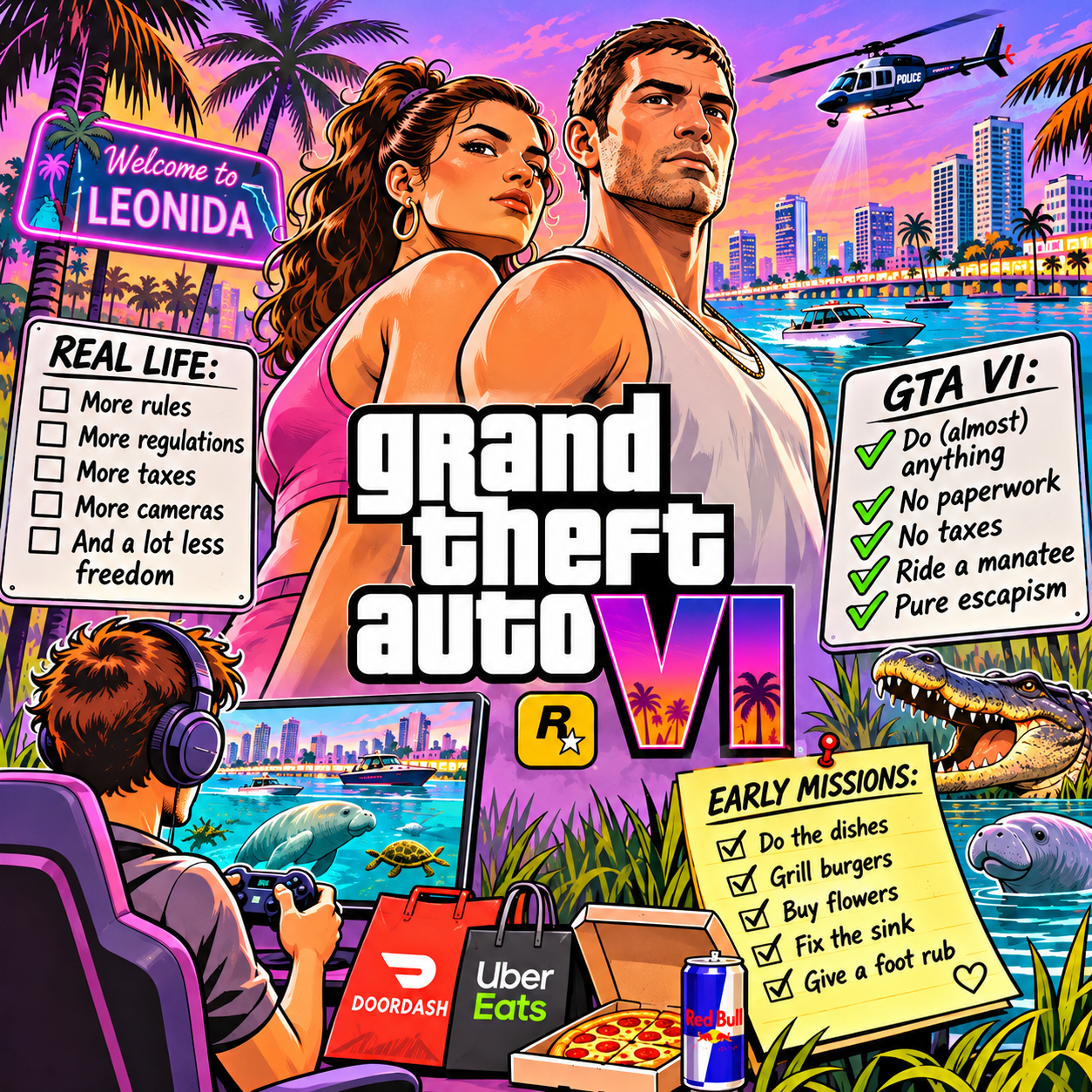
🔥 For me, as an outside observer, the most amusement was delivered by the loudest nexus of complaints: that the “reality game” is too realistic. The main character is the male half of a duo of down-on-their-luck lovebirds. Many of the game’s early missions involve hyper-realistic and all-too-familiar ‘chores,’ like: doing dishes, grilling burgers, holding hands (by repeatedly mashing the controller buttons), buying flowers, fixing broken sinks, picking up groceries, and giving his girlfriend foot rubs.

If that sounds like the opposite of relaxing fun, you aren’t alone. But this cutesy relational spadework is not without rewards. A sufficient performance of acts of service is eventually rewarded in the simulated love language of R-rated digital canoodling. Which admittedly invites wonderful opportunities to analyze players’ willingness to invest time in rubbing their digital girlfriend’s feet rather than operating on the real ones in the next room, which might produce more satisfying results.
Here are a few examples of early game ‘missions:’

These acts of kindness —which are probably just excuses to move the player around the game map— provided plenty of fodder for folks looking for things to criticize. But it would be myopic and reductionist to characterize the game experience this way.
To some, the relationship-building element represents Rockstar’s woke political pandering. But it is not that simple. First, the developer has obviously learned painful lessons from the prior games. In a video game where players spend inordinate amounts of time stealing things, assassinating random pedestrians, and in shootouts with cops —and eventually, if they play their crimes right, with the military itself— it helps soften the social pushback if the character is, at least, a good boyfriend.
But more importantly, the game’s overt politics, if anything, seem to lean nonpartisan or even slightly conservative. The Mar-a-Lago estate, for example, is conspicuously absent. In one widely shared and decidedly not-woke encounter, a gang of tree-hugging environmentalists frees a bear, and the bear immediately eats them.

Rockstar knows its audience, which transcends party politics. Politicians of either party criticize the game at their peril. Florida Senator Ashley Moody (R), for example, mildly quipped yesterday about the Sunshine State’s low crime rate compared to the game and was promptly savaged on X as fiercely as the liberals who let the bear loose. She’ll probably steer clear of the subject.
🔥 GTA VI’s wild popularity tempts social analysis. What does a hyper-violent video game’s off-the-charts popularity say about us, about our social fabric? The game defies that kind of simplistic deconstruction, since its fictional world is so much richer than its conflict mechanism.
For just one example, players can swim underwater and frolic with manatees and sea turtles in a fictional Florida Keys (the game is set in a clone of Miami). Yes, it is more rewarding to do this in real life. But doing so is a wet, all-day affair, and the sea cows avoid cold water and herd close to shore, making January the best manatee spotting month. (And I, for one, refuse to swim in January, because I am not a masochist.)

My working hypothesis is that many people prefer a lawless game experience as escapism. Real life has become so overburdened with statutes, regulations, and rules that life often feels, well, stifling. Well-kept lawns sprout “do not walk on the grass” signs. Parks are decorated with giant rule boards printed in six-point type. Don’t even get me started on the tax code. Or try driving 10 mph too fast in a school zone sometime —with an empty street— and see what happens. Most school zones now have sleepless automated camera systems that vigilantly ensure we get every single ticket we deserve.
Most of all: avoid manatees and sea turtles. In real life, if you happen to touch one of these critters, even accidentally, it is a federal crime with up to a year in prison and a $50,000 fine. But in GTA VI, there’s not even any paperwork for molesting manatees. Pat them on the back if you want. Ride a sea turtle. Or just run them over. (But don’t mess with the game’s alligators, which is also great real-life advice.)

Over the years, there have been fierce debates about whether violent video games desensitize children, give would-be shooters target practice, or even invite demonic activity. That argument continues and won’t be resolved anytime soon. At least, not this week.
Maybe the lesson is not that people desire to be violent criminals. Maybe what the GTA phenomenon represents is that people yearn to be more free. And when they do finally give expression to that repressed desire, it sometimes bursts into digital carnage, which, after all, is harmless in that it has no real-world consequences. Unlike failing to file your annual income tax return on time.
The ‘solution,’ if one is needed, might be to dial back the regulatory state by a lot. Then folks won’t need to escape real life as much. It’s just a thought.