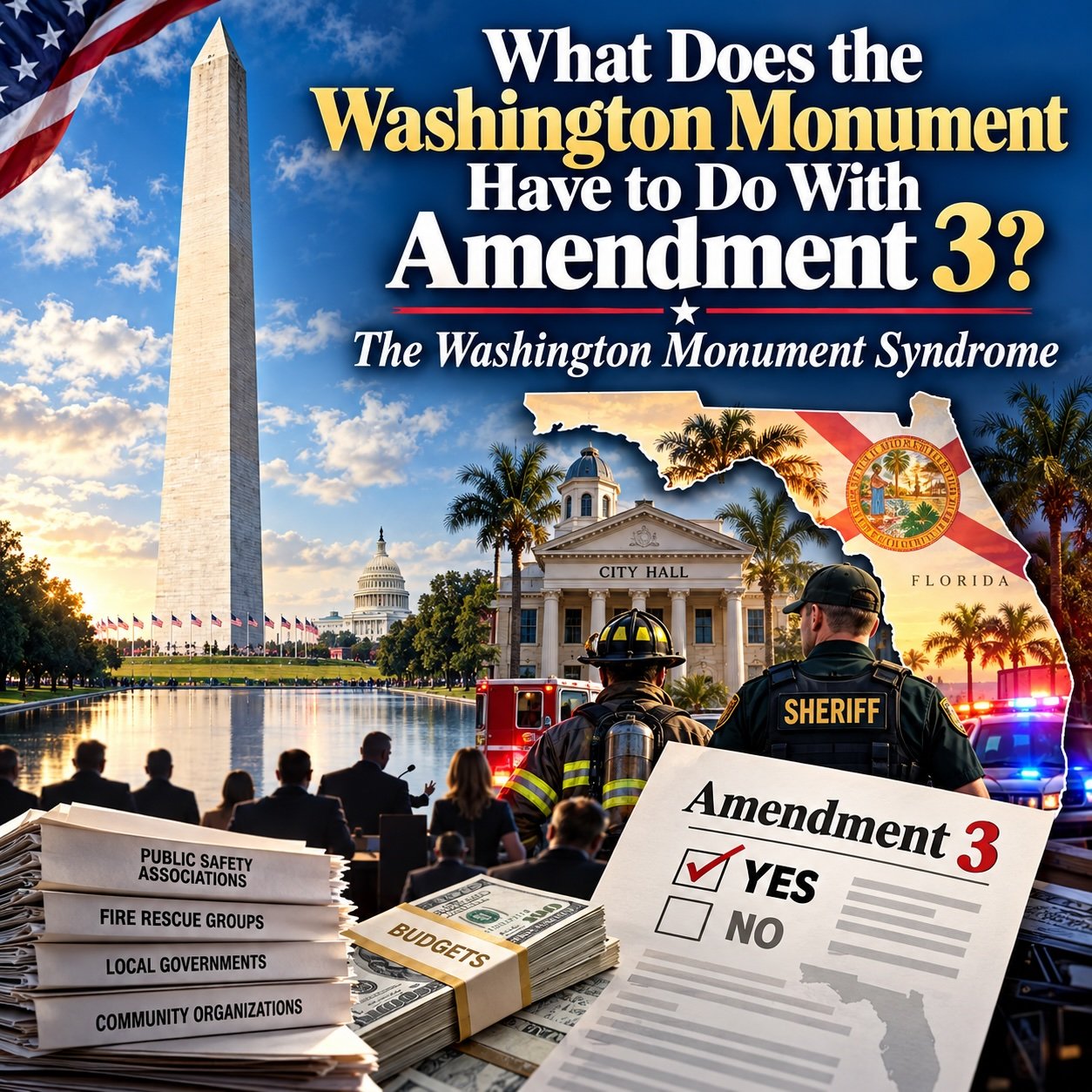
I love it when our Eye on Jacksonville readers teach me something new!
After we published “Shame on the Sheriffs: Don’t Use the Badge to Sell Fear,” about the campaign against Amendment 3, one reader left a comment that caught my attention.
“It’s the Washington Monument Syndrome.”
The what?
I’d never heard of it, so naturally, I went digging. And boy, am I glad I did!
What a find! The more I learned, the more I recognized similarities to the messaging we’re hearing about Amendment 3.
So, a big thank-you to the reader who sent me down this rabbit hole. Here’s what I discovered.
A Little History Lesson
Washington Monument syndrome describes a government budgeting tactic in which officials facing spending cuts highlight the potential loss of popular or essential public services.
Think police officers, firefighters, teachers, libraries and national parks.
The term dates back to a 1969 budget dispute involving the National Park Service. Facing budget reductions, officials closed some of America’s most recognizable attractions, including the Washington Monument, two days a week.
The public noticed. Pressure mounted. And funding was restored.
In other words, show taxpayers what they love most, threaten to take it away, and watch what happens.
Some might call that manipulating the public.
But here’s the really interesting part.
Washington Monument syndrome is also known as the “firemen first principle.”
You can’t make this stuff up!
Read more about Washington Monument syndrome here.
Now, Let’s Talk About Amendment 3
Fast-forward to 2026.
The Florida Sheriffs Association and other organizations have joined the campaign against Amendment 3, while local government officials are raising concerns about reduced services. The question is whether these warnings reflect unavoidable consequences or budget choices that deserve closer examination.
What about administrative overhead, unnecessary programs, consultants, wasteful spending and layers of bureaucracy?
Have those dollars been examined before warning families that nobody might answer their 911 calls?
Show us the numbers. All of them.
I’m not suggesting every organization in this coordinated campaign against Amendment 3 are intentionally practicing Washington Monument syndrome. They may not even know it’s a “thing.” But the similarities in the messaging are hard to miss.
Government Has Associations. Who Speaks for the Taxpayer?
Here’s what really got me thinking.
Sheriffs have associations. Firefighters have unions. Government agencies have professional organizations.
They can organize, raise money, hire consultants, lobby legislators and launch coordinated campaigns.
But what about the average Florida taxpayer?
Who’s sitting in Tallahassee every day speaking for the family struggling to afford its home? The senior citizen on a fixed income? The small business owner trying to make payroll while taxes and expenses keep climbing?
Yes, taxpayer advocacy organizations exist. But ordinary citizens don’t have the same built-in network of public officials and professional organizations speaking with one voice.
Most are too busy working, raising families, running businesses and paying the bills.
They don’t have a badge, a public relations firm or a powerful statewide association speaking for them.
But they do have a vote.
And when individual votes come together, they create a collective voice government cannot ignore.
That’s the beauty of our system.
Don’t Confuse a Warning With the Only Possible Outcome
Government officials have every right — and a responsibility — to explain the financial consequences of Amendment 3.
And reduced revenue can create real challenges. But it doesn’t automatically dictate which services must be cut. Those decisions involve priorities, alternatives and leadership.
Taxpayers deserve to see those options before being told what they stand to lose.
That’s the lesson of Washington Monument syndrome.
When government warns that the services you value most are at risk, ask whether every other option has been examined first.
Government associations have their voices. Special interests have their lobbyists. Public officials have their platforms.
The people have their votes and if we all show up in big numbers – we beat the Washington Syndrome campaign!
You’ve been educated thanks to one of Eye’s readers!! We appreciate you and ask that you keep those comments coming and help us learn what we need to know. Become our “eyes” and ears!!