It is not at all surprising that the Jacksonville Transportation Authority (JTA) is in financial trouble.
JTA took over a failing bus operation and then made it worse by lowering fares and raising costs.
Then, it decided that a pointless “people mover” was the answer to mass transit in Jacksonville. Millions more were sunk into that losing venture.
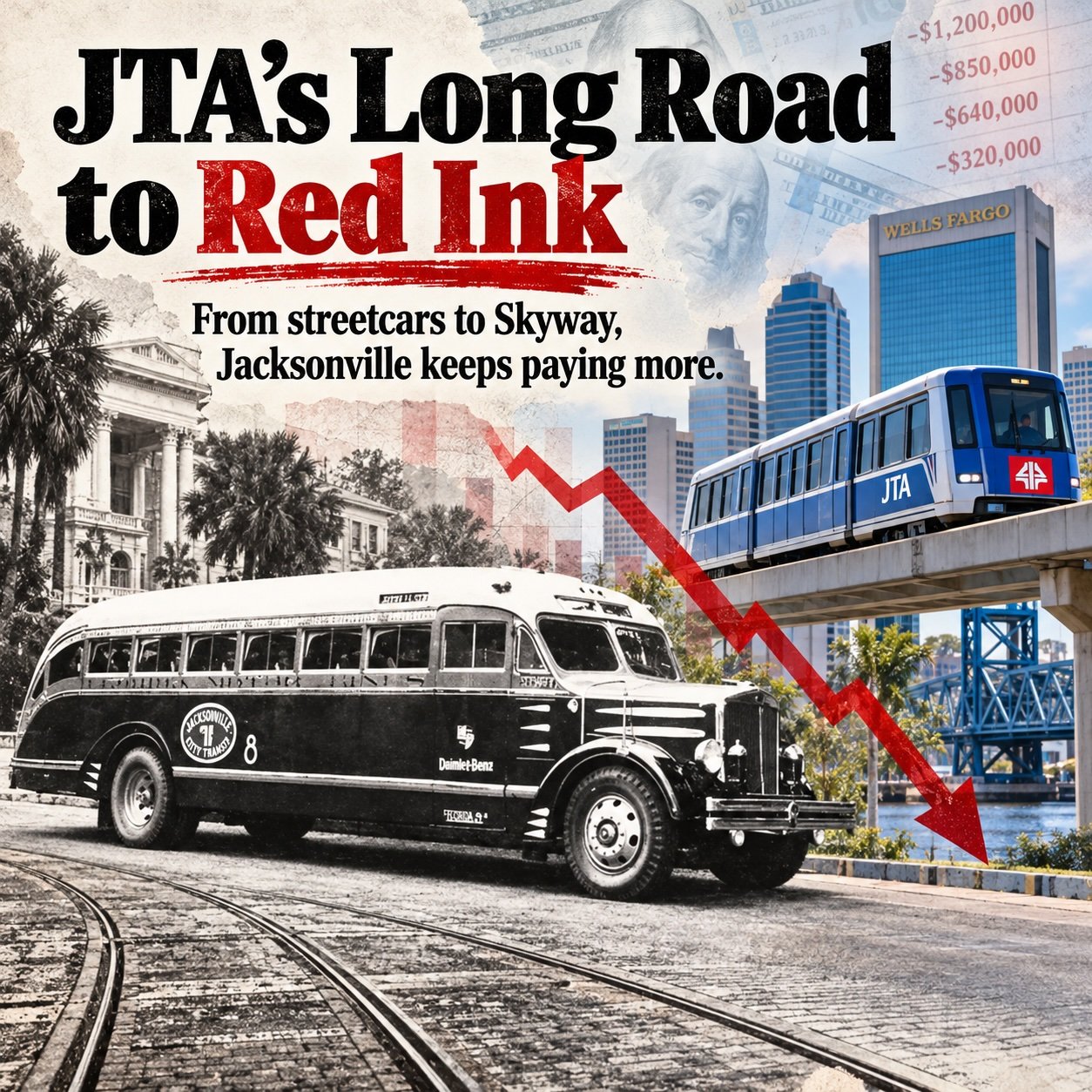
Today it is $39 million in the red, and being investigated by city and state officials.
Jacksonville’s mass transit history dates to 1875, when the Jacksonville Street Railroad Co. was formed. It planned a horse/mule-drawn street railway.
Financial difficulties caused that first company to fail before establishing a lasting system, which should have been a harbinger.
Around 1880, Henry B. Plant and associates established the Jacksonville Street Railway Co. It operated mule-drawn streetcars, initially serving the downtown area.
Jacksonville’s first electric streetcar ran on Main Street in February 1893. Other private companies gradually consolidated. Plant acquired the remaining independent street railway interests around 1900.
The Great Fire of 1901 badly damaged Jacksonville’s street railway infrastructure. Afterward, Stone & Webster became involved in managing and rebuilding the system.
By 1911, Jacksonville had approximately 80 electric streetcars and 43 miles of track, employing about 300 people. In 1912 the street railway properties were reorganized as the Jacksonville Transit Co.
The streetcar system reached its peak in the 1920s. In 1925, there were 101 passenger cars operating over nearly 60 miles of track and they reached far-flung areas of town such as Springfield and Ortega.
Like many American cities, Jacksonville began replacing its fixed rail streetcars with rubber-tire buses.
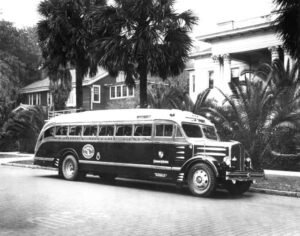
Jacksonville’s streetcar era ended on Dec. 12, 1936.
Bus and cab transportation ruled for the next 35 years, and the key company eventually became Jacksonville Coach Co.
But after World War II, several things worked against the private model and by the early 1970s, the private bus operation was losing money.
The Jacksonville Expressway Authority had been created by the Florida Legislature in 1955. Its original job was highways, bridges and toll facilities — not public transit.
In 1971, the Jacksonville Expressway Authority became the Jacksonville Transportation Authority and entered the bus business soon afterward.
I was covering City Hall for a newspaper at that time and remember the matter well.
City officials concluded that it was in the public interest to acquire the private bus system. It sought assistance from the federal Urban Mass Transportation Administration (UMTA) and conducted a feasibility study.
The authority negotiated with the existing private operators, including City Coach Lines, Inc. and its subsidiary Jacksonville Coach Co., to acquire the system.
Some local citizens objected and filed a lawsuit essentially asking, “If this private company couldn’t make the system work financially, why should taxpayers buy it and then pay the same company to run it?”
The suit reached The Florida Supreme Court. Its 1973 decision in Betz v. Jacksonville Transportation Authority basically said stupid decisions by politicians were not unconstitutional.
Whereupon in December 1972 the city bought the company for $5.3 million, using $850,000 from the Jacksonville City Council and $885,458 from the state Dept. of Transportation.
Very quickly, the City Council had to give it $900,000 to cover a first-year operating deficit.
But JTA didn’t operate the system. It paid the former owner a first-year management payment of $292,500.
The JTA made substantial changes, including:
- new routes;
- schedule changes;
- lower fares;
- new buses;
- additional service.
Last year, bus operations cost $146 million while fares covered only $7.35 million of that. The Skyway cost $8.72 million and charges nothing, so all of it is subsidized. After 50 years of modernization, it carries half as many bus passengers.
At about the same time it became a bus company, JTA got a whiff of more free money in the air. The federal government was beginning to push mass transit upon the masses and was lavishing Other People’s Money on cities willing to participate.
After some debate, and another UMPTA study, the JTA decided to go for it. The winning argument seemed to be that the larger capital cost would be borne by federal taxpayers, leaving only the annual operating cost to be covered locally.
But the line was short, less than three miles. This modern innovation also was obviously a jazzed-up version of “the el” that had been used in large cities since the 19th century but likened to the Disney monorail.
Immediately, people began asking: Why would anyone going downtown drive most of the way there, then park and climb on a little bus to ride another half-mile and walk the rest of the way – especially when there was ample parking downtown?
They will love it, the mass transit enthusiasts said.
They didn’t love it. No matter how JTA arranged the figures, they weren’t good and, finally some 50 years later, they have suspended service on what is now called the Skyway Express.
Tampa tore down its people mover years ago, admitting failure. JTA says it would cost too much to tear down its failure — even though its main value seems to be providing shade from the heat and cover in the rain.
Now a special committee of the City Council is looking into JTA finances.
History suggests that cutting the JTA budget and its operations substantially might be the best course.