Keep an eye on this next story. The tech outages are a sideshow act compared to the potential significance of Trump’s Asian trip, which has received much quieter coverage. Trump left Manila for Shenzhen, China, where President Xi of China personally greeted him on the tarmac. With a very un-Xi-like hug.
This morning, NBC reported, “Xi Jinping greets Trump as he arrives in China, a rare move ahead of Putin talks.” Rare is one way of putting it.

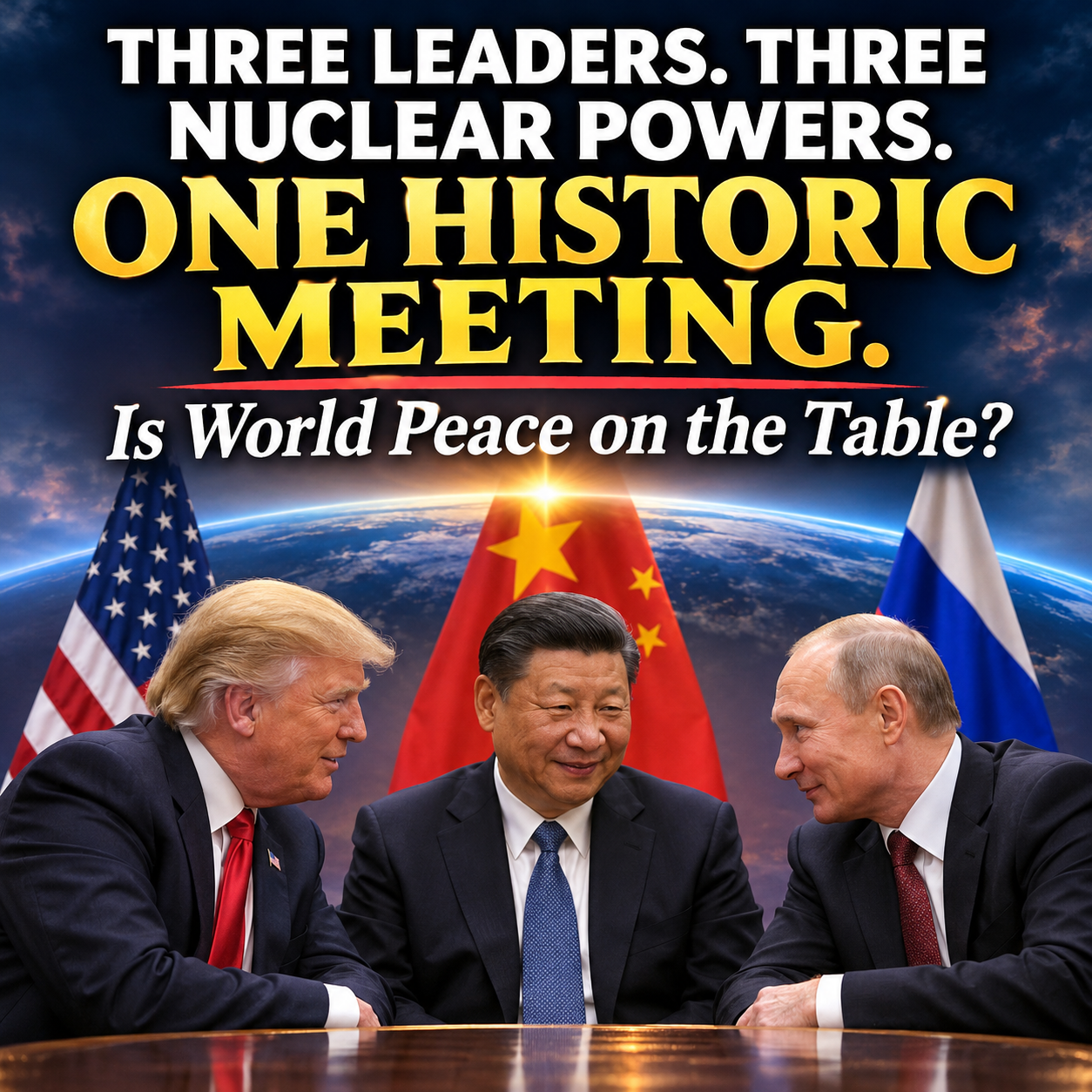
When the two leaders met at the airport early this morning, Xi had just finished meeting with Russian President Putin. Tomorrow, the three leaders will confer together. If you’re an American, this might be news to you, and you might not know what to make of it. From our coverage, it sounds like just another Trump meeting.
It isn’t. This is historic, and everyone except New York Times readers knows it. The AP euphemistically called it “unprecedented.”
🔥 Get this: the leaders of China, Russia, and the United States have never held an in-person meeting together. When I say ‘never,’ I don’t just mean since Trump became president. I mean never never. Never ever. That’s not a scheduling accident.
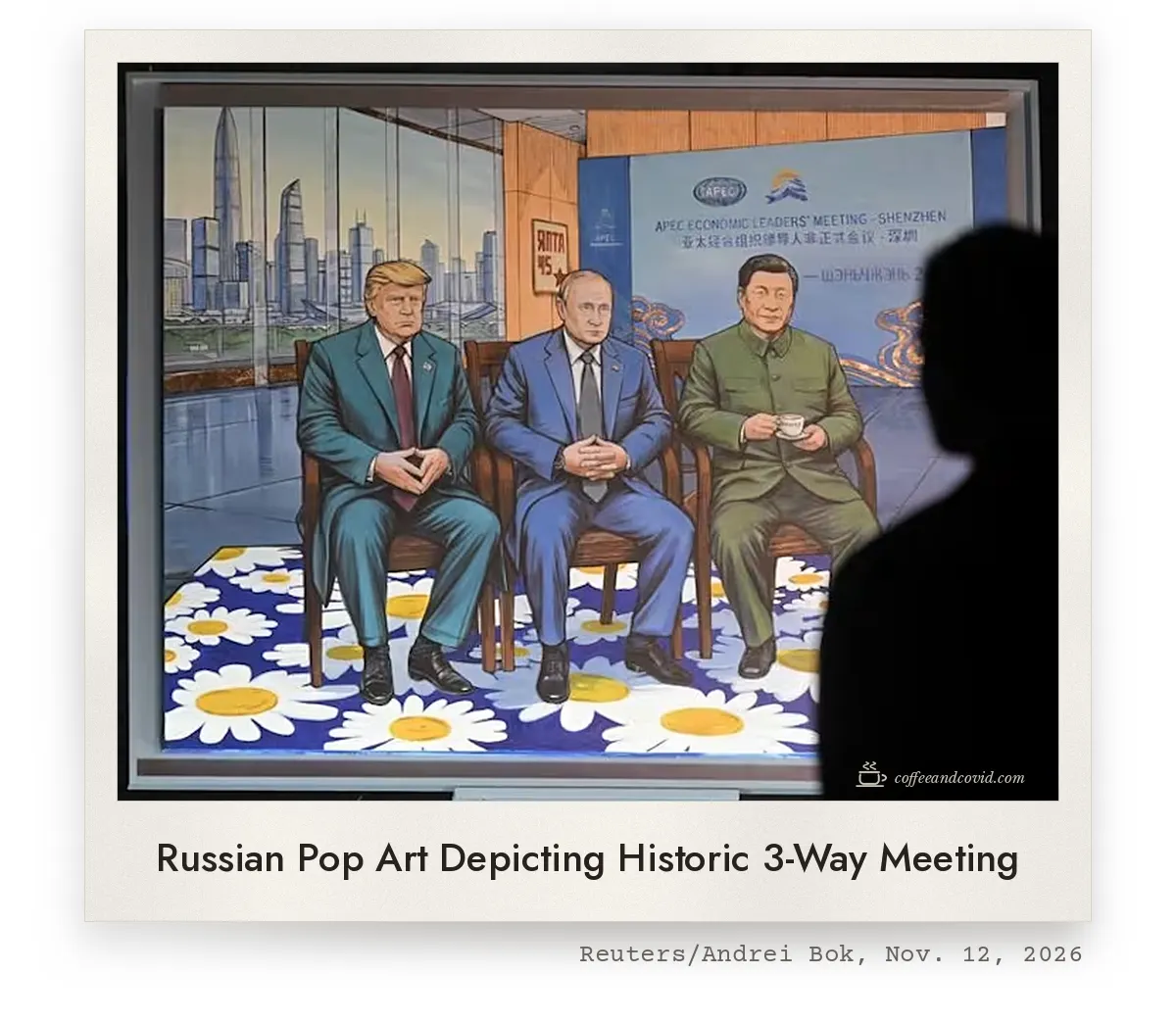
It is so significant that some Russian pop artists are painting posters about it.
Even World War II never managed to bring the trio together, even though the nations were ostensible allies. In 1943, Roosevelt met Chiang Kai-shek in Cairo, but Stalin stayed away, partly because the USSR wasn’t yet at war with Japan. At Yalta and Potsdam, Stalin met the Americans and the British, but China wasn’t at the table. In 1972, Nixon saw Mao in February and Brezhnev in May, which was the whole point of triangular diplomacy: play them off each other and never seat them together.
So it wasn’t any failure of diplomatic hospitality or a faux pas with the invitation envelopes. It was the core strategy of the globalists and neocons. They meant to keep Russia and China separated, aggravated with each other, and not bring them together. The neocons’ notion was that it would be easier to beat them separately than if the two countries ever got along with each other.
You couldn’t even imagine a more ambitious agenda.
🔥 China’s foreign ministry says the three will hold “in-depth exchanges on safeguarding world peace and promoting strategic stability in major-power relations,” calling it of “groundbreaking significance.” Yuri Ushakov, President Putin’s foreign-policy aide, said that “the significance and symbolism of this meeting can hardly be overestimated.”
Those comments were not hyperbolic. Normally, getting any group of high-visibility leaders together would take months or even years of wrangling over the location, the signaling, and even where the table settings go. This one only seems to have taken about a week. Maybe it’s because the three men like each other.

🔥 The Guardian reported that, when asked about expected topics, Trump listed denuclearization, the Iran war, economics, trade, and, sarcastically, “my favorite subject, Ukraine.” All three leaders (or their top officials) invoked World War II alliances. They are certainly not trying to downplay the meeting or set low expectations.
You’d be surprised, but not everyone likes the idea of a historic and unprecedented conference of the world’s three most powerful leaders discussing world peace. NBC reported Trump’s comments “sparked anxiety in places such as Ukraine, Iran and the Beijing-claimed island of Taiwan.”
The Europeans asked to come along. Trump said “no.” German Chancellor Friedrich Merz called it “completely unacceptable for third countries to discuss Ukraine’s fate without involving Ukraine itself.” He begged, “Please, no surprises.” Poland’s Sikorski criticized giving Putin a seat at all, and the quintessential whiner Zelensky muttered that Ukraine “doesn’t want Yalta 2, 3, 4.” Headline from WION:

Apart from American media, which is trying to frame this history-making meeting as merely a trade conference, the rest of the world is buzzing with guesses ranging from mild to wild.
Q folks’ excitement is off the charts. Back on April 8, 2018, Q dropped #1081. It quoted a reader comment: “Putin becomes our Ally. Xi becomes our Ally. Xi & Putin are also under attack by the deep state.” Q replied, “POTUS NEVER telegraphs his moves. Think logically.” The Q substacks think that tomorrow’s meeting confirms that “The Storm” has arrived, which is probably more meteorology than the facts support. But there you go.
My take is that Trump is on a clock. The lame duck is a window, and it closes on January 3, 2027, when the new Congress is sworn in. Anything needing a vote, whether sanctions relief, world peace, or a nuclear de-escalation deal, has about six working weeks, which includes Thanksgiving and Christmas. After that, any deal with Putin and Xi collides with Speaker Hakeem Jeffries, who will first need to consult Europe, Ukraine, and his feelings.
Whether any public developments follow or not, it does give the three men who control most of the world’s nuclear weapons an unprecedented chance to meet privately without electronics or eavesdroppers. That’s what really has everyone worried, especially the globalists and neocons, who wish to prevent the formation of a “multipolar world.”
For eighty years, the experts made sure these three chairs never sat at the same table. Tomorrow they do. Whatever comes out of that room, the seating chart alone just set a new benchmark. World peace only comes from conversations, not policy papers.
Blue tsunamis and software glitch-storms notwithstanding, we are living through a historic epoch. We should stop every once in a while to appreciate that.