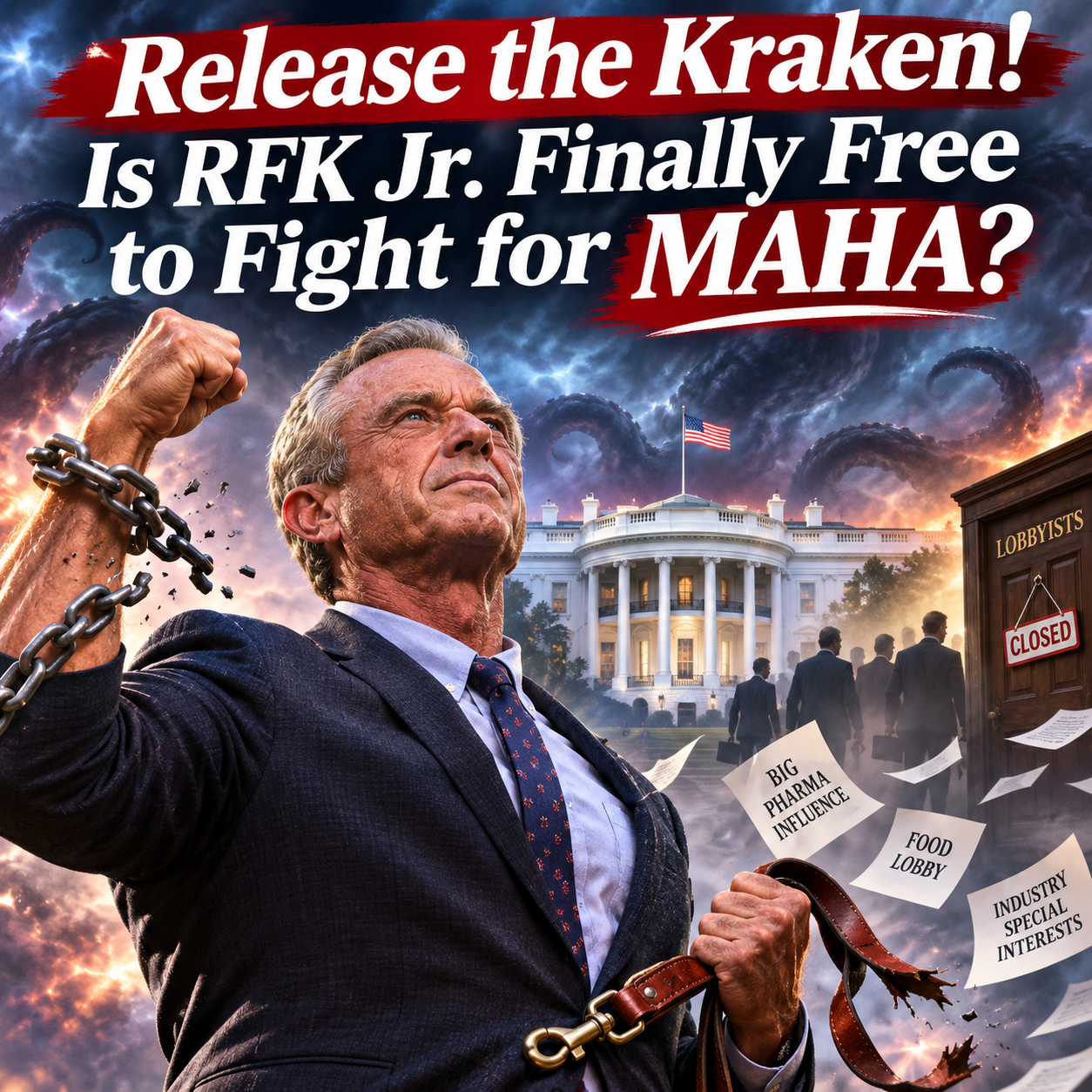
We are beginning to see what Kennedy’s Kraken looks like. Yesterday, the Hill reported, “White House staff to need prior approval to meet with lobbyists, under Stephen Miller memo.” New Chief of Staff Stephen Miller launched a memo banning unsanctioned lobbying meetings on White House grounds. He also gave Cabinet members —think Bobby Kennedy— authority to speak without close supervision. Welcome to the new boss, not the same as the old boss.

One of last week’s most damaging political dustups was Calley Means’ podcast with Joe Rogan. Calley is a MAHA darling and is upset about being pushed out of the Administration. He noisily resigned on October 22.
Right after the elections, he told Rogan that the MAHA agenda was stymied by lobbyists and suffocated by Chief of Staff Susie Wiles. He said Wiles sold out the MAHA agenda to industry donors “underneath Trump’s nose.” He also said she told him repeatedly, “We need money for the midterms, Calley.”
Calley called Wiles “the most powerful chief of staff in modern American history,” with a “stranglehold” on health policy. (Wiles has strongly denied all this and called Calley’s remarks “provably false.”) Here’s how CBS covered it on November 8th:

On X, Calley astonishingly compared Susie Wiles to some kind of mafia boss, saying without explanation that she “has the capacity to inflict physical harm.” Presumably he wasn’t suggesting an MMA-style Octagon fight or that he was worried about meeting the 69-year-old grandmother in a dark West Wing hallway.

How much this ugly public disagreement helped Democrats in the Blue Tsunami isn’t clear, but it certainly did not help. Regardless, the same night that Means’ episode was taped —two days after the elections— Wiles ran out of time.
CBS reported, “Her resignation” —HuffPo claimed that Trump fired her— “was tied to Republicans’ midterm defeats, according to three sources.” It added, “It is not clear at this time whether Calley Means’ public remarks factored into the president’s decision to expedite Wiles’ departure.” It is still not clear. But Calley’s comments couldn’t have helped.

There are other reasonable explanations for Wiles’ departure. She was treated for breast cancer this year, for instance, and Chief of Staff is a pretty stressful job. Separately, a midterm shellacking is a great time to shake up the top of the roster. But the timing was suggestive, since she quit (or got fired, or both) the same day as Calley’s interview.
🔥 Also recall that Democrats have been loudly complaining about Trump officials getting cozy with industry and personally profiting. They’ve been calling it a “culture of corruption,” which is deeply ironic, of course. How about the Biden Crime Family, Ukraine, Burisma, Hunter’s painting career, welfare fraud, learing centers, and all the rest? Never mind!
Sadly, some unfortunate Administration blunders have handed the Democrats a few talking points.
For instance, news broke last month of a leaked Signal text allegedly showing Kimberly Guilfoyle pressuring a wealthy Trump donor to pay for her $100,000 American Express bill. She resigned as Ambassador to Greece on October 13th. (Guilfoyle denies any wrongdoing, and the donor never made the alleged payment.) She’s also accused of helping broker deals for Greek businessmen and over-enjoying luxury travel perks. NBC reported that the State Department Inspector General is investigating her.

Maybe the Administration is moving quickly to defuse Democrats’ “culture of corruption” claims.
The White House pooh-pooh’d Calley’s comments about Wiles, but the results speak for themselves: Wiles is out, and Stephen Miller is in. Among other great things, Miller is an anti-lobbyist. This week, Politico reported an anonymous lobbyist who said, “He’s impossible to lobby, no one can do it, not even the people that you would think are closest.”
If Trump’s White House does have a culture of corruption, as Democrats claim, Miller was a strange choice. Maybe that was the point.
So perhaps it’s unsurprising that one of Miller’s first official memos banned White House staff from meeting with lobbyists at the White House without formal pre-approval. In other words, the revolving door has been shut, at least on the White House grounds. More accurately, it was more about sending a message than an outright ban, since, for instance, staff can still meet lobbyists over at Caribou Coffee, an infamous brokering site near the White House since the Obama era.
“No President in history has fought more relentlessly, selflessly or courageously for the American People than President Trump,” Miller wrote in his memo. “Following his example, White House staff are expected to dedicate their time unwaveringly to the working people of the nation.” A nicely put sentiment. Nobody, not even the DSA, can disagree with that.
🔥 This part of the Miller memo was the most well covered. Reining in industry lobbying is a solid start, and is welcome. But maybe the more significant move for medical freedom folks was the memo’s second part: “Each cabinet leader serves as the best leader and communicator for their individual Departments,” Miller wrote, “and this new position of Cabinet Relations will ensure our Cabinet is resourced and bolstered by the White House to deliver swift, critical, and lasting wins.”
That sounds promising, but was not super clear. However, two days ago, Fox quoted anonymous folks who provided more context. One said Wiles had held “a chokehold on nearly all the administration’s communications,” with “a lot of prescriptive directives.” The same official also said Wiles often told people, “I can’t control Trump. But I can control everything else.” She does look kind of scary.

Control of political messaging is necessary, and one can put a positive spin on Susie’s “control” quote, assuming she said it. But it’s a balance. It’s also possible to have too much control. Fox’s source explained that, when Miller wrote that Cabinet members are the best leaders and communicators for their individual Departments, it was “unleashing the Cabinet to be the captains of their own ship.” (Another Naval allegory.)
How this will play out precisely remains to be seen. But it hints at why Secretary Kennedy was so exuberant when Miller was picked for the job. After all, the two men are long-time allies. And do you remember all the press earlier this year about Kennedy being told to pipe down about vaccines before the midterms? As a reminder, here’s a WSJ headline from March:

Bloomberg joked that Kennedy had been put on a “low-risk messaging diet.” All in all, it sure sounded like muzzling. It caused a lot of criticism for the Secretary. Publicly, Kennedy denied being muzzled. However, other reports swore he’d privately admitted that White House political advisers did tell him to tone it down. Maybe he was muzzled about being muzzled.
And maybe the leash was chokingly tight. “It’s more of a recognition that you can’t possibly effectively micromanage this wide of an organization and that sometimes it might be better to trust and invest in a support system that elevates the people closest to the issues,” Fox’s source explained.
Connecting these dots, it seems abundantly clear that some messaging orders came down from Wiles’ office. And either way, Kennedy now seems to be off the choker chain. At least, Kennedy seems to think so. Politico:
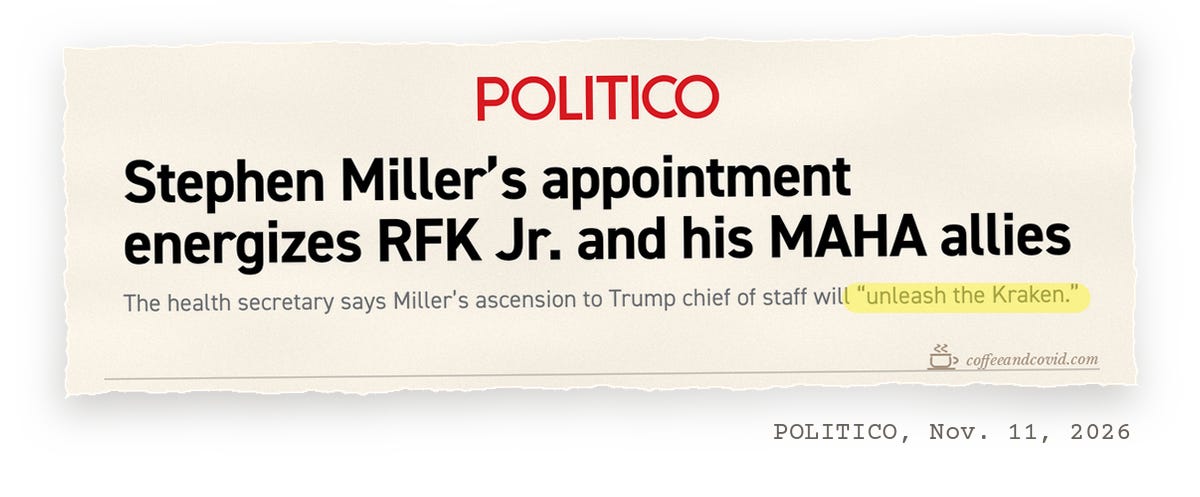
It is good news for MAHA. Kennedy needs to use his additional freedom responsibly, so he isn’t put back on the leash. At least it will be entertaining to watch it play out.
What do you think Secretary Kennedy should do first? Let me know in the comments.