If you think about it, there is possibly no single bigger Trump 2.0 story than the Epstein files. It dominated the news for most of last year. It came close to shattering the MAGA movement. I’ve written more about Epstein than any other topic outside of pandemics and vaccines. Then it seemed to stall out, as file folders closed and our attention shifted to a long list of Trump wins and Democrat shenanigans.
Epstein remains an open, seeping wound. There has been no closure. We know a lot more about how he operated, but we still don’t know for sure: how he died, who he worked for, where the money came from and went, who did it with him, how he got started, where all the secret video went, and why the financial genius couldn’t finish a sentence without an egregious typo. In what can only be described as sensational timing, on Tuesday, Politico reported, “House Oversight Republicans release final report on Epstein investigation.”

It’s pretty obvious the report arrived just before Republicans turn over Congress. Democrats, of course, are not accepting any “final” report and are promising to have the last word. “We will not allow the President and his allies to dismiss this investigation,” said Representative Robert Garcia (D-CA), the leading Democrat on the Oversight Committee.
The main headline is that the report, now released to the public, cleared President Trump. To a point, that is. Of the documents the Committee did receive, and according to the 17 witnesses the DOJ interviewed —including Epstein celebrities like Bill Clinton and the DOJ prosecutor who gave the billionaire his sweetheart deal in Florida— no evidence has appeared linking the President to Epstein.
But there is undeniable evidence that after 2004, Epstein and Trump did not get along, which is putting it mildly. Trump even helped victims and police make cases against the International Man of Mystery, while Epstein was trying to undermine Trump behind the scenes, especially after the colorful New York real estate developer announced his presidential candidacy. They were going after each other, in other words.
Politically, it might have been more helpful had the Committee released its report before the midterms. I assume there’s a good reason for waiting. Probably. Maybe it just wasn’t ready. Or maybe it’s because the report criticized the DOJ for withholding documents. It complained, “Despite extraordinary efforts undertaken by DOJ staff to expedite the release of EFTA records, questions remain as to whether the DOJ has released all relevant documents.”
The report more harshly criticized Obama’s DOJ for the 2009 slap-on-the-wrist non-prosecution deal gifted to Epstein and all his associates, which the report described in scornful detail and concluded it had “undoubtedly allowed Epstein’s heinous acts to continue for years without recourse.” So.
🔥 The 137-page report is a salacious read. Anyone with more than a passing interest in the Epstein Files scandal will find it moderately fascinating. I said “moderately fascinating” because the report offered very little that was new. It offered no closure. It even admitted, in spongy euphemistic language, that it could not “dispel certain theories” about Epstein’s suicide. It did not describe the “certain theories” that it was unable to definitively dispel.

Do not hold your breath waiting for definitive answers.
Obviously, in 137 pages, it covered a lot of ground. But neither the report nor the media’s unenthusiastic articles focused on the main issues of where the money came from, where it went, and most of all, what Epstein’s ties to intelligence were. It said the billionaire procurer’s links to intelligence agencies “remain unproven,” but apparently only checked by asking Epstein’s friends and associates whether he was a spy. The words “CIA,” “ODNI” (the Office of the Director of National Intelligence), “NSA,” and Mossad never appear in the report.
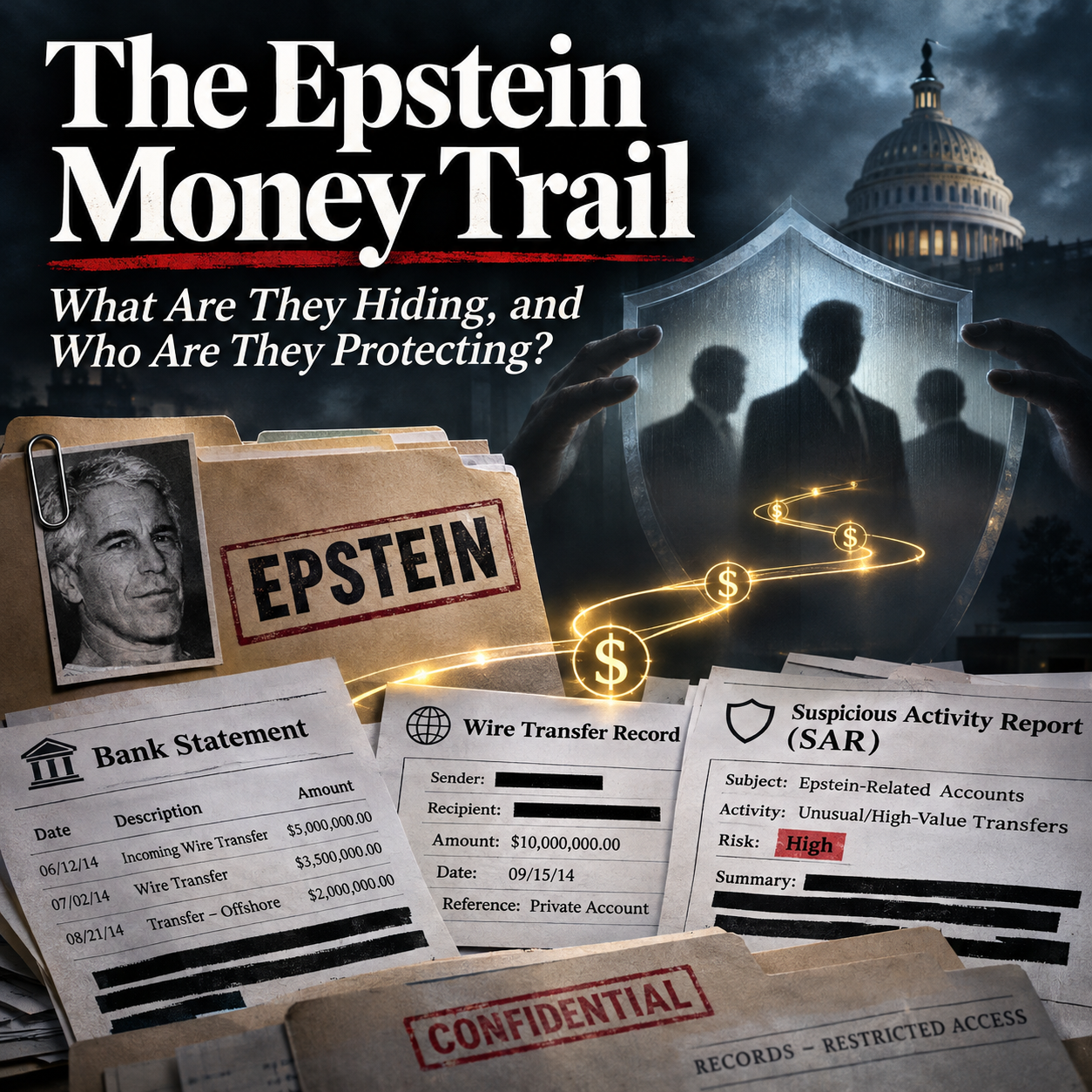
As to Epstein’s finances, much was said. But little was new, and none was helpful. It reported that four billionaires paid him hundreds of millions for ‘tax advice,’ expressed appropriate skepticism, and left it there. The DOJ has not released Epstein’s bank statements, which is probably the single biggest red flag in the flag parade. Nor has it released the many “suspicious activity reports” (SARs) filed about Epstein by various banks over the years. The bank statements and SARs are the single most important evidence that remains AWOL. And nobody’s even acting outraged about it— not even Democrats.
That might be a trifle harsh. Nobody besides Ghislaine was arrested or even charged, but there have been plenty of professional casualties. One of the few bits of novel information in the report made waves in Florida. The report explicitly accused another Democrat —a former Miami mayor— and a celebrity hairdresser of trafficking women with Epstein. It reminded us of the colorful detail that Epstein and his many good friends used code words for trafficked women— in the names of Disney Princesses, which probably says more about Disney than the mega-corporation would like to admit.
🔥 The Epstein scandal is the most investigated sex-trafficking ring in history, and it still has exactly one convicted trafficker and zero convicted clients. Weird! To be fair, prosecutors require evidence, not theories, and there’s not much hard evidence around. Well, apart from emails showing high-level JPMorgan Chase bankers referring to young women by Disney Princess code names while chatty merrily with a convicted trafficker. Whether that’s enough to get a conviction, I could not say.
But bank statements could provide plenty of potentially actionable evidence. And the Committee did get some bank statements— but not from DOJ. From the banks, via subpoena. It said it “reviewed financial records” showing millions of dollars wired to accounts in Russia, Ukraine, and Eastern Europe that several banks had flagged as suspicious. It noted without comment that most of JPMorgan’s flags came only after Epstein’s 2019 arrest.
It was a Democrat, Senator Ron Wyden (D-OR), who tried to get the SARs from Treasury. But he was ultimately forced to give up after facing insurmountable stonewalling. (Republicans were no help. In March, Senate Republicans blocked Wyden’s bill to force Treasury to turn them over.) Wyden’s staff was invited into Treasury to ‘inspect’ some of the SARs. At least $1.5 billion in suspicious transactions turned up in, just the parts they saw, which Wyden called “inexplicably high” given what’s known of Epstein’s income. This was an understatement.

This seems like a good place to remind readers that Epstein was not a licensed tax attorney, a CPA, an active broker, or even a garden-variety certified financial planner. He didn’t even run a Liberty Tax franchise. Yet his fortune supposedly came from his innate brilliance as a tax consultant to billionaires like Leon Black. He never finished college. A truly self-made man! Doing the work that normally requires floors of tall-building professionals at Deloitte. From his home office. But never mind.
🔥 It seems inarguable that, if the DOJ were really investigating Epstein all the way to the bottom, it would have flyspecked every single bank statement from his dizzying array of shell companies, overseas interests, island accounts, fake genetic research firms, and faux charities. Logic says it almost certainly did. Those documents must be somewhere in the withheld tranches. (DOJ legitimately claims that some documents are sealed by court orders and grand jury rules, and, more sinisterly, by claims of national security.)
Payments leave permanent records that witness testimony can’t match. Bank statements don’t have memory lapses. They answer questions that human witnesses dodge: who paid Epstein, who he paid, exactly how much, and precisely when. Wire transfers don’t forget dates. They’d show payments to recruiters, politicians, and “friends,” travel and payouts to the girls, and where the money came from before Epstein hooked his first big client, Victoria’s Secret billionaire Les Wexner. Similarly, the SARs tell their own tales and would, at minimum, be a great place to start digging.

Now let’s connect a few Epstein dots in light of recent developments.
🔥 The first dot is the biggest one: Democrats are now saying they will demand the bank statements and SARs, after all. Till now, Ron Wyden has been a lonely warrior. He has been pushing for bank records for four years and has mostly been ignored, including by his own party and even the “No Kings” brigades, who’ve made a cottage industry out of Trump/Epstein t-shirts.
The Democrats’ incoming House Oversight Chair, Robert Garcia (D-CA), says he wants Epstein hearings and a special counsel, but has also mentioned Treasury’s files. That money trail runs through Wall Street and big donors on both sides, and following the money puts everyone’s fundraisers at risk. Not to mention tilting towards whatever the intelligence agencies might prefer stay hidden.
But will they do it? Are Democrats willing to expose more of their own to get Republicans? We’ll come back to this.
Next, there’s the sunk-cost leverage. Let’s explore a hypothetical. Assume the Epstein conspiracy maximalist position is true. In short, that ‘Epstein the tax advisor’ was a complete fiction, a creature of intelligence from day one, manufactured by the three letter agencies and Mossad to create a worldwide blackmail-honeypot network because powerful elites and elected officials are out-of-control sex addicts who can’t keep it in their pants (even the women).
None of the millions of pages of evidence the public has seen to date has ruled out the maximalist conspiracy theory. To the contrary, all the circumstantial evidence points straight in its direction. You could even say it is currently the most elegant explanation.

If the blackmail theory is true, to any degree, it stands to reason that a global blackmail network created through decades of clandestine effort by investing a vast Solomonic fortune would remain incredibly valuable even after Epstein’s death. No agency worth its salt would surrender that intelligence asset without a fight. Setting aside the unsettling question of whether agencies should pay open-minded girls to have sex with targets, there’s still an argument they’d continue to have a legitimate duty to protect the network once it had been built.
If this honeypot influence network does exist, burning it would be a massive catastrophe, a Hindenburg-level intelligence disaster, and would probably ruin dozens of political careers on both sides of the aisle. So, prying any more information out at this point would need an incentive more powerful than protecting an incredibly valuable global blackmail network.
You asked for a miracle? Behold the Democrat blue wave.
🔥 Could the House Epstein Report story be the real buried lede for the midterms? Now I’ll break my normal rule and offer a wild theory you’ve probably never heard. You know that the Epstein story runs straight through Trump’s first term. His DOJ arrested Epstein after decades of official disinterest from every previous Democrat or Republican administration.
Here’s the first and most mind-blowing question. What if everything is really about Epstein? By everything, I mean two impeachments, an election stolen via a global pandemic, criminal charges, lawfare, and all the rest. And now, a blue wave.
I don’t have time this morning, but here’s the main thread: the timeline is eye-wateringly suggestive. Trump’s DOJ nabbed Epstein on July 6, 2019. He died (allegedly) in federal lockup on August 10th. Two days later, on August 12th, Democrats filed their flimsy Ukraine whistleblower complaint and launched Impeachment 1.0. It was led by Adam Schiff, Chairman of the House Intelligence Committee. Was it deep state panic?
What if the deep state wasn’t actually afraid of what Trump would do to the country? What if the deep state was most afraid of what he’d do to the network? If Trump went after Epstein, he would —at least arguably— be threatening a real U.S. national security interest: the ultra-classified, global Epstein blackmail network. Think about that.
If this is even partially true, accepting the barest part of the “Epstein as spy” theory, the agencies would have a legitimate (seeming) motive to defend themselves. In that version, they wouldn’t need to be corrupt or treasonous to oppose Trump. They’d only need to believe that he endangered a critical intelligence asset protecting American interests at home and abroad. In their own eyes, at least.

This would explain much.
🔥 In 2016, Trump was a known enemy of Epstein. Epstein knew it, and his emails to reporters show it. He all but admitted Trump was one of the few men he couldn’t reliably collect. Trump was also closely allied with Kash Patel, a known Epstein conspiracy theorist. So Mueller and crew could have had a defensible reason to fabricate Russiagate and Crossfire Hurricane, well before the billionaire’s arrest. (I know, it’s a lot. As I said, I can’t flesh it all out right now. At least trust me that I can make a compelling case based on all the circumstantial evidence.)
Critics will rightly point out the lack of direct evidence. But demanding direct evidence of an ultra-classified program is pointless. Here’s the thing. Unlike many or even most popular conspiracy theories, this one is not unfalsifiable. The evidence is —or is not— in the bank statements and Treasury SARs.
Just for a second, even though today is CISA Secure Election Day, set aside the midterm legitimacy issues. Consider how Democrat control of Congress flips the mirror on the first two years of the Epstein investigations. If the Republicans did selectively leak information damaging only to Democrat donors, officials, and allies, then it is probably payback time.
There are some curious clues. In January, Ron Wyden will become the Senate Finance Chair, with oversight authority and subpoena power over the Treasury Department, which is holding back all the SARs that he’s been trying to get.

About three weeks ago, on October 15th, Elizabeth “Eagle Nose” Warren and Robert Garcia introduced the Epstein Wall Street Records Act, with Thomas Massie as its lone Republican cosponsor. It would force the Fed, FDIC, OCC, and SEC to release their Epstein supervisory files and investigate banks and executives. Headline from CNBC, October 15:

Trump might sign it. After all, he complained but signed the first Epstein Disclosure bill after it passed the House 427-1 and cleared the Senate without objection.
He cannot afford to sign it eagerly. He must remain reluctant. If President Trump’s real goal is to burn down the Epstein network, he faces serious constraints. Not just from the deep state. He cannot burn Republican donors and officials in the process. If anyone even suspected he might do that, it would be game over. The Republicans stand in the gap between Trump and impeachment.
Thus, and ironically, only Democrats can do it.
🔥 Are they sufficiently enraged about their own Epstein treatment to launch mutually assured destruction? Would they really go all-in on Epstein, even though they ran on “affordability”? Consider yesterday’s Politico headline:

So another unexpected miracle of the midterm disaster is that it will revive the moribund Epstein story. Democrats are itching to deliver a new round of disclosure, even though their reason is that they are trying to embarrass Trump, expose Republicans in the Epstein files, and cure a case of political constipation that doctors will still be talking about in the break room twenty years from now.
I’m not looking forward to much else that’s coming down the pike. But this is good. In whatever way we get more Epstein transparency, it is what the country, nay, the world needs. This episode begs for closure. Best of all, because it would come through Democrats, their base would believe what it had long written off as a MAGA/Q conspiracy.
More Epstein sunlight shouldn’t be controversial. And it probably won’t be. Not in public, anyway. Remember— the last major bipartisan accomplishment was the Epstein disclosure files bill. We probably underestimated its significance at the time.
Never say we can’t agree with Democrats. The Epstein story isn’t even close to over.