
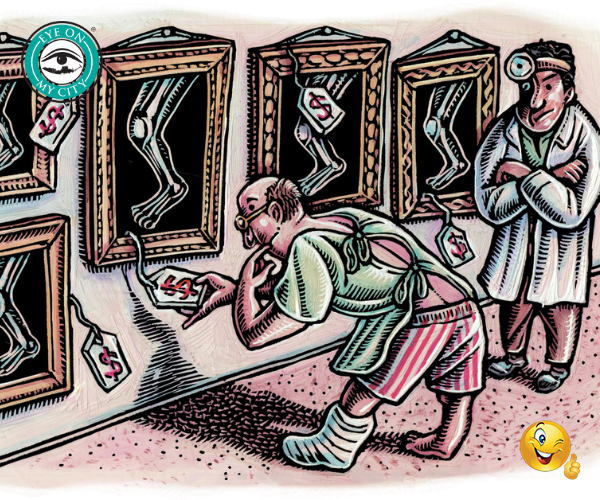
Imagine that you go to your favorite restaurant with two other couples. The first thing you notice is that the prices have been removed from the menu. You asked the waiter where the prices are. The waiter reassures you, “Don’t worry, we will bill you in about a month for the meal.”
You each have the same appetizer, entree, dessert, and wine with your meal. One month later, you received the bill for $7,532! You are shocked as you’ve never spent more than $200 at this restaurant. You call your friends and find out they are in a diner’s club that gives them a discount on their meals. One couple paid $5,000, and the other paid $2,500.
You are shocked that three couples would have three different bills for the same meal at the same restaurant. Precisely what happens in healthcare every day, and we are supposed to sit back and accept it.
U.S. Sen. Rick Scott of Florida has had enough, and he has come up with a new plan to fix the Affordable Care Act, also known as Obamacare. Scott’s bill is called the More Affordable Care Act.
A few basic concepts in this bill differ from the current law. The most significant change is that the subsidies will flow to individuals through health savings accounts rather than to insurance companies.
The subsidies can be used not only to pay medical expenses but also to pay insurance premiums.
Currently, health savings accounts cannot be used to pay insurance premiums. This will allow patients to choose the health plan that suits their needs.
The plan will also allow patients to purchase healthcare policies across state lines. Under the current Obamacare rules, we aren’t allowed to buy health plans across state lines, thereby limiting our choices. Scott’s plan would preserve protections for Americans with pre-existing conditions and expand our choices of insurance options.
His bill would put the patient in charge of his healthcare instead of the government.
The bill intends to turn patients into shoppers of medical services. There are two barriers to patient shopping for healthcare right now. The first one is that it’s very difficult to see the prices for medical services. It is rare for patients to know the cost of a medical service before receiving it. Most patients have no idea what their copay, coinsurance, or deductible will be for a procedure.
The second barrier to patient shopping for healthcare is that there’s usually no incentive provided under current insurance plans. Once a patient has met the deductible, he no longer asks the price of medical service, but only what their copay or coinsurance will be.
This leads to the current situation in which patients don’t shop for services, the services are costly, and in return, we face rising insurance costs each year.
In order to demonstrate the need and ease of patients shopping for their care, a hearing was chaired by Scott Oct. 22: “Modernizing Healthcare” This was a unique hearing because the government was discussing how to empower patients to save money, not how it was going to spend more money.
It was noted that 40% of all health services are shoppable, and currently, there are multiple prices for the same service provided at the exact location on the same day, all based on the insurance coverage.
The first speaker was Mark Cuban, co-founder of Cost-plus Drugs. He shared that 162 million people are on Amazon, and all Shark Tank businesses have no choice but to be on it due to its extensive network. He then reported that 270 million Americans receive their brand-name prescription drugs from the three largest pharmacy benefit managers (PBMs), which the largest health insurance companies own. PBMs are the drug supply middlemen that determine which drugs you can use and at what price.
Because of their enormous network, PBMs set the rules that drug manufacturers must follow. These rules require the manufacturers to pay large rebates to be included on the formulary or lists of approved drugs. If your drug isn’t on the formulary, the company won’t be able to sell it to the patients.
The PBMs also prevent the drug manufacturers from contracting with Cost-Plus Drugs.
This lack of competition leads us to pay over four times as much as other countries do for brand-name drugs.
Cost-Plus Drugs is able to supply customers with generic drugs as the PBMs don’t control that market. The good news is that 90% of all drugs are generic. Cost-Plus Drugs is entirely transparent and publishes all of its prices online. This empowers patients who want to compare the insurance price of their drugs, and oftentimes, the cash price is much lower.
The next speaker was Dr. Smith, a co-founder of the Surgery Center of Oklahoma, a leader in transparency in pricing. They publish all their prices online, and the prices are all-inclusive. They include the surgeon’s fees, anesthesia, and the facility fee. You have one price that you know before the surgery. The Surgery Center of Oklahoma can offer extremely low prices because it accepts cash payments only and does not accept insurance.
They have raised their prices only once since opening in 1997. Their prices are 1/6 to 1/10 of those at neighboring hospitals. They recently performed a tonsillectomy on a child for $3,875, and the parents were quoted a cost of $72,000 in a Dallas, Texas, hospital.
Half of their patients are from out of state or international. This works well for patients with a high deductible or for employers who have a self-funded plan. Employers with a self-funded plan pay the bills themselves and benefit from the Surgery Center of Oklahoma’s low prices.
The third speaker was Don Moulds, the chief health director of CALPERS. CALPERS is the largest municipal union in California, and it insures 1.5 million people. Because of the large number of insured patients, they can use reference pricing for common surgeries. Referenced pricing occurs when the payer sets the fee for a surgery, and hospitals that agree to those fees receive patients.
This use of referenced pricing has been expanded to 18 procedures and has saved CALPERS millions in claims.
Sen. Roger Marshall of Kansas, who is also a physician, discussed his “Price Tag Bill”. This bill would require the following:
- Public reporting of prices charged to various insurance plans, as well as the cash price charged by hospitals, ambulatory surgery centers, imaging centers, and clinical labs.
- Ensure that employers have access to their claims data, as this will provide transparency in pricing.
- Make sure that patients receive an itemized bill for every healthcare service.
All of these are excellent ideas and patients and employers must know what the prices are before the medical service is provided.
Scott’s hearing clearly revealed the power of patients shopping for their care, and the bills he and Marshall are sponsoring will ensure this becomes the new normal.
We can all agree that healthcare in America is too expensive, and we can’t continue with the current failed approach.
I hope there will be overwhelming and bipartisan support for these common-sense solutions.








One response to “It is time to go shopping for healthcare!”
Excellent article, Dr. O’Leary. I may be the first MACA adherent! More Affordable Care Act). Sen. Scott has made his mark on the Senate already, and all citizens should applaud his (and your) efforts to sink obamacare, which is and has always been an abomination. Kudos to you both!