
The conservative counter-revolution has breached its first legacy media fortress, and corporate journalism is reacting the only way it knows how: silence. No coverage. No editorials. No thoughtful reckonings. Just a blackout. So we dive into Status.News, which ran the quietly explosive headline, “The Dokoupil Doctrine.” The subhead was more explicit: the incoming CBS Evening News anchor’s public rejection of “academics and elites” is the clearest sign yet of where CBS is headed under new leadership.
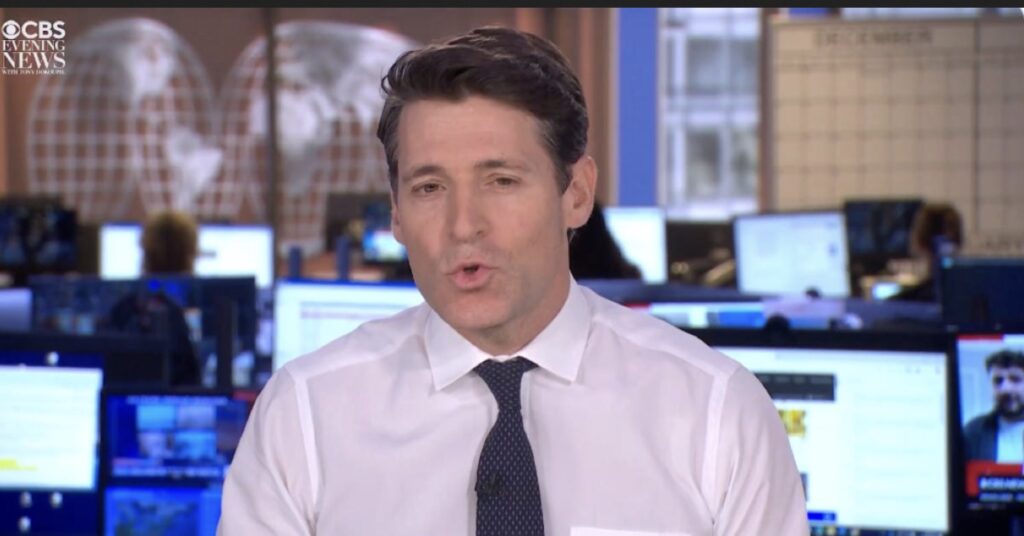
CLIP: CBS Evening News swears to earn back public trust (2:18).
CBS Evening News, the network’s flagship program, has a new anchor: Tony Doukopil. “Here’s my promise to you,” Tony said in his introductory broadcast. “You come first, not advertisers, not politicians, and not corporate interests, including the corporate owners of CBS.” He finally admitted the fact that should be the subject of every single news broadcast in America, every night: “people do not trust us like they used to,” Tony said, stating the obvious. “And it’s not just us—it’s all of legacy media.”
“On too many stories,” Tony explained, “the press has missed the story because we’ve taken the perspective of advocates and not the average American. Or, we’ve put too much weight on the analysis of academics and elites, and not enough on you.”
“The new CBS Evening News,” he said, “starts Monday at 6:30 p.m. ET on CBS.”
In another tweet, CBS said it had whittled its 38-page newsroom handbook down into five core values. The kind of values you’d think would go without saying— except, of course, they don’t anymore. Here they are:
- We work for you. You come first— not advertisers, politicians, or corporate interests (including the owners of CBS News).
- We report on the world as it is. The show will be honest and direct, using no weasel words, reporting facts as they emerge, updating when new information arises, and admitting mistakes.
- We respect you. The show believes Americans are smart and discerning, trusting viewers to make up their own minds and decisions for themselves, their families, and communities.
- We love America. The show makes no apologies for this, highlighting America’s foundational values of liberty, equality, and the rule of law as making it the “last best hope on Earth,” while aiming to contribute to discussions about the country’s present and future.
- We aim to earn your trust every night. What we can guarantee is that the tools will continue to change- but some things never will. One of those things is honest journalism.
In other words, America First. There you go.
Three months ago in October, Bari Weiss was named editor-in-chief of CBS News— the top editorial post at one of America’s oldest news institutions. Her appointment wasn’t the product of a traditional broadcast journalism career, but was the culmination of a trying and difficult path: after being hounded out of the New York Times in 2020 amid internal clashes over free speech and hyper-woke newsroom culture, Weiss founded her own media company, The Free Press, which became a subscription-based platform for critiques of what she saw as ideological conformity in elite media.
In October, to get Bari, CBS’s owner Paramount/Skydance acquired The Free Press in a multimillion-dollar deal, and installed Weiss at the helm of CBS News, placing her in charge of editorial direction and reporting priorities, even though her entire career was in print journalism, with no prior broadcast newsroom experience.
This breathtaking mea culpa and ideological realignment —in which CBS essentially admitted it has been dishonestly reporting the news— is almost certainly Bari’s work. Progressives should love Bari. She’s a classic liberal: secular, Jewish, culturally liberal, a democrat voter, anti-authoritarian, skeptical of corporate power, hostile to nationalism, and supports gay rights (she’s married to a woman). But she flunked the progressive purity test on one issue: free speech. Bari is reflexively opposed to all censorship, and has argued that conservative voices should get equal treatment as progressives, which painted a target right on her shoulders.
CBS is the first legacy platform to say the quiet part out loud. Trust in corporate media hasn’t merely declined—it has collapsed. In a recent Gallup survey, Republicans reported just 8% confidence in the media—an almost comically catastrophic number. In a sane industry, results this dire would trigger mass firings at the executive level, emergency board meetings, and the hiring of radical change agents to tear down whatever was left of the old model and start over.
Instead, most newsrooms have carried on as if nothing had happened, blaming misinformation, polarization, or us, the audience— anything but their own conduct. That CBS acknowledged the problem marks a genuine break from the whiteout of institutional denial that has long ruled corporate journalism.
Who knows whether it will last, or whether any of CBS’s competitors will be forced to follow. It’s far too early to tell. But the mere fact that one of the legacy networks at the core of national reporting is openly trying to rebuild trust with its audience signals something real has shifted. Institutions don’t confess failure until the old equilibrium is already broken. You can almost hear it now— the sudden whoosh of air as the pendulum, long stuck at one extreme, finally starts swinging back.