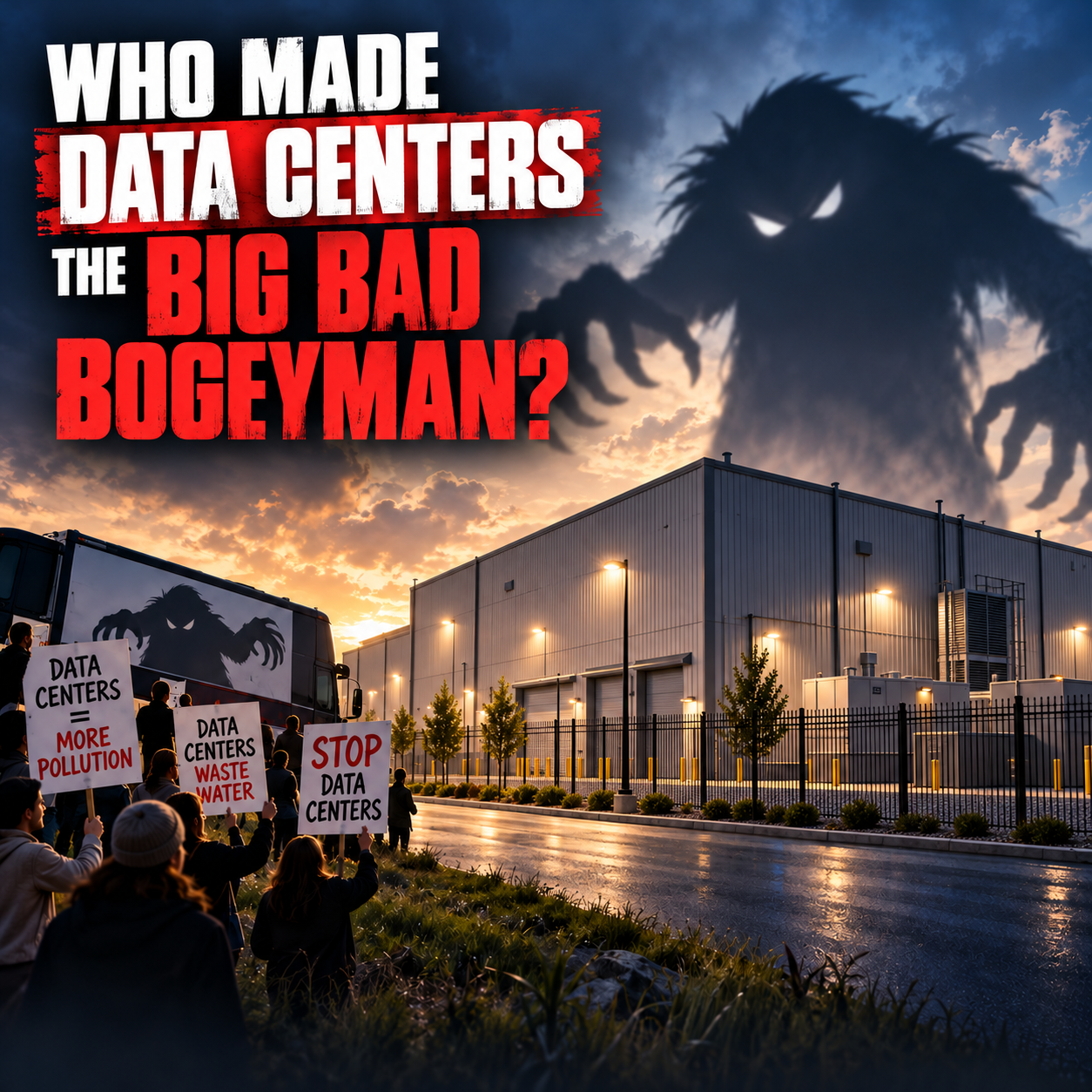
At what point did a building full of computers become America’s newest bogeyman?
I’ve watched the debate over data centers grow from legitimate questions about infrastructure into something resembling a national fear campaign.
Humans First, an organization opposing the rapid expansion of AI data centers, took its message on the road with a national bus tour. The message arrived in communities with warnings about what these facilities could mean for our future. But I have a few questions of my own.
Did we send buses across America warning communities about manufacturing plants? Petrochemical facilities? Distribution centers? Massive warehouses? Or the countless other infrastructure projects that have accompanied America’s changing economy?
All of these developments come with challenges. They consume land, require utilities, affect traffic, and sometimes raise environmental concerns. That’s precisely why we have zoning laws, permitting processes, environmental regulations, and elected local governments.
So why have data centers become the big, bad bogeyman of American development?
Is it because they’re connected to artificial intelligence? Is it because technology is changing faster than many of us can comprehend? Or is it because fears about surveillance, China, and a future police state make for a more dramatic message than discussing zoning and utility agreements?
I don’t dismiss legitimate questions about water, electricity, or infrastructure costs. Those are exactly the questions communities should be asking. But here’s what seems to be missing from this national conversation: local communities are capable of making decisions about their own futures.
If a developer wants to build a data center in Jacksonville, Nassau County or anywhere else, let that developer present a proposal. Let elected local officials examine the infrastructure requirements, financial commitments, environmental protections, and economic benefits. Let residents have their say in the public process.
Negotiate the deal. Protect taxpayers. Require the developer to cover the infrastructure costs attributable to the project. And if the project doesn’t make sense for the community, say no. If it does, stamp “approved” on it and get it built. That’s how local government is supposed to work.
Florida reinforced that principle in 2026 with SB 484, which preserves local land-use authority and adds requirements concerning large electricity users and water permits. The law provides tools for oversight; it doesn’t mean every project deserves approval or that every risk has disappeared.
And here’s something else that bothers me: data centers are infrastructure projects. They are not inherently political statements.
Yes, artificial intelligence raises serious questions about privacy, surveillance, and individual liberty. But those are questions about how technology is used and how government exercises its power. A data center doesn’t write surveillance laws or authorize government agencies to monitor citizens. Public officials make those decisions, and citizens should hold them accountable.
We’ve seen similarly dire messaging in other local debates, including arguments about Amendment 3 and property taxes. The underlying issues deserve examination. But citizens deserve a fair presentation of competing evidence, not simply worst-case scenarios.
And what about communities that welcomed data centers?
While national campaigns warn about data centers, perhaps we should also listen to communities that have actually lived with them. Their experience isn’t universally positive, but it offers real-world evidence rather than speculation.
In Quincy, Washington, a state data-center workgroup reported that the city’s property-tax levy rate fell about 70% from 2006 to 2025—from $3.12 to about $0.88 per $1,000 in assessed value. Data centers helped expand the tax base as the community invested in public buildings and infrastructure. A lower levy rate does not guarantee every property owner’s bill fell, but the change is significant.
In New Albany, Ohio, the city reports that data-center projects generated approximately $10 million in community development charges for tax year 2024, collected in 2025. City officials point to revenue supporting a new park, police expansion, and other public improvements. That’s a concrete result, not a hypothetical promise.
And in Mecklenburg County, Virginia, County Administrator Alex Gottschalk told WRAL in October 2026 that data centers account for roughly 45% of the county’s general fund. Local leaders cited the financial flexibility provided by that revenue.
Loudoun County, Virginia, offers an even larger example: the county reports $1.2 billion in real and personal property-tax revenue from data centers for fiscal year 2026, or approximately 39% of its overall budget. The scale also brings real land-use and infrastructure debates. That’s precisely why project-by-project scrutiny matters.
These aren’t guarantees of what will happen in Florida. Each state has different tax rules, utilities, incentives, and local conditions. But they show that well-managed data-center development can provide substantial public benefits—and that communities should be allowed to weigh the tradeoffs for themselves.
Maybe before another bus rolls into town warning everyone about the next technological bogeyman, we ought to hear from the communities that have actually built these facilities. Their experience deserves a seat at the table, too.
Let the community decide
I’m all for facts. I’m all for transparency. I’m all for holding developers accountable and protecting taxpayers. But I’m also for innovation, private investment, and allowing communities to determine what kind of economic development makes sense for them.
Not every data center is a good project. Not every proposed location is appropriate. And not every developer deserves approval. But neither should every project be treated as a threat simply because someone has turned it into a national cause.
One supporter of the opposition recently asked, ‘Florida’s Data Center Rush — When Is Enough, Enough?’
Well, here’s my answer:
Enough already. Stop the fear. We know what to do. Thank you.
Sources and further reading
Florida Senate, SB 484 summary: https://www.flsenate.gov/Committees/billsummaries/2026/html/484
Washington State Department of Revenue, Data Center Workgroup findings: https://www.dor.wa.gov/sites/default/files/2025-10/DataCenterWorkgroup_AdoptedFindings10_2025.pdf
City of New Albany, City Finances: https://datacenters.newalbanyohio.org/city-finances/
WRAL, Mecklenburg County investigation (Oct. 29, 2026): https://www.wral.com/news/investigates/data-center-virginia-tax-revenue-mecklenburg-county-neighbor-concerns-october-2026/
Loudoun County, The Loudoun Story: https://www.loudoun.gov/6408/Data-Centers-The-Loudoun-Story