
Axios ran the most incredibly encouraging article under the most depressing headline it could come up with: “Worker shortage could hurt AI construction boom, BlackRock warns.” Defying corporate media claims, and defying blackpill AI predictions, a new BlackRock economic analysis predicted massive job demand across the board:
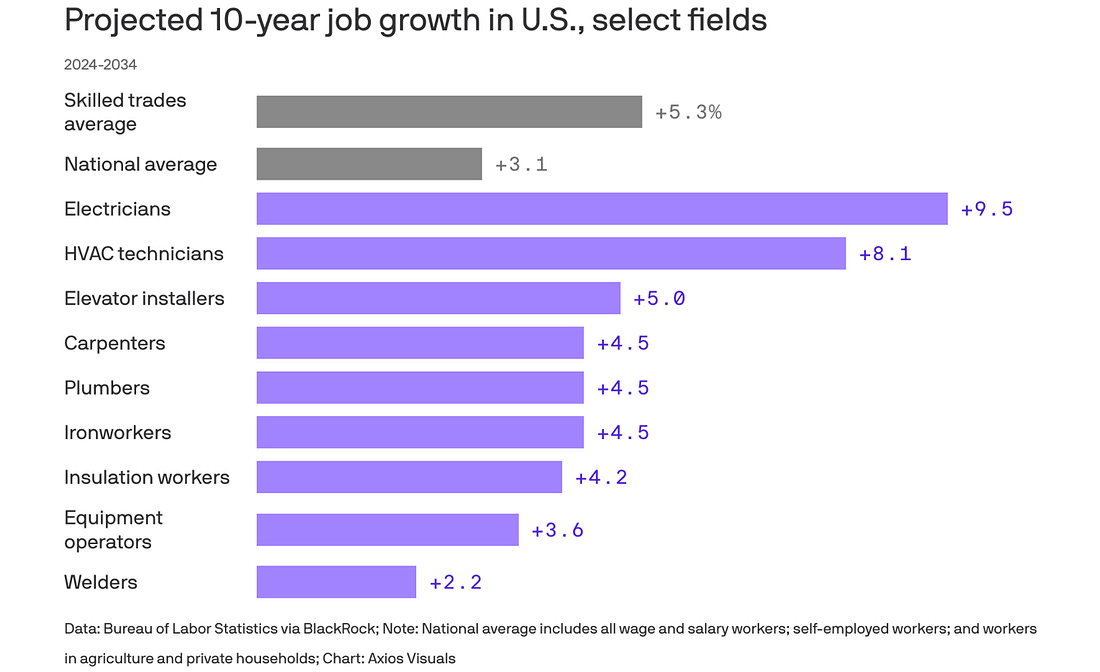
“The world,” Axios reported, “is entering what could be the greatest period of construction in human history.” The expected growth so surpasses economists’ expectations that they can’t believe it could even happen. “The U.S. may not have enough workers to make it happen, BlackRock warns in a new paper,” Axios said, reporting the story as an exclusive.
In fact, things are surging so fast that, since the paper was written, the numbers are now probably even better. “Even that estimate is probably understated,” BlackRock admitted, explaining that “the growth rate is likely higher now, given how quickly demand for AI-related infrastructure has accelerated since these estimates were produced in 2024.”
That’s a booming job market. Or maybe something beyond booming. Worker shortages are negative unemployment. We may be about to have the happy problem of an overheated economy.
🔥 There’s a ready answer to what appears to soon be the biggest worker shortage in history, and the inarguable solution is something that would have made you laugh out loud just two years ago: robots. Article from the Wall Street Journal, two weeks ago:
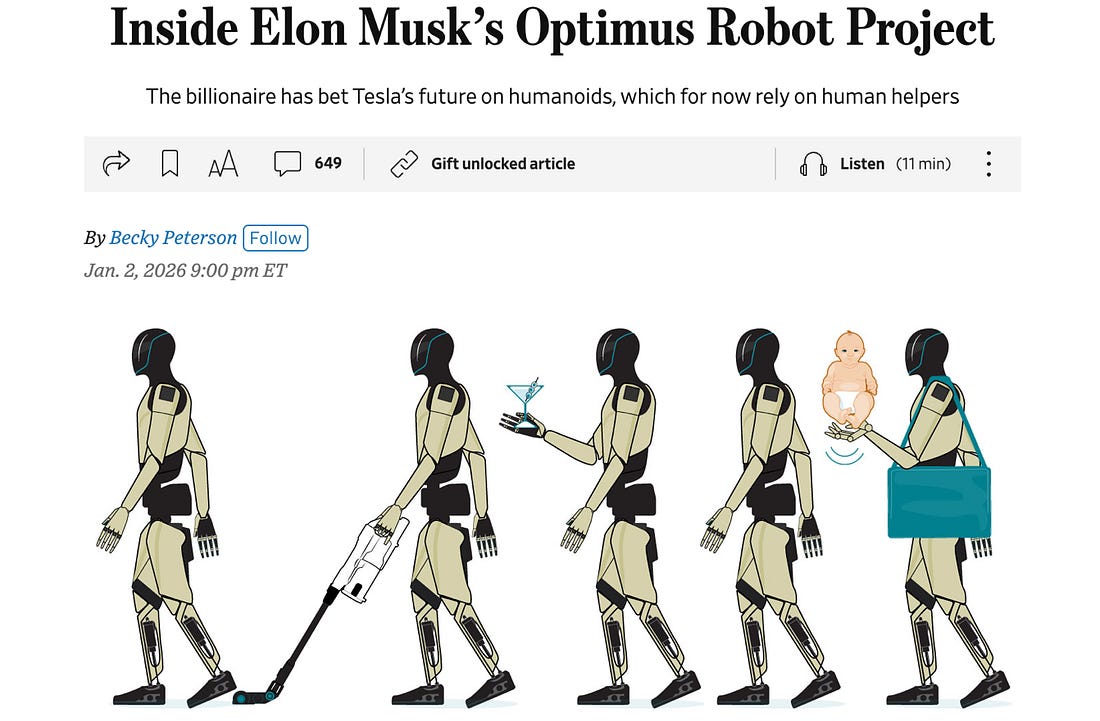
Elon Musk just negotiated a record-shattering $1 trillion pay package. To earn it, he has 10 years to make Tesla an $8.5 trillion company, including selling at least one million robots (among other product and financial goals). If he fails, he gets nothing.
So far, the videos of prototype robots are fascinating— but far from consumer-ready. Still, this week Elon Musk advised students, “it’s pointless; don’t go to medical school.” Why not? “In four years,” Musk said in a viral video clip, “there will probably be more Optimus robots that are great surgeons than there are all surgeons on Earth.” (He walked it back slightly, allowing students could still go to medical school for “social reasons.”)
I thought the space billionaire was about to discourage medical school because students are being taught that men can get pregnant. Or possibly because of the astronomical rates of deadly malpractice. But Musk was looking far beyond that particular problem. Frankly, I can’t see robots coming online that quickly; but Musk is much closer to it than I am. And he has a massive incentive.
What we’re watching is nothing less than the development of a fantastical near-term future where human workers are fully employed, with the slack taken up by AI-powered robotic helpers, whether humanoid, box-shaped, or resembling the robo-butler from The Jetsons.
Think about this very carefully: four years ago, none of this would have seemed possible; it would have been the sole province of science fiction. Now it’s actually happening, faster than real-time.