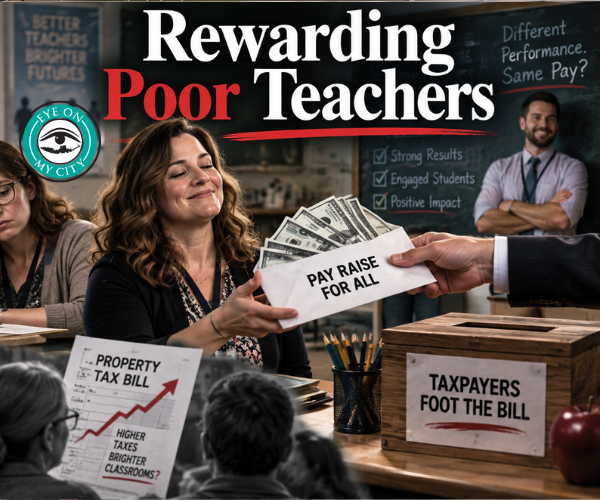
Jacksonville voters will decide in November whether they want to pay higher school taxes.
Some of the money would be used to pay teachers more money. Teachers, like firefighters, generally are viewed favorably by the public and that should produce some votes in favor of higher taxes.
But the justification is sketchy.
To begin with, there is the fact that per pupil spending on K-12 education in America has quadrupled since 1960. Most spending goes into salaries.
Florida has followed that national trend, rising from $3,300 to $12,500, adjusting for inflation.
Regarding pay specifically, supporters of higher taxes say Florida ranks at the bottom of 50 states in teacher pay.
True enough, but that fact overlooks the rest of the equation: what does the state get for its money?
People rarely complain when they are able to go to a store and buy an item that costs more at another store but is the same in quality and performance.
Historically and in recent years, Florida has performed exceptionally well in early-grade literacy and math on the National Assessment of Educational Progress (NAEP), commonly known as “The Nation’s Report Card.”
Unfortunately, there is a dip in results for eighth grade students in reading. Overall, however, Florida ranks in the middle tier of broad public school quality rankings.
In short, the state spends less yet gets average results. This suggests a lack of a correlation between spending on education and educational achievement, and there is little evidence to the contrary.
As for pay, Florida ranks near the top tiers for entry-level educators but falls to the absolute bottom for overall average pay.
Again, that must be compared to results.
But this is the most important part: The best evidence that compensation is too low is that people don’t apply for the job. There has been no reported lack of applicants for teaching positions. If that was the case, everyone might agree on the need for increased compensation.
The constant cry for higher teacher pay is driven by Democrats, and it is self-serving.
Larger paychecks for teachers produce greater revenue for teacher unions, and teacher unions are among the major donors to Democrat Party candidates.
With the government schools experiencing an exodus of students because of school choice, taxpayers should expect lower taxes, not higher.
It is likely that states like Florida, which produce more educational value, have better teachers. But not all of them. Despite what teacher union bosses say, some do better than others.
In the private sector, better teachers would be paid more. Not in government.
But, in the 1980s, Florida led other states by introducing a merit pay system, called the “master teacher program.”
Using a testing method developed in the University of South Florida, called the Florida Performance Measurement System (FPMS), teachers could qualify as master teachers and earn more.
FPMS grew out of process-product research on effective teaching (the kind of research linking specific, observable teacher behaviors to student achievement gains). It broke teaching down into measurable “domains” — planning, classroom management, and instructional organization — with concrete, low-inference indicators trained observers could code, like rule explication and monitoring, teacher “withitness,” and academic feedback. The idea was to replace subjective rating scales with something that was scientific and reproducible.
In addition to the test, a teacher needed a superior classroom performance evaluation and a superior score on a subject-area exam, plus four years of experience, and had to score at or above the 75th percentile on both the exam and the performance evaluation, with observations done by the principal and a second certified, state-trained observer.
Teacher unions were outraged at the suggestion that one teacher could do a better job than another teacher. They called it a “fad” and predicted it wouldn’t survive and worked hard to make their prediction come true.
It is entirely reasonable to say that when you increase the pay of all teachers, you are cheating the best and rewarding the worst. But logic was not in play.
By the end of the 1980s most state plans died because of the fierce opposition from the union bosses.
Still, the idea of paying for performance isn’t dead and it is possible some will decline to vote for higher taxes until a fair system of paying government schoolteachers is put into place.