When City Hall holds a press conference to announce a major union contract, the optics are always triumphant. Elected leaders step behind the microphones, surrounded by labor representatives, celebrating double-digit wage increases and declaring a new era of respect for municipal workers.
It is a carefully staged political victory. But for thousands of rank-and-file city employees and Jacksonville taxpayers, that victory is an illusion.
While the administration calls itself a hero at the bargaining table, it quietly takes those raises right back on payday. For a municipal worker with a family, dependent healthcare premiums, high deductibles, and out-of-pocket maximums can easily surpass $10,000 to $18,000 a year. A worker might gain 16% on paper, but after surging health deductions, their net take-home check barely moves.
City Hall insists this cost burden is unavoidable — blaming private insurance companies and national inflation.
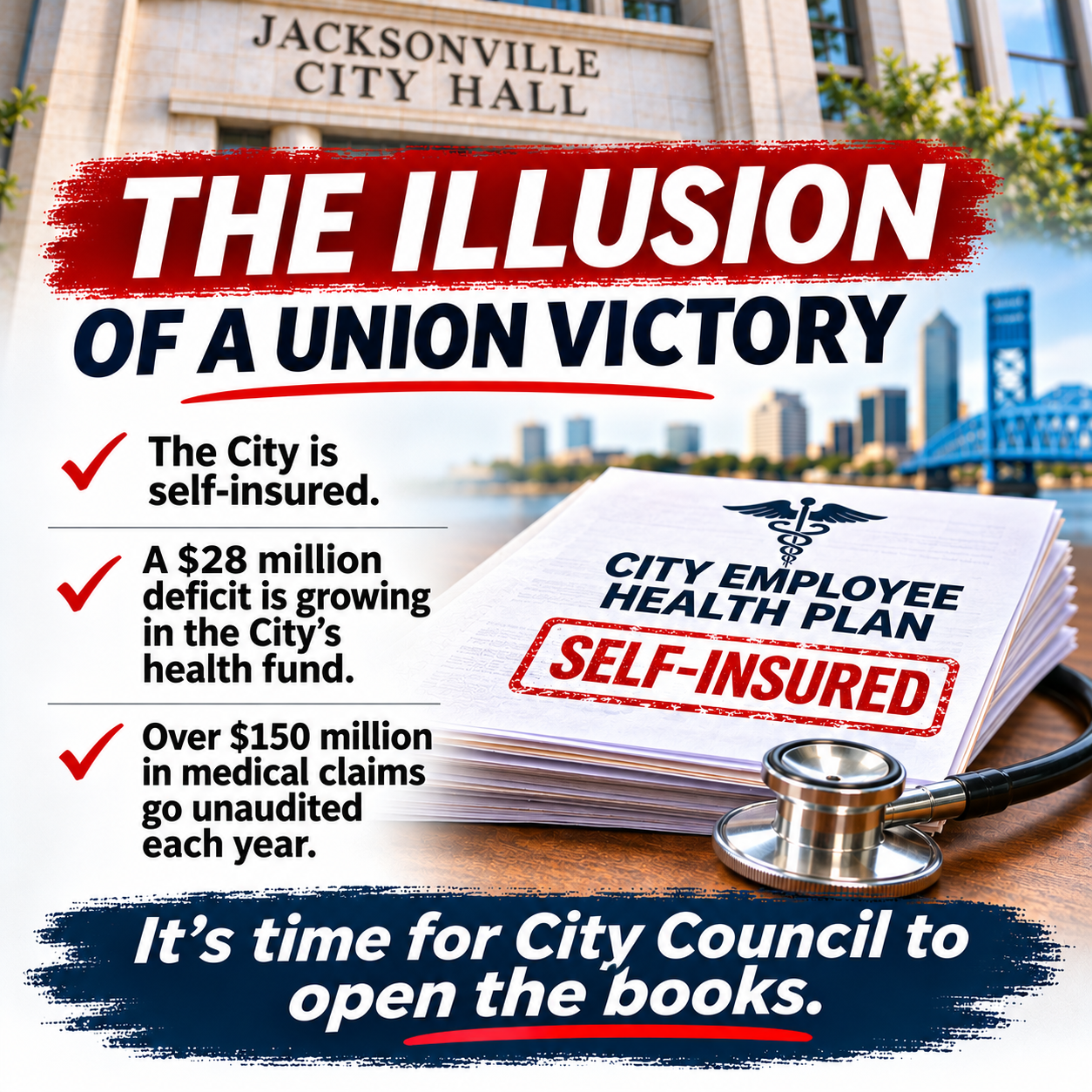
That explanation is fundamentally untrue. The City of Jacksonville doesn’t buy private insurance. The city is self-insured.
City dime paid for medical procedures, hospital admissions, and prescription drugs comes directly out of city funds — paid for by taxpayer dollars and employee paycheck deductions. Florida Blue is simply an administrator hired on a multi-million-dollar contract to process the paperwork.
Even more alarming, under the city’s only contract, Jacksonville carries a $1,000,000 individual stop-loss deductible. If a city employee, retiree, or dependent faces a severe clinical event, taxpayers pay the first million dollars entirely out of municipal cash reserves before reinsurance covers a penny. Across general employees and public safety personnel, that unaudited claims pipeline now bleeds over $150 million annually.
Council Auditor Phillip Peterson’s ledgers reveal the consequences: the City’s insurance fund (Fund 56201) has collapsed into an ongoing $28 million structural deficit. To keep the fund from running dry, City Council quietly approves tens of millions in stopgap bailouts — including an annual $23 million General Fund cash subsidy and emergency reserve transfers.
When a private company spends $150 million a year, it reviews the receipts. But at City Hall, the Office of General Counsel and benefits leadership enforces a contractual cap that restricts independent audits to an arbitrary 250 claims a year — shielding 99.9% of all municipal medical spending from outside forensic scrutiny.
This is where the failure lies. Under Article 7 of the City Charter, the Office of General Counsel holds a legal monopoly over the consolidated government. Its duty is to protect public funds, not commercial vendor arrangements. Yet when provided an uncompensated, zero-dollar statutory tender to audit the raw electronic claims data — identifying hospital markups and pharmacy spread pricing without spending a single taxpayer cent — the general counsel chose total silence, officially entering administrative default.
City Council Members — including senior members who sit on finance committees — routinely vote to transfer taxpayer millions into this fund while claiming the city lacks Citywide funding for neighborhood infrastructure, drainage, and basic services.
The math is simple: City Hall is burning over $100 million in public cash to backstop an unaudited healthcare pipeline, while civil servants shoulder thousand-dollar monthly deductions on a plan the city funds itself.
Celebrating a wage increase while ignoring a $28 million healthcare leak isn’t public leadership — it’s a distraction. It is time for City Council to stop the cash transfers, exercise its charter subpoena powers, and open the books.
Vincent Barone is a Duval County taxpayer, healthcare fiduciary specialist, and managing principal at Straight Talk with Vinny Inc. He resides in Jacksonville.