
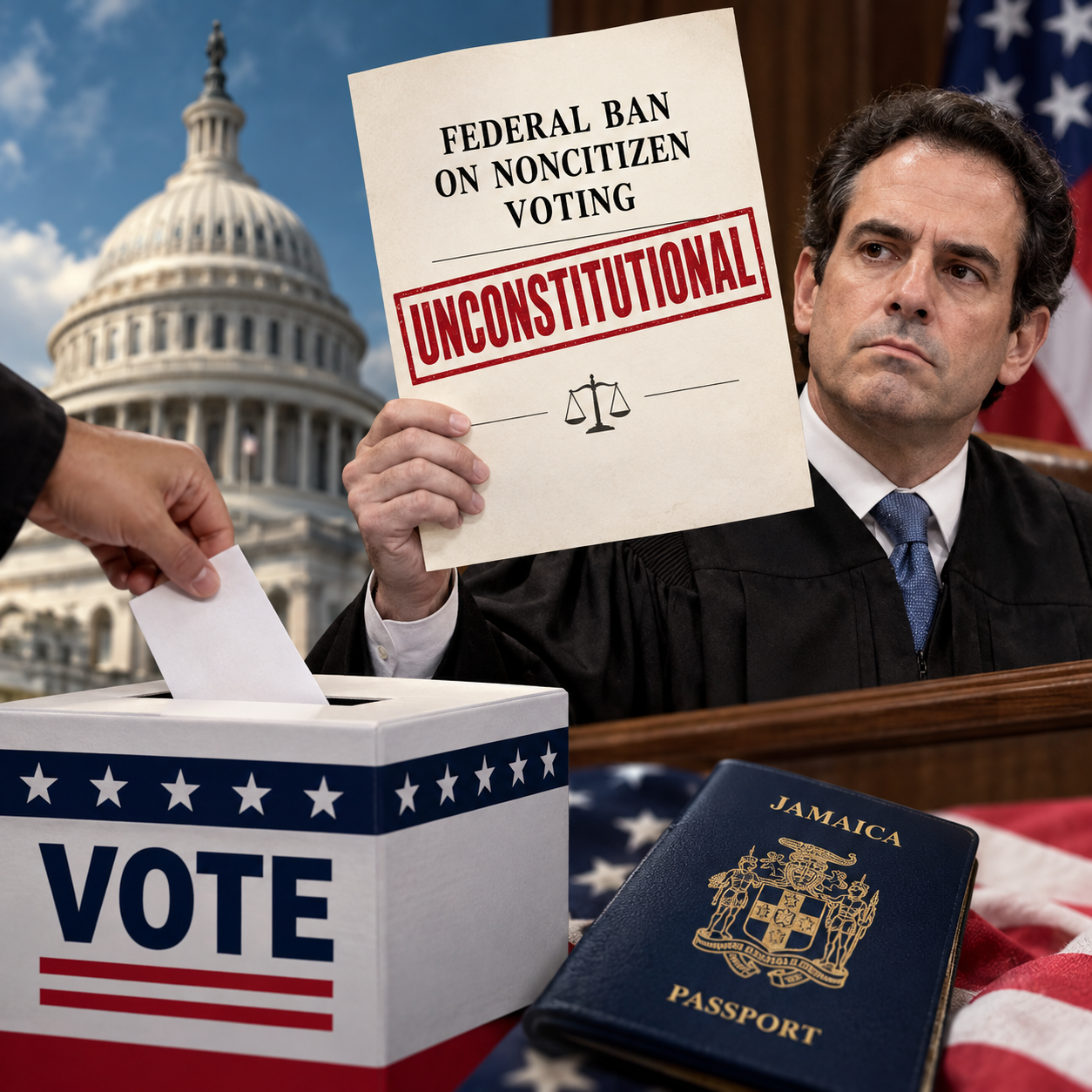
Not only does the thing that never happens keep happening, but now a Biden judge has said the thing that never happens must keep happening. On Friday, Florida Politics reported, “Miami Judge’s ruling on noncitizen voting case rejects federal ban as unconstitutional.” In other words, the judge ruled that federal law cannot ban non-citizens from voting in federal elections, which is a lot like telling parents they can’t make rules about who their kids can invite to sleep over.

It started when federal prosecutors charged a Jamaican woman who voted in the 2020 election (over the complaints of a small crowd of reporters standing by and screaming that non-citizens never vote in U.S. elections). Regardless, they charged Chelsea Michelle Ann Cox (yes, four names, and yes, her last name was probably difficult during middle school), under a Clinton-era federal law, which criminalized non-citizens voting in federal elections, a rule that until last week surprised exactly no one.
That was where the prosecutors blundered. They assumed the federal charges were enough. They should have also charged her under a similar Florida law, or let Florida prosecutors do it.
Last week, U.S. District Judge David Leibowitz (Biden appointee from March 2024) tossed her charge in a 31-page opinion that Courtwatch drily noted carries potentially far-reaching implications for similar cases. In April, Judge Leibowitz dismissed a lawsuit by Epstein victims for lack of jurisdiction (later successfully amended under a magistrate). Anyway, he’s back in the news.
The legal issue is thornier than you might think. And in a twist that will probably not surprise you, the parties were on opposite sides of the same argument earlier this year. Florida passed a state version of the SAVE Act that requires ID and proof of citizenship to vote; Democrats then argued that federal law governed voting requirements in federal elections. Whoops! Reverse.
Of course, in the Florida SAVE Act case, Republicans also swapped roles, successfully arguing (so far) that the Constitution lets states decide who can vote in state elections even if federal candidates are on the ballot. The Supreme Court has never ruled on it. The closest it came was a clunky 1970 case where it upheld a federal law lowering the minimum voting age to 18, preempting state laws requiring older minimum ages.
As Florida Politics was quick to point out, that ruling, which otherwise might have been helpful this week, was “without a majority agreeing on the constitutional basis for doing so.” Lawyers sometimes euphemistically call these types of cases “poorly reasoned.”
In other words, the Justices couldn’t even agree on what Constitutional provision allowed the federal government to override states’ voting ages in federal elections. And, also unhelpfully for present purposes, Oregon v. Mitchell was a thin, 5-4 decision, by that Court’s five liberal justices, who wrote separately. So it was another Roe v. Wade-style case where SCOTUS just did what it wanted. Ta-da.
Rubbing it in, Judge Leibowitz wrote that Ms. Cox’s charge would have been upheld if she’d been charged under Florida law. Whoops again. Fortunately, making this story much less apocalyptic than the headlines, Courtwatch opinions, and social media hot-takes suggest, all 50 states require U.S. citizenship to vote in state elections. (For now, at least.)
Prosecutors just need to charge people under state laws. That’s the whole story. Well, kind of.
The real reason this under reported story is making waves is that it once again proves that that thing media swears never happens —foreigners fraudulently voting in presidential elections— is happening so much that progressive judges are now interpreting those laws in 31-page opinions and striking down federal laws banning the thing that never happens. So.
In other words: this case proves that the previous absence of convictions, which media trumpets as evidence of absence of fraud, is really just because we never prioritized prosecuting fraudulent voters, or else this issue would have surfaced decades ago.
But that was not even close to being last week’s most interesting legal development.