Big Brother is watching, just as author Geroge Orwell predicted.
In Orwell’s novel 1984 government – or Big Brother — watched citizens via cameras located almost everywhere.
This is happening in 2026, and the most recent innovation causing concern is automated license plate readers (ALPRs), also known as Flock cameras after the manufacturer. They are among what is called a “connected public safety platform” that also includes video cameras, gunshot detection, and software tools.
You may not notice them, but they notice you.
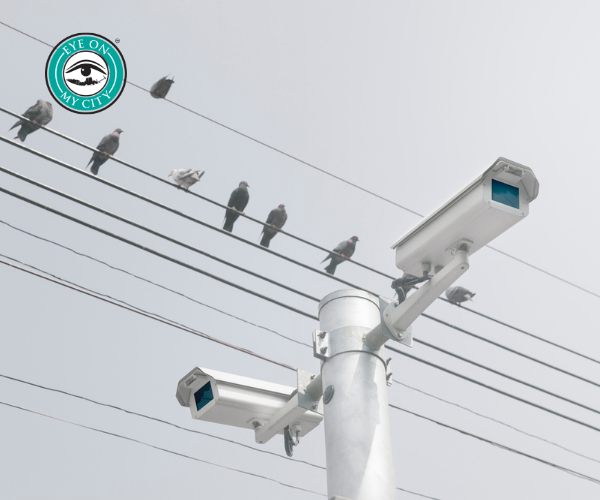
Typically, they are small devices mounted on poles near roads, intersections, neighborhood entrances, parking lots, or private properties.
Motion sensors set them off, and they read the license plate.
Then the ALPR creates a “vehicle fingerprint”: make, model, color, body type, and distinctive features such as bumper stickers, roof racks, dents, or damage.
The data is uploaded through a cellular connection to a cloud database.
Although they are similar to red-light cameras, they do not enforce traffic laws or issue tickets. Flock claims they focus on vehicles and do not use facial recognition.
While cops may use them, other customers include homeowners associations (HOAs), schools, businesses, and private companies.
Of course, supporters say if you haven’t done anything wrong you have nothing to fear.
But Americans know that when government says you have nothing to fear you have something to fear.
There are already documented cases of police officers allegedly using the system for non-investigative purposes, including a Central Florida cop accused of tracking his ex-wife 717 times through an ALPR.
Flock-watchers estimate there are 100,000–120,000 cameras nationwide, including more than 7,000 in Florida and more than 200 in the Jacksonville area, the highest single-city total in the state. They are widespread in Northeast Florida.
It isn’t easy to locate them because the locations are semi-secret, apparently even from Florida’s broad open records laws.
Critics, including privacy advocates and civil liberties groups, describe it as a form of mass surveillance: the cameras photograph virtually every passing vehicle, enabling detailed tracking of movements over time and distance without a warrant.
This, while your computer and phone are tracking your web browsing and movements also.
People have sued but most courts have upheld their use as constitutional under current usage, though cases remain ongoing, some lower-court rulings have gone the other way and related statutory/privacy issues have produced mixed outcomes. No U.S. Supreme Court decision has directly ruled on networked Flock-style systems but a 2026 U.S. Supreme Court ruling on geofence warrants (Chatrie v. United States) has been called potentially relevant to location-data aggregation arguments, even though it did not address ALPRs directly.
President Donald Trump said that Flock cameras are currently “under review”, which could mean he would weigh in soon.
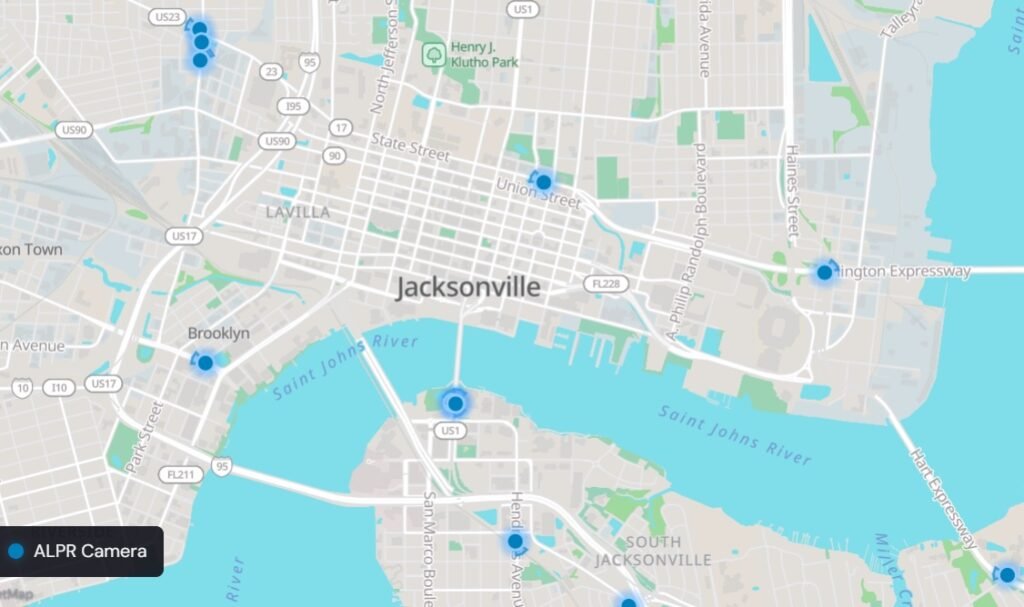
The art shows the location of cameras in downtown Jax, from a website that tracks them.