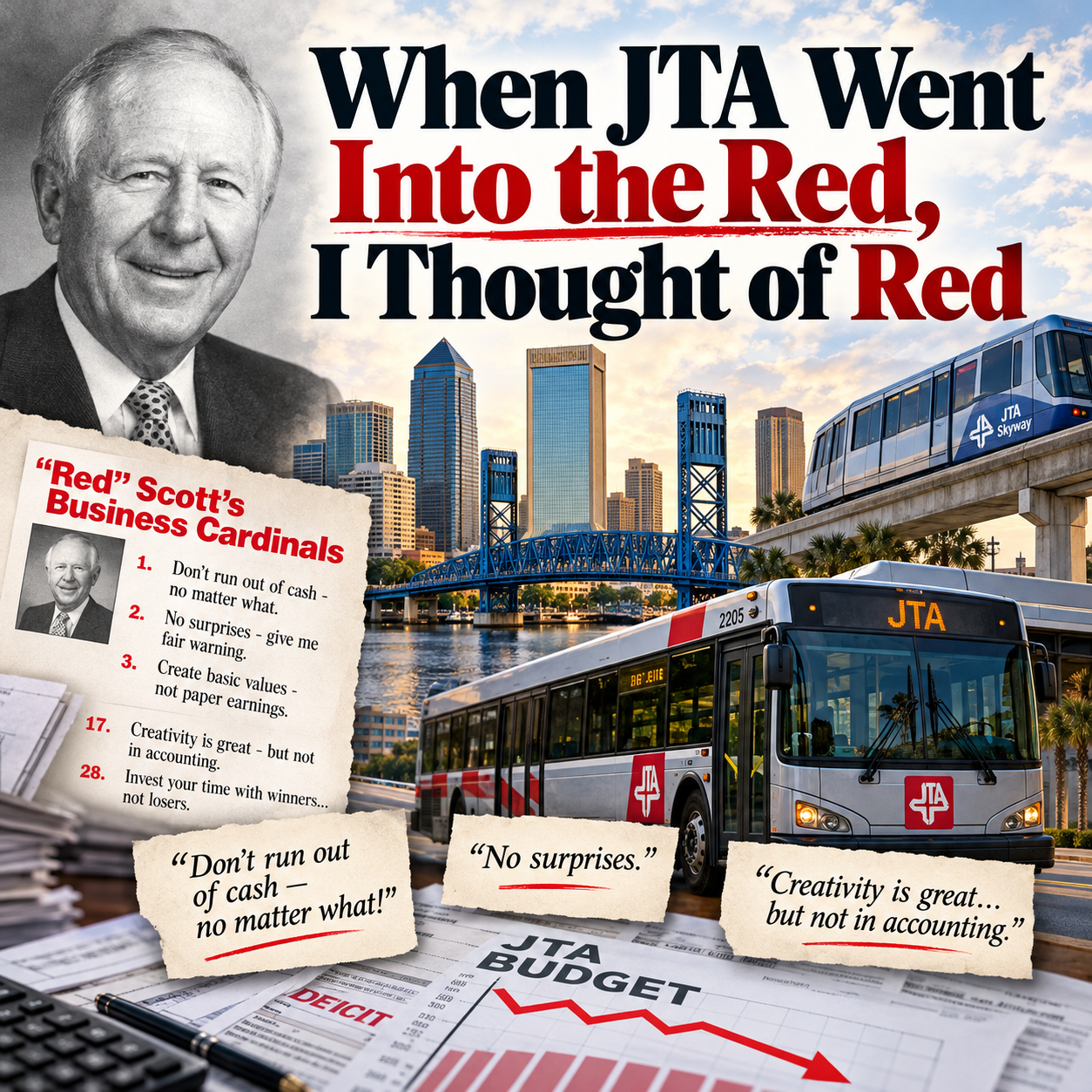
Some people leave behind money. Others leave behind buildings bearing their names. My former boss and mentor, Charles “Red” Scott, left behind something far more valuable to those of us fortunate enough to learn from him — wisdom that never goes out of style.
And as I’ve watched the financial troubles unfold at Jacksonville’s Transportation Authority, I can’t help but think how much heartache — and taxpayer money — might have been saved if someone had been following a few of Red’s rules.
Red had a collection of business cardinals that were simple, memorable, and sometimes downright blunt. He believed successful leadership didn’t have to be complicated.
As I read about JTA’s financial crisis, I could almost hear Red rattling off a few of those rules.
And boy, could Jacksonville have used his advice!
Rule #1: “Don’t run out of cash… no matter what!”
This was one of Red’s cardinal rules.
You can have wonderful ideas, ambitious plans, exciting projects, and the best-looking presentations in town. But if you run out of cash, you’ve got a serious problem.
Apparently, that’s exactly where JTA found itself.
According to reports, the agency exhausted its reserves, accumulated more than $20 million in unpaid invoices, and had vendors threatening to stop providing services.
The new CFO, Randall Barnes, explained it rather simply: JTA was spending a lot more than it was bringing in.
Now there’s a sentence that ought to be framed and hung in every government finance office in Jacksonville.
JTA ultimately needed a $25 million line of credit to help deal with overdue bills. City Council is now considering a plan that would allow the agency to borrow $30 million from accumulated gas-tax funds to stabilize its finances.
Red’s lesson: Cash doesn’t care about your good intentions.
And taxpayer money doesn’t grow on trees either, although sometimes I wonder if government leaders have found a secret forest somewhere.
Rule #2: “No surprises: Give fair warning when you hear bad news.”
This might be the most important lesson of all.
In July 2025, JTA projected it would finish its fiscal year with a $3.9 million surplus. A few months later, that cheerful projection turned into an approximately $19 million deficit. That’s nearly a $23 million swing!
Then came another year of troubling projections. In May 2026, JTA was forecasting a $2.3 million deficit. By August, that projection had grown to $31.8 million, with later estimates approaching $39 million.
Now, I’m not a forensic accountant, but I’ve spent decades working with CEOs and business owners. When financial projections change that dramatically, somebody needs to be asking some very serious questions.
When did management know things were going wrong? What information was being provided to the board? Were warning signs overlooked, or was the information simply inaccurate?
We don’t yet have those answers.
But I know what Red would have expected.
Bad news doesn’t improve with age. Tell the truth early, put the problem on the table, and give your leadership team a chance to address it.
Red’s lesson: Surprises are wonderful for birthdays. They’re terrible in boardrooms.
Rule #3: “Creativity is great… but not in accounting.”
Oh, how I wish Red were here to discuss this one!
JTA has pursued some innovative transportation ideas, including its NAVI autonomous shuttle program.
I’m all for innovation. Entrepreneurs thrive on it.
But creativity in operations is one thing. Financial reporting is another. Numbers must represent reality, whether that reality is pleasant or not.
JTA’s financial projections were so far off that City Council is now investigating how the agency arrived at them.
Was the problem faulty assumptions, inadequate financial controls, poor communication, or something more serious?
An independent audit should help answer those questions.
Until then, it would be wrong to suggest anyone intentionally manipulated the numbers. But there is one thing we can say: The financial information being provided was not giving decision-makers an accurate picture of the trouble ahead.
Red’s lesson: Be creative with your ideas. Be boringly accurate with your books.
Rule #4: “Be careful: A little success can create a whole lot of overhead.”
This one is especially relevant when organizations begin pursuing exciting new projects.
JTA’s budget included approximately $11 million for its newly launched NAVI autonomous shuttle service while financial problems were developing.
Now NAVI is scheduled to pause, along with the Skyway, and JTA is cutting bus routes and employee positions.
That doesn’t automatically mean NAVI caused the financial crisis. The audit needs to identify the actual costs and causes.
But it does raise an important leadership question.
Shouldn’t an organization first make sure it can afford its existing responsibilities before adding new ones?
I’ve watched businesses grow themselves right into financial trouble because they became so excited about the next big thing that they neglected the fundamentals.
Public agencies aren’t immune to that temptation.
Red’s lesson: Growth and innovation are wonderful, but the overhead they create still has to be paid for.
Rule #5: “Plan strategy and set objectives before fixing structure.”
Now JTA is cutting jobs, reducing routes, canceling contracts, and suspending services. Some of those measures may be absolutely necessary to restore financial stability.
But cutting expenses without a clear strategy can create another set of problems.
What should JTA’s priorities be? What services are essential? What can taxpayers realistically afford? And what does success look like five years from now?
Those questions should drive decisions about staffing, programs, projects, and organizational structure.
Red taught that strategy comes first. You figure out where you’re going before rearranging the furniture.
Red’s lesson: Decide what the organization must accomplish, then build a structure that can accomplish it within its means.
Rule #6: “Be careful of a quick fix.”
Here’s where the City of Jacksonville comes into the picture.
City Council is considering allowing JTA to use $30 million from gas-tax funds to address its immediate financial emergency, with the money to be replenished over time.
I understand the urgency. We can’t have essential transportation services collapsing while everyone debates who made what mistake.
But Red would remind us that a quick fix isn’t necessarily a permanent solution.
Moving money from one account to another may solve an immediate cash problem. It doesn’t necessarily fix the budgeting, reporting, spending controls, or leadership decisions that created the crisis.
Before this chapter closes, taxpayers deserve answers.
How did the forecasts become so inaccurate? Why were reserves depleted? What financial reports did the board receive? What safeguards will prevent another crisis?
And perhaps most importantly, will the same lessons be applied to Jacksonville’s other independent authorities?
Because if the oversight systems are inadequate at one agency, we ought to make sure they’re working at the others.
Here’s the lesson for every government board in Jacksonville
During my years working with CEOs, I learned that a board seat is not an honorary title. It’s a responsibility.
Good board members don’t have to be accountants, but they must understand enough about financial statements to recognize warning signs. They must ask questions, demand reliable information, and make sure management has the systems and people in place to protect the organization.
And when the numbers don’t make sense, they shouldn’t be satisfied until they do.
That’s not micromanagement. That’s governance.
I have been writing quite a bit lately about the importance of appointing qualified people to Jacksonville’s boards. The JTA situation is another reminder of why those appointments matter.
Financial training for board members is worthwhile, but training alone doesn’t produce good judgment, courage, or accountability.
We need people willing to ask tough questions, even when those questions make others uncomfortable.
And we need leaders who welcome those questions rather than resent them.
Red May Be Gone, But His Wisdom Lives On
Red Scott has passed away, but thankfully, his wisdom hasn’t.
I was blessed to work alongside Red during my years with TEC Florida, now known as Vistage. He was my boss, my mentor, and one of the wisest businessmen I’ve ever known.
What made Red’s 31 Business Cardinals so valuable was that they weren’t written by some consultant sitting behind a desk. They were lessons he learned in the real world — through successes, mistakes, tough decisions, and more than 40 years in business leadership.
Red learned some of those lessons the hard way so the rest of us wouldn’t have to.
And as I look at the mess at JTA, I can’t help but wonder how different things might have been if those in charge had followed just a handful of his Cardinals.
I’m sharing Red’s original 31 Business Cardinals with you today. Download a copy – see below. Print it. Keep it on your desk. Share it with someone in leadership. And most importantly, learn from a wise man who earned every bit of that wisdom through experience.
Red may be gone, but his lessons are timeless.
And Jacksonville? Let’s gather some wisdom from all this mess at JTA. We must change how we are running our city and our agencies because it sure isn’t working the way it should. We are running out of cash and Red would tell you — that’s a big deal!
Red_Scotts_31_Business_Cardinals