
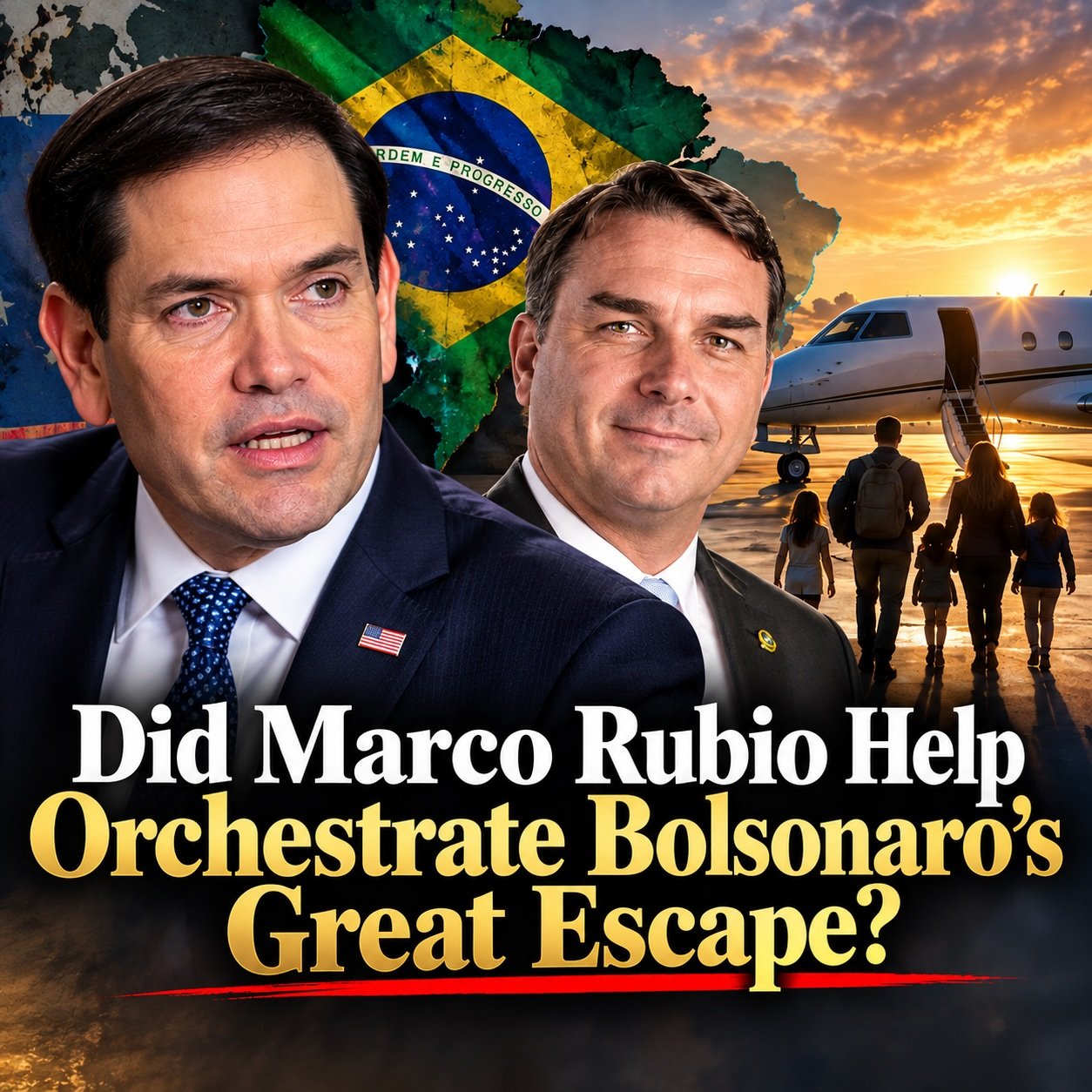
After Monday’s election debacle in Brazil, I told you Marco Rubio would have a lot to say. He just said it behind the scenes. Now we have a made-for-streaming-series story of international intrigue, governments in exile, and midnight flights across borders, and the New York Times —which had blanketed its home page with Brazil stories earlier this week— couldn’t make room on the website for the followup. Yesterday, Reuters reported, “Flavio Bolsonaro declares himself rightful president-elect of Brazil.”

Lula’s win was mathematically confirmed at 9:09 p.m. Sunday. Seven minutes later, at 9:16, Brazil’s Federal Police filed a 16-page request to seize the loser’s passports, which was plainly already drafted and waiting for the result. Demonic Supreme Court Justice Alexandre de Moraes granted it that same night, without even first consulting the prosecutor general’s office. He officiously canceled Senator Flávio Bolsonaro’s Brazilian passports and gave him 24 hours to surrender any foreign ones. Police cited the “risk of flight,” helped along by Flávio’s brother Eduardo, who had said on a podcast two days earlier, “If my brother doesn’t win, I’m in favor of him leaving the country.”
On Monday, Flávio posted a video promising to comply and waving off talk that he’d run. That same evening, according to the Wall Street Journal, he vanished into a convoy of four dark cars that pulled away from his Brasília home and split in four directions, leaving reporters and police guessing which one held the senator. By Tuesday afternoon, his allies were telling reporters he’d already landed in Florida. He hadn’t. He was still in Brazil, riding a van roughly a thousand miles to the Argentine border.
Then he ran. Tuesday’s 11 a.m. deadline came and went. His Brazilian passports were already canceled, but Flávio wisely kept his Italian one. At 10:50 that night, he, his wife Fernanda, and their two daughters crossed the Tancredo Neves Bridge into Argentina on foot. Argentina said they entered “without any legal impediment.” Argentine airport police escorted their car straight to immigration, and the Journal reports that President Milei’s top aide, Santiago Caputo, was monitoring things from Puerto Iguazú and coordinating directly with Eduardo.
Waiting on the runway was a private Gulfstream G400, tail number LV-JQW, which had flown in from Buenos Aires the day before. Trump adviser Jason Miller helped line up the charter. The flight manifest listed Flávio on his Italian passport.
Just after midnight, the jet took off, looped around Brazil through Paraguayan, Bolivian and Peruvian airspace, refueled in Guayaquil, Ecuador, and made for Miami. By then the secret escape was the most-watched flight on Earth: 927,367 people tracked it on FlightRadar24. Three TV news helicopters were circling Opa-locka Executive Airport before it touched down around 9:30 Wednesday morning. Flávio stepped off in a navy polo and a backpack, and uniformed officers tried to hide the family under umbrellas, which is a lot like holding a napkin over a parade float.
Washington had already thrown out the welcome mat. Hours before he landed, a senior State Department official said visas were waiting for the whole family. According to the Journal’s reporting, Trump personally approved the family’s entry on Tuesday, and Secretary of State Marco Rubio then moved to issue the visas. The family reportedly came in on one-year humanitarian parole. “We gave him a pass to come into the country,” Trump said. “I thought they were treated very unfairly… But I won’t get involved — it was a very strange election, that’s for sure.”
Who arranged it? Simón Levy, a Mexican lawyer and Trump ally, posted that “The mastermind behind this operation is U.S. Secretary of State @SecRubio,” and described “a US protective operation.” Folha’s sources say Marco Rubio “played an active role.” The State Department is still not commenting.

Once he was safely in Florida, Flávio declared himself the real winner. “I did not flee Brazil; I left for Brazil’s sake,” he said. He promised to lead the opposition from America, and his allies are already calling it a government in exile. President Lula, celebrating his 81st birthday, sneered: “A citizen who secretly flees his country does so because he must have something to hide.”
It’s becoming a family tradition. In December 2022, after losing to Lula and refusing to concede, Flávio’s father Jair flew to Orlando and stayed about three months. He went home and was later convicted of plotting a coup and sentenced to 27 years.
Lula might be the one with something to hide. A judge extended voting a minute after the polls closed, the police filed 16 pre-written pages seven minutes after the result, and the loser’s passports were stripped before breakfast. Whether you think the charges are trumped up —an expression that now has fuller flavor— Flávio clearly didn’t believe he’d get a fair hearing, and I doubt the State Department did either. This story is far from over, and the corporate media have celebrated too early.