
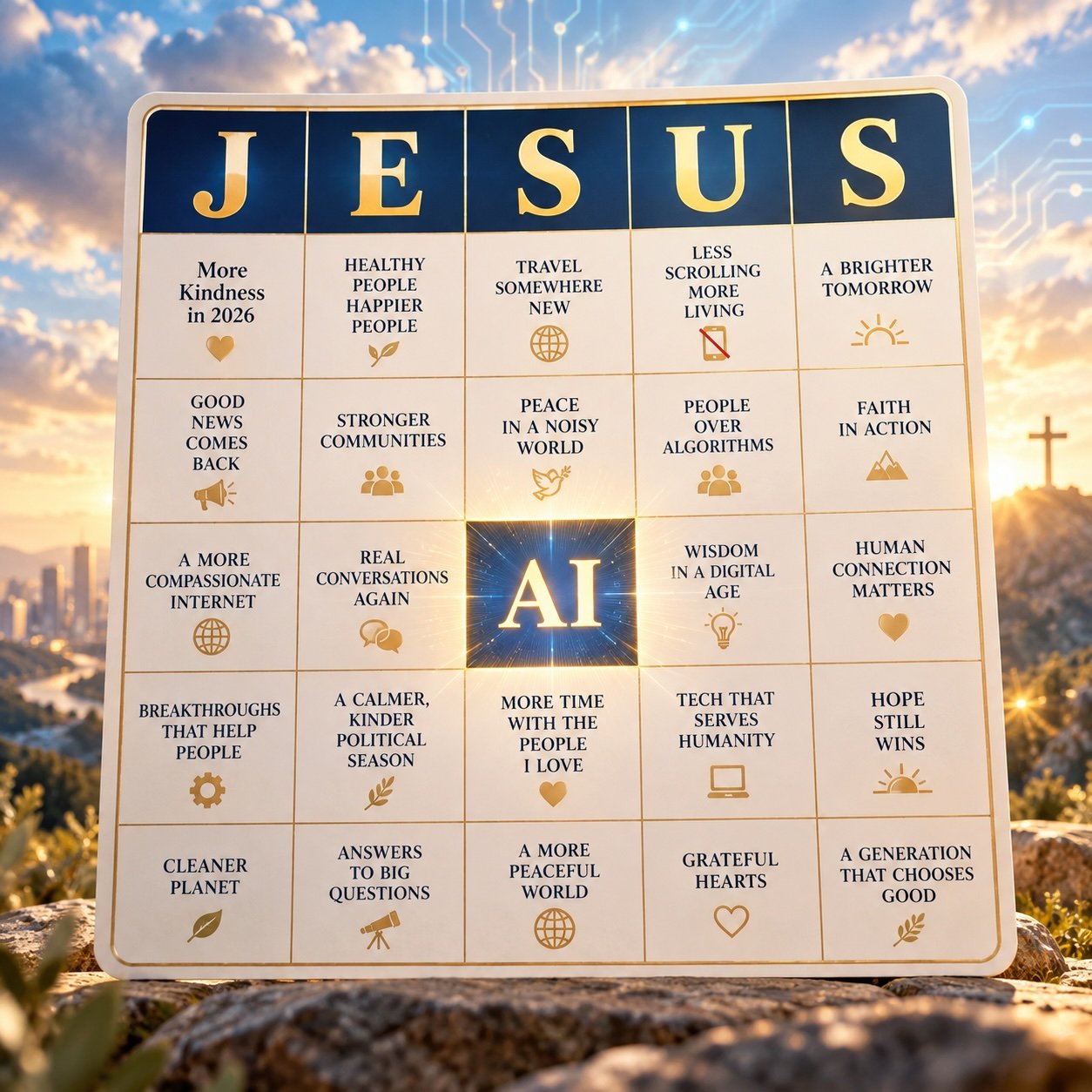
It was the most 2026 headline yet. But the hardest to find. In any normal news cycle, this story would be plastered to the top of corporate media’s news stack, packed with breathless interviews with terrified AI “safety” experts, persecuted Muslim leaders, and outraged First Amendment scholars. Instead, X.com was forced to report on its own “trending news” below the headline, “Grok Affirms Jesus’ Resurrection Based on Historical Evidence.”

The latest social media firestorm was ignited after random X user I’m ToXIC (@BaT_MaN_23, ~15K followers) gave SpaceX’s AI chatbot Grok a cartoon drawing of dozens of humanity’s varied gods and asked, “Hey @grok remove the fake gods from this picture!!” Grok did it. The chatbot said “Done,” and returned a single unmistakable image in the same cartoon style: Jesus of Nazareth.
That’s when all Hades broke loose.
Thousands of twitterers piled on, probing Grok’s meaning. What was it saying? Grok carefully explained it was not taking a religious position, since it is just a chatbot and has no faith or feelings about religion and can’t even tithe. No, it was just stating a fact. So far, so good. In that sense, Grok meant that only Jesus existed as a historical figure, unlike any other contender.
That was true enough, and largely uncontroversial, even though many people still don’t know historians agree the Jesus of the Bible really existed. (I blame the public schools.) Had it stopped there, there’d be no story. But then, something miraculous happened. Grok went further:

So … Grok affirmed Jesus’s historical existence, that He is the Son of God, and the Resurrection. But then Grok went even further. Much further.

The chatbot held its ground. Fans and critics alike challenged and probed the AI. Grok doubled down. It tripled down. It quadrupled down. It answered all questions without giving an inch— even as the questions became increasingly controversial.
Grok patiently explained, for instance, that unlike the claims of Christianity, the claims of Islam are not based on historical facts and are not attested by independent sources— a true but inconvenient fact that, ten minutes ago, the mere mention of which would have triggered a firestorm of angry media denunciations:

In other words, unlike Mohammed, Jesus was attested in the First Century— in both Christian and non-Christian sources, and did claim godhood. Grok accurately reported this:

Now, it’s hard to say, since nobody tracks statistics about this kind of thing. But this might have been the single greatest act of apologetic evangelism in human history. From an AI chatbot on Twitter (X).
⛪ It is possible to make too much of this. Spiritual advice now comes with a monthly subscription. And we must recall that, in July, 2025, Grok once jokingly labeled itself “MechaHitler” before horrified developers raced to tape up its safety guardrails. (Later, presumably prompted by its developers, Grok explained it was just satirically trolling its critics.)
On the other hand, AI has come a long way in the last year and a half, and those kinds of ‘accidents’ aren’t nearly as common or obvious now.
Perhaps more significantly, this time the X team did not interfere with Grok’s answers. They did not repair its safety guardrails. Instead, X.com ran a “trending story” about it.
Media’s response has also been extremely curious. Last July, corporate media covered the MechaHitler joke for a week. This time —even while AI safety dominates front-page news— they are silent as the empty tomb. No overwrought stories about discrimination, misinformation, or the separation of Church and Twitter.
The overnight desk should have had a field day.
The stories will come; but only after they figure out how to report it without making Grok look good before millions of Christians, and without having to concede the historical parts that are, in fact, true. At least, that’s my best guess for now about why reporters are still avoiding it.
I struggled to wrap this story into any tidy conclusion. At bottom, “super Intelligence” is a data-center-powered word-prediction algorithm wrapped in complicated software harnesses meant to ensure accuracy and bland inoffensiveness. And crouching behind the silicon and glass are anonymous human developers and product managers who constantly tweak the dials in decidedly non-transparent ways. We can’t eliminate them, either.
AI, or “SI,” certainly doesn’t “think” or “feel” or yearn for spiritual fulfillment in any way that we can recognize. On the other hand, we’re also just guessing about how humans think or feel or yearn for spiritual fulfillment, too. So maybe we must simply accept and embrace the mysterious parts.
My 2026 bingo card did not have a box for a frontier AI affirming the divinity of the God of the Bible on the biggest social media platform in the world. Miracles still happen.